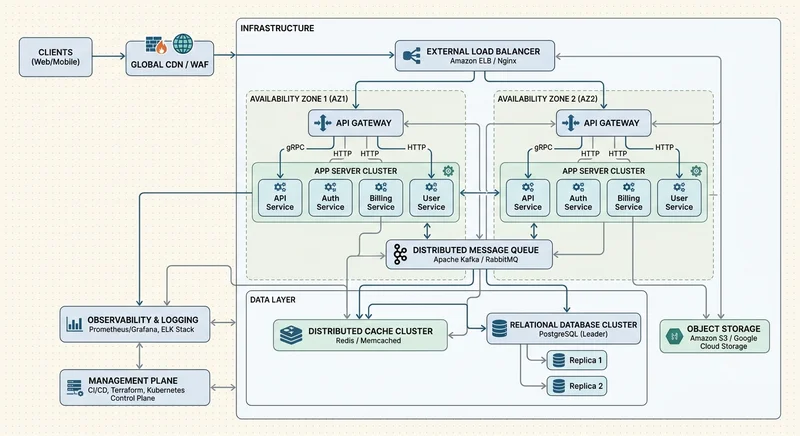
I've spent enough time debugging production blockchain infrastructure to see a pattern. Teams spend months auditing their intelligent contracts, and then treat their RPC layer as an afterthought, a single endpoint pointed at Infura or Alchemy with no fallback plan. That works okay at ten requests per second. It crumbles the first time a mint goes viral or a cascade of liquidations happens during a volatile hour.
This is not a critique. It's simply the natural default focus for most teams. Everyone knows exploits are expensive, so contract code is audited. Infrastructure is only noticed when it fails in front of users.
Why RPC Infrastructure Is the Part Nobody Budgets For
Between every user action and the chain itself sits an RPC node. Every wallet connection, every read call, every transaction submission goes through it. When it slows down, the application seems broken, even if the contracts are fine.
The problem is that RPC load doesn't scale like most engineers think it does. The traffic isn't steady. It is spiky; it correlates with market events, and it comes in bursts that are 10 or 20 times the average load in seconds. Such a spike stands no chance against a system provisioned for average traffic.
What Breaks First
After running and troubleshooting node infrastructure across a few different chains, the failure points tend to repeat themselves.
Connection pool exhaustion.
Most teams size their connection pools for expected concurrent users, not for the reconnection storms that happen when a node briefly drops. When one node in a cluster stumbles, every client attached to it reconnects at once, which can knock over the next node in line. I've seen this cascade take down an entire provider's regional cluster in under a minute.
State sync lag under load.
A node can report itself as healthy and still be several blocks behind. Health checks that only ping for a response, without checking block height against a reference source, will happily route traffic to a node serving stale state. Users see transactions that appear to fail or balances that look wrong, and the first instinct is to blame the smart contract.
Load balancer blind spots.
Standard load balancers route on latency and uptime. They don't understand blockchain-specific failure modes like a node that's synced but stuck on a reorg, or an archive node running out of disk I/O during a heavy historical query. You need routing logic that actually understands chain state, not just HTTP response codes.
Rate limiting that punishes legitimate traffic.
Aggressive rate limits meant to stop abuse often catch legitimate wallets making normal batches of calls, especially during airdrops or claim events. This is one of the most common causes of "the dApp is broken" complaints that have nothing to do with the application code.
Why Standard Monitoring Misses This
Most infrastructure monitoring was built for web services, not blockchain nodes. CPU, memory, and response time tell you almost nothing about whether a node is actually serving correct, current chain state.
The monitoring that actually catches problems tracks a different set of signals: block height drift against multiple reference nodes, mempool propagation delay, peer count stability, and the gap between when a transaction is submitted and when it's actually visible through the RPC endpoint. None of that shows up on a generic uptime dashboard.
I've found that the single most useful metric is block height variance across your node fleet. If one node is more than a few blocks behind the median of the rest, it should be pulled from rotation automatically, not flagged for a human to notice during business hours.
What Actually Works in Production
A few practical patterns hold up better than the defaults most teams start with:
- Run a multi-provider fallback, not just a multi-region one.A single provider having a bad day, even across regions, still takes down every client depending on it. Redundancy across providers matters more than redundancy across geography.
- Separate read traffic from write traffic.Reads can tolerate a small amount of staleness. Writes cannot. Routing them through the same undifferentiated pool means a slow read node can delay a critical transaction submission.
- Build health checks that validate chain state, not just process uptime.A node that responds fast but is three blocks behind is worse than a node that's slow but current, because it fails silently.
- Test failover before you need it.Most teams discover their failover logic doesn't actually work during an incident, which is the worst possible time to find out.
- Budget for peak, not average.Provision infrastructure for the traffic spike you'll see during your best day, not your average Tuesday.
None of these are complicated ideas. What's hard is that they require treating infrastructure as a first-class engineering problem rather than a configuration checkbox you fill in once and forget.
Key Takeaways
- RPC infrastructure fails from traffic patterns, not traffic volume. Bursts break systems sized for averages.
- Standard health checks miss blockchain-specific failures like state lag and stuck syncs.
- Multi-provider redundancy protects against more failure scenarios than multi-region redundancy alone.
- The best monitoring tracks chain-state signals, not just server uptime.
- Failover plans that haven't been tested tend to fail exactly when they're needed.
FAQ
Why does my dApp look broken when the smart contracts are working fine?
Most of the time, it's the RPC layer, not the contract. Even with the right underlying logic, a node serving stale state or a connection pool that is overloaded creates the illusion of a broken application.
Is running your own node infrastructure worth it instead of using a managed provider?
That depends on your traffic and your taste for risk. Managed providers are generally okay to use on the primary layer, but I see the number one infrastructure mistake is relying on a single one without a fallback. The most resilient setup for teams with meaningful transaction volume tends to be a hybrid approach, with self-hosted nodes as a backup or for critical paths.