For food-loving travellers, the hotel restaurant is no longer an afterthought
Hotels across Asia are turning to local produce, regional dishes, famous chefs and interactive dining to make their restaurants destinations in their own right.
Decades ago, hotel meals rarely ended up on food-loving travellers’ to-eat lists. That has changed dramatically, especially in the past five years. Luxury hotels are now cooking up increasingly ambitious dining experiences to woo both travellers and local diners.
According to a joint white paper by BurdaLuxury, GMO-Z.com Research and Vero released in May, the global fine-dining sector was valued at US$166.86 billion (S$213 billion) in 2024 and is projected to grow at a compound annual growth rate of 6.54 per cent to reach US$243.14 billion by 2030. The report identifies Southeast Asia as one of the markets where changing attitudes towards luxury, travel and dining are reshaping how consumers choose where and what to eat.
Marriott International’s The Future of Food 2026 Asia Pacific Report found that 59 per cent of guests prefer casual dining experiences over formal ones, while 53 per cent favour a la carte options over traditional set menus. Vegetarian (64 per cent) and vegan choices (63 per cent) are also increasingly sought after. Guests are also becoming more curious about provenance, asking about the origins of ingredients (75 per cent) and sustainability practices (58 per cent).
Petr Raba, Marriott International’s vice-president of food and beverage, Asia Pacific (excluding China), said: “Over the last five years, traveller expectations have shifted decisively from a desire for standardised exclusivity to a demand for ‘comfort as the new luxury’, where authenticity and personal well-being take precedence. Guests today are seeking more than just a meal; they want a narrative, a sense of place, and a deep connection to culinary artistry.”
Hilton’s 2026 Trends Report reveals similar findings. Intergenerational family travel is on the rise and one of the top activities is culinary exploration (69 per cent), where memorable and gourmet experiences that cater to a wide age range, inspire discovery and encourage meaningful connection are priority.
LOCAL FOCUS
At InterContinental Halong Bay Resort, the F&B offerings are designed not simply as a hotel service but as part of the reason to visit the destination, said general manager Grant Thompson. “Guests increasingly expect restaurant-quality cuisine, strong culinary identities, and concepts that feel rooted in place rather than interchangeable across destinations.”
Across InterContinental’s dining venues, including French-Vietnamese bistro La Baguette, Japanese restaurant-bar Roku & Star Bar and seafood-focused diner Del Mar, local produce such as Tien Yen chicken, Van Don grouper, Ha Long Black Tiger prawns and Dam Ha crab are used in dishes from pasta, pizza and burgers to aromatic stir-fries in spiced and fermented sauces. These ingredients are sourced from the Quang Ninh province, where the hotel is located, and neighbouring provinces.
Marriott’s Luxury Dining Series, running from August to October, is themed “Across The Table”. There will be more chef interactions over meals like a traditional Indonesian feast at Mandapa, a Ritz-Carlton Reserve in Bali; a dinner of Indian dishes paired with cocktails that use Maldivian island ingredients at The St. Regis Maldives Vommuli Resort; and a walk-about among live stations where seasonal produce is explained at The Ritz-Carlton Kyoto.
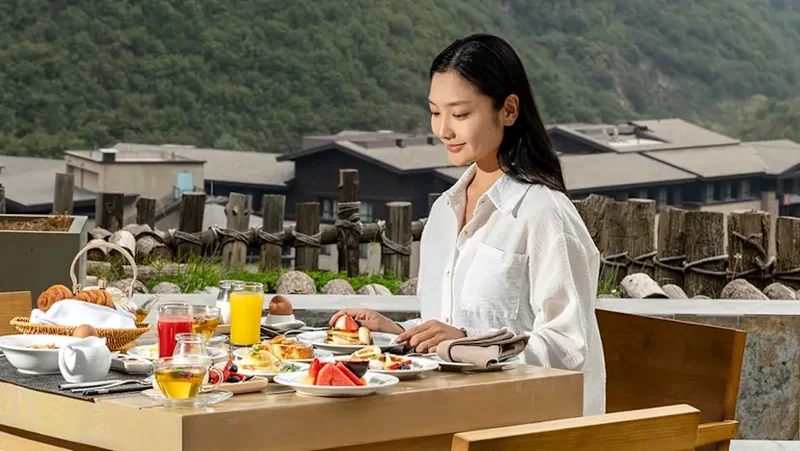
Hilton is also turning breakfast into more of a signature hotel experience, with made-to-order dishes, live cooking stations and menus that reflect local culinary traditions.
Conrad Manila serves silog – garlic fried rice and egg – and taho, a popular street food of silken tofu and sweetened sago pearls. At Conrad Jiuzhaigou, guests can tuck into local black truffles, yak brisket noodle soup, yak yoghurt and tsampa, a Tibetan porridge made from roasted and ground barley, amid mountain scenery. Conrad Chongqing, meanwhile, puts a refined spin on rustic dishes such as wan za noodles, you cha and spicy soy bean curd.
Waldorf Astoria Bangkok trots out a mango sticky rice cart, where freshly steamed glutinous rice and locally sourced fruit are served tableside. Chilli eggs cooked with Thai basil, dried shrimp-chilli paste and chicken floss are also served alongside the iconic Waldorf eggs Benedict.
The Sukhothai Bangkok, a member of Small Luxury Hotels of the World (SLH), revamped its Sunday brunch after finding that guests preferred freshly prepared dishes, greater interaction with chefs, lighter and more plant-forward options, and smaller portions that allowed them to sample more.
The revamped brunch has more live cooking stations, with chefs on hand to explain the stories behind the dishes, as well as a broader selection of seafood and grilled dishes. Rotating themes spotlight chef signatures and regional flavours, with dishes such as Southern Thai seafood salad with scallops, shrimp and young mangosteen, and slow-braised wagyu with aromatic Thai spices and hand-pounded curry pastes.
Another SLH member hotel Amanor Hotel Chiang Mai, serves Italian dishes with a local accent at Lumi, using seasonal ingredients such as locally sourced meat, organic fruit and vegetables, and tuna from the Gulf of Thailand. Dishes include Kao Soi 9 Beef Cheek, which pairs crispy egg noodles and ricotta ravioli with pulled beef cheek in a rich kao soi broth, and Chiang Mai Six Cheeses, a platter of artisanal cheeses from the region.
FAMILIAR COMFORT WITH REGIONAL DEPTH
Familiar favourites keep regulars coming back, and hotels with long-established restaurants are finding ways to refresh these concepts without losing what made them popular in the first place.
Andreas Stalder, Hyatt’s senior vice-president of F&B operations and product development in Asia Pacific, said: “Today’s guests seek experiential and interactive dining. We are constantly seeking new ways to engage our diners, with show kitchens and tableside cooking, where culinary craftsmanship meets showmanship.”
For Grand Hyatt Singapore, this means keeping iconic halal-certified buffet restaurant Straits Kitchen and Italian trattoria Pete’s Place.
Straits Kitchen continues to focus on Singapore dishes cooked a la minute in its show kitchens. Grand Hyatt Singapore general manager Edouard Demptos added that the emphasis now is on better ingredients, “cooking with clear, specific cultural roots instead of generic Asian categories”, and dishes rarely seen at hotel buffets, such as wok-fried mud crab in spicy scallop sauce, Petola Masak Lemak Bersuún, a home-style luffa dish in coconut milk gravy, and Sotong Sambal Hijau, or octopus with green sambal.
The buffet also features Southeast Asian-Chinese crossovers such as steamed sour and spicy local fish with pineapple, tomato and chilli, and wok-fried chicken with shrimp paste and curry leaf. Regional Indian curries like the Hyderabad-style fish curry Machi Ka Salan and prawn-based Jhinga Kadai are also in the line-up.
At the hotel’s Italian trattoria Pete’s Place, which has been open since 1973, the spaghetti carbonara is now closer to the Roman original, made with guanciale and pecorino rather than the streaky bacon and parmesan used previously. New additions such as crudo and vitello tonnato, a Piedmontese dish, bring a lighter, more contemporary touch. There is also a chef’s table offering off-menu dishes, an antipasti bar and an expanded wine cellar.
Another heritage hotel, the 21-year-old Mandarin Oriental The Landmark, Hong Kong, reopened in June after a major renovation. In addition to the current French bistro Somm and popular Michelin-starred venues Amber, Sushi Shikon and Kappo Rin, there is a new champagne bar Blanc de Noirs and an artisanal coffee space The Communal in the lobby. French restaurant Amber also added a pairing dinner experience in their stylishly expanded wine cellar.
The Landmark’s culinary director chef Richard Ekkebus shared: “Guests are increasingly gravitating toward relaxed, flexible, fine‑casual formats where comfort and familiarity are elevated through precision, technique and thoughtful execution. We have deliberately de-formalised our dining environments, refining them to feel more intuitive, more human, and more attuned to the way guests wish to dine today.”
FAMOUS CHEFS AND HERITAGE RESTAURANTS
Big-name chefs have also proven to be a draw.
Chef Huang Jing Hui – better known as Chef Fei – is from China’s Chaoshan region and has opened several Cantonese restaurants with Mandarin Oriental Hotel Group. They include the two-Michelin-starred Jiang by Chef Fei in Guangzhou, The Bay by Chef Fei in Shenzhen and Cherry Garden by Chef Fei in Singapore. The menus span Cantonese classics and traditional recipes with European touches, including wagyu beef tart dim sum, deep-fried pigeon and spiny lobster with creamy garlic sauce.
Hyatt partnered Dutch chef Sergio Herman to open Le Pristine in Tokyo’s Hotel Toranomon Hills, The Unbound Collection and Grand Hyatt Singapore. The restaurants serve neo-Italian cuisine with unique city dishes such as Japanese Akaushi beef and pizzette with chili king crab, basil and zucchini toppings.
At Conrad Osaka, South Korean pastry chef Justin Lee, whose JL Dessert Bar in Seoul is well-known for its innovative dessert tasting menus, helms the 12-seat Mudae. With only counter seating, diners get a front-row view as each course is plated.
Nearer home, Taiwanese chef-owner Andre Chiang of the now-defunct two Michelin-starred Restaurant Andre has opened 1887 by Andre in Raffles Singapore. It serves recipes from the hotel’s early years and Chiang’s signatures such as a creative version of Turtle Soup from 1887 made with double-boiled chicken, grouper and herbs, and Royale of Foie Gras, a goose liver custard. Instead of a fixed tasting menu, diners choose from an a-la-carte menu of around 60 items.
Shangri-La Singapore brought back 48-year-old Hokkien restaurant Beng Hiang, which closed last year, as part of its culinary residency programme. Popular classics such as seafood Hokkien noodles and slow-braised pork belly in fluffy steamed buns are served alongside newer dishes such as crystal jellyfish with Yongchun aged vinegar and Fujian-style Buddha Jumps Over The Wall.
CREATIVE COLLABORATIONS
Multi-chef collaborations and pairing dinners continue to be a popular way to attract diners to hotels.
Four Seasons Hotels & Resorts regularly brings together its executive Chinese chefs for gourmet showcases. For example, a recent six-hands series between the chefs from Four Seasons Guangzhou, Suzhou and Singapore properties at Four Seasons Singapore’s Jiang-nan Chun demonstrated how Su Bang and Yue cuisine can complement each other. Unique courses like braised pork belly with fermented red rice, steamed lobster in salted fermented milk and double-boiled sea cucumber soup with deer antler, were served as part of the six-course meal.
Mandarin Oriental Hotel Group’s global F&B marketing director Laura Goldwyn said the group was shifting towards “a more destination-led approach with an emphasis on experience creation in F&B”. She added: “A large portion of customers dining with us are locals, rather than staying guests, so it is imperative our concepts resonate with them while also appealing to international visitors.”
Case in point: Mandarin Oriental, Tokyo’s wine series, which was launched in 2015, caters to local and overseas wine lovers through themes revolving around interesting pairings, wine makers and vintages. The current series, called “Resonance”, includes pairing Italian cuisine with Japanese wines, a high tea with emerging expressions of champagne, and a tasting of Burgundy vintages with Cantonese dishes cooked with Japanese ingredients.