Commentary: This bad movie is a good guide to China’s stock market
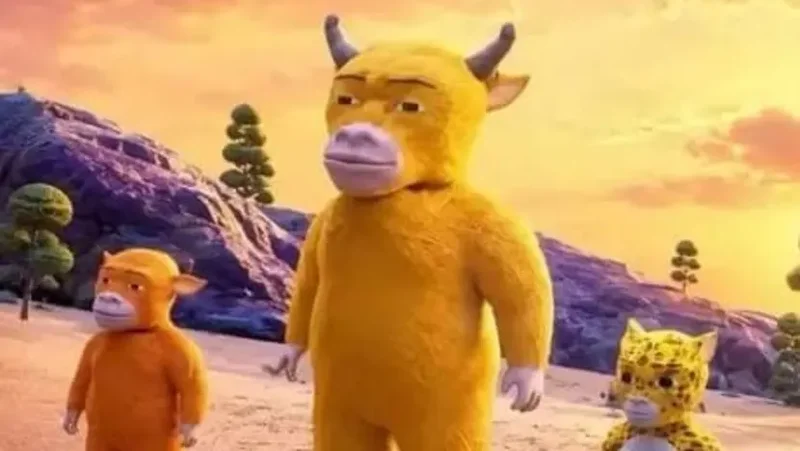
Niu Lai, which translates as Here Comes the Bull, is an ironic name in a nation that is perpetually waiting for one, says Shuli Ren for Bloomberg Opinion.
HONG KONG: Frustrated stock investors in China are finding dark humour from a crude, low-budget film that has become a box office hit.
Niu Lai, which translates as Here Comes the Bull, is an 86-minute animation about a newborn calf that follows a skylark into an abstract dream sequence.
In it, the calf, Niu Lai, encounters a mysterious cobra, befriends a young leopard, and fights against a pack of wolves. He learns life lessons from his mother who sacrifices herself so her son has a chance to escape the predators. When Niu Lai wakes up, he finds the strength to stand up and live a full life.
The film grossed just 7,700 yuan (US$1,140) in the first 10 days after its release on Aug 5. But online discussions of how bad it is, especially the “hand-crafted” animation in the era of artificial intelligence, has turned it into a meme not just for young audiences, but for retail investors.
It has now generated more than 25 million yuan at the box office, the biggest dark horse – er, wrong species – of this summer’s movie season.
A REFLECTION OF THE STOCK MARKET
It was good timing. Having just emerged from a nasty wipeout in July, individual investors are turning the young bull’s personal growth story into a reflection of the brutal reality of being preyed on in China’s US$15 trillion stock market. They tend to chase after momentum stocks, and last month, this investment style had its worst drawdown in history.
The parallels came naturally. The mysterious cobra is perceived to be the shape-shifting K-line chart that millions of mom-and-pop investors use to read market psychology. But just like Niu Lai, who gets bitten by the snake and becomes scared of it, over-reliance on technical analyses hasn’t panned out, causing many to lose faith in their validity.
Over the last decade, good candlestick patterns, which many believe foretell upward market trends, are followed by negative 20-day returns 55 per cent of the time, according to data compiled by Bloomberg Opinion.
Clusters of strong technical indicators and poor returns tend to overlap with negative macro backdrops. Examples are 2022’s pandemic lockdowns, or in 2023, when China’s reopening failed to revive the economy, and in late 2024 after Beijing didn't undertake the massive stimulus it had vaguely promised.
The young leopard, whom Niu Lai befriends, is uncannily called Bao La. Its name can be translated as a sharp spike up. The brave Bao La tries to fend off a pack of wolves with little success – just like the many dead-cat bounces that Chinese traders are all too familiar with.
SYMBOLISM AND DARK HUMOUR
Niu Lai’s name is eerily called out many times during the movie, as the herd panics over predators and migrates across arid land with little food or water, hoping to get to a safer landing. Isn’t this the experience of a typical retail trader?
There’s no slow and steady bull; the benchmark CSI 300 Index is a perpetual manifestation of booms and busts, with less-informed investors caught out by brokerage hype.
By comparison, average Americans are faring much better. They have come to rule the market, notching impressive gains by buying the dip.
With the aid of AI, the internet is creating parodies with clever word plays. My favourite is a video that borrows from a scene in the movie, in which Niu Lai comes to his mother crying after tripping over a big stone.
“Silly child, that’s semiconductors. Even dogs won’t touch them.” The benchmark index of Shanghai’s STAR board, which hosts chip companies that the exchange claims to align with “national strategies”, is down as much as 30 per cent from its late June peak.
To be sure, the animation is poor quality. But watching the movie through an investor's lens, it’s full of symbolism and dark humor that bring knowing laughter. Here Comes the Bull is an ironic name in a nation that is perpetually waiting for one. It’s become a meme for good reason.