IN PHOTOS | Canadian science photos win at global image competition
See all the winners in the BMC Ecology and Zoology competition, from manatees to battling cuttlefish
Two Canadian researchers are among photographers awarded in a global image competition highlighting ecological research.
The 2026 joint BMC Ecology and Evolution and BMC Zoology image competition awarded 11 photos by researchers all over the world and at various stages of their careers. The photos depict animals in their natural environment, scientists and students in the midst of ecological research and other natural scenes.
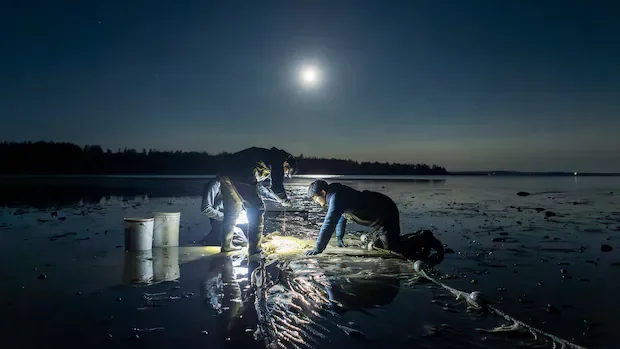
Intertidal education by Liam Brennan, a master’s student and photographer at the University of New Brunswick (UNB) won the competition’s research in action category.
A bridge between past and present by Allen (Haolun) Tian, a post-doctoral researcher with Queen’s University and Hangzhou Normal University and Zhejiang University in China won the category titled "protecting our planet."
For researchers, images are a way to document their work — and open a window to science.
“Images like the one I took and the other ones in this competition — they help build public trust. Number one, in the value of obtaining an environmental education, and also in the value of pursuing ecological research,” Brennan said.
'Curiosity on their faces'
Brennan captured Intertidal education while working as a teaching assistant, supervising a group of undergraduate students monitoring coastal fish species in St. Andrews, N.B. Decked out in weighted gear, they dragged a seine net onto the shore and began recording the species they pulled up.
“We were out there at night, which helped I think emphasize the moment of curiosity on their faces,” he said. “I was especially grateful to include the full moon in the background, just as a fun artistic touch.”
The Bay of Fundy has the highest tides in the world, up to 16 metres. In the moment, that gave Brennan an extra juggling act to keep the electronics away from salt water.
Brennan previously won the 2025 Images of Research competition at UNB for his photo Tides of Change.
To him, sharing research in action helps show people what scientists do and emphasize the value in ecological studies and findings.
“We can help affect more meaningful change when our research is grounded not just in really solid scientific methods, but also in strong communication strategies.”
Photographers say images help build 'natural empathy'
Tian’s image, A bridge between past and present, was a composition of 33 drone photos of the Long Sault Parkway, which connects 11 islands in the upper St. Lawrence River. Combining 360 degrees worth of photos grants a fish-eye view of the region.
“The reason I like this type of photo, these little planets, is because it really shows the ecosystem as a whole,” he said. “I feel that can really magnify the impact of science, especially in a field like conservation.”
The chain of islands formed after the area was flooded when the Moses-Saunders Power Dam was built in the 1950s, which devastated fish and plant life. Tian said the photo demonstrates the unintended consequences of human action, including on often-overlooked freshwater ecosystems.
“Our lakes, our rivers, they're the cradle of our civilization,” he said.
“Even disturbed ecosystems are still very beautiful ecosystems that we should be protecting and caring about.”
Because not everyone can access a conservation area or gorgeous environments around the planet, Tian said showcasing where he researches is important.
“Photography can really build natural empathy and get people to relate to environments that they use indirectly,” he said.
Earlier this year, Tian won the 2026 Nature international photo competition in the scientists at work category for a drone photo he took of a Queen’s graduate student studying algal blooms.
See more BMC Ecology and Zoology winners
Window to the Wetlands, taken by Sritam Kumar Sethy, a student at Berhampur University in India, won the overall prize for the best photo at the BMC image competition. Taken in the Balasore district of India, it features an orange-tailed marsh dart damselfly, a key wetland predator, poking through a natural hole in a leaf.
The competition's overall runner-up was A space for frogs, taken by Ryan Wagner, a PhD researcher at Washington State University. It features two students attaching a radio transmitter to a northern red-legged frog near Portland, Oregon, which helps researchers understand habitat connectivity.
Giant cuttlefish in breeding battle by Victor Huertas, an adjunct research fellow at James Cook University in Australia won the category titled "relationships in nature." He took it during the Earth's only known mass aggregation of giant Australian cuttlefish in the Upper Spencer Gulf, where tens of thousands of the animal court, compete and spawn.
Go away by Alwin Hardenbol, a postdoctoral researcher at the Natural Resources Institute Finland, was runner-up in the relationships in nature category. He captured the moment a brown goshawk, usually a fierce predator, was harassed by two noisy friarbirds protecting their territory.
The runner-up for research-in-action behind Brennan's photo was Everglades monitoring by Florida International University researcher Brandon Güell. The photo shows field technicians counting aquatic species in a throw trap in Everglades National Park, Fla.
The runner-up in the protecting our planet category behind Tian's photo was Tide, turtle and trust! by Abhijeet Bayani, a biologist at MES Abasaheb Garware College in India. He captured the moment a tiny olive ridley sea turtle looked up toward the hand of a community conservation volunteer who had just released him.
Güell also took Manatees seek freshwater in the everglades, one of three highly commended photos in the BMC image competition. It shows three manatees drinking freshwater from a drain near Flamingo Visitor Center in the Everglades, reflecting how human activity and changing salinity levels affect the animals.
Into the bear's realm by Vineet Kumar, a faculty member at the Zoological Survey of India was highly commended in the BMC competition. Researchers climbed three hours to the cave they expected to be a Himalayan brown bear den, instead finding nomadic shepherds using it as a shelter.
Barking up the right trees by Luke Jeffrey, a fellow at Southern Cross University in New South Wales, Australia was also highly commended by BMC judges. He samples microbial communities within tree bark, this time in a Melaleuca wetland in the Northern Territory, Australia.