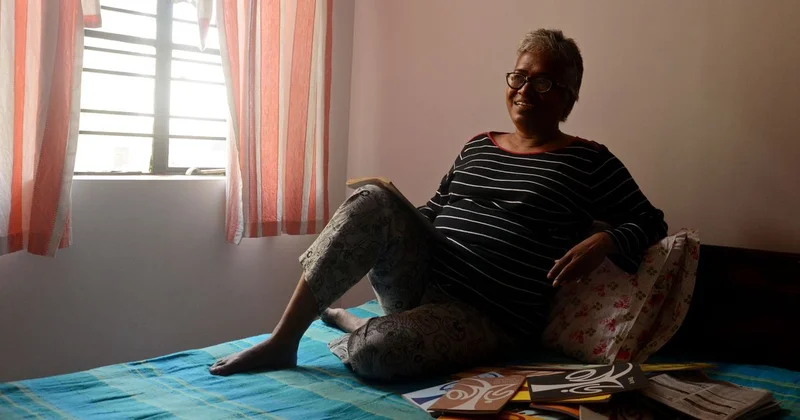
Within the larger category of Dalit writing, where can we situate Dalit women’s writing?
Dalit girls, tribal girls, and girls from the minority sections of society are educationally and economically far behind compared to girls from other sections of society. There are a lot of obstacles in the way of Dalit literature, where the authors, publishers and sellers are all Dalit writers themselves. It is very difficult for a Dalit woman writer to transcend that barrier. Moreover, Dalit literature is not literature for pleasure because of which its subject matter and style of writing are very different. Dalit girls still haven’t progressed to the level of education that is required to contribute to Dalit literature. Hence, one can find only a handful of Dalit women writers. They need more educational and economic opportunities along with awareness about Dalit issues. Dalit female writers very obviously have different ideas than feminist writers because they are much further behind in generational education than the latter. As much as they need more opportunities to progress further, they also need more time.
Where can we place Dalit women’s writings vis-à-vis women’s writing in India?
The difference between Dalit women’s writing and Indian women’s writing in general is that there are very few women writers whose works are specifically focused on Dalits, the caste system, the role of religion, the history of social thinkers from the lower echelons of life, et cetera. With regard to the Dalit women writers, the ones who are writing today face a lot of obstacles in the path of their work. All of them have to cross these hurdles to write about eminent figures who have been branded as untouchables and not given a place in history despite their immense social contribution. Their work is committed to bringing such marginalised voices to the forefront through their writings, along with writing about Dalit subjugation and the ways of overcoming it. Since most of them acquired education much later than their upper-caste counterparts, we only get to hear a limited number of such Dalit women writers.
Among non-Dalits, we may find a handful of women writers like Kalyani Bandopadhyay, Sukumari Bhattacharya and Devi Chattopadhyay who write about Dalit issues, about caste, class and religious divisions. But apart from them, no other women writers from the country have written consistently on these issues or even on Ambedkar, especially from a region like Bengal. Therefore, Dalit women have been trying to fill in these gaps by addressing such issues in their works, though to a lesser extent. The attempt is to restore the dignity of those who are left out of history with the hope that others too will realise their importance.
As a writer, do you write with the consciousness of a Dalit “woman” writer or simply a Dalit writer?
I am a Dalit writer as well as a Dalit woman writer. This is because the patriarchy which I experience within our social system as a woman in general exists within Dalit society too. However, many great men were born within Dalit society who took up the cause of women’s advancement and spoke boldly in favour of women’s freedom. These include Harichand Guruchand Thakur, Jyotirao Phule, Periyar EV Ramasamy, and above all Babasaheb BR Ambedkar. My father was also very liberal and modern-minded on the subject of women’s freedom and equal rights for children irrespective of their gender. A Dalit woman is doubly oppressed: one, due to the patriarchal social structure, and the other due to the caste-based social structure.
Why is it important to assert this female identity? Does the larger politics of Dalit identity cause a silencing of the Dalit women’s identity?
This is important not just to assert. I feel that when we talk about caste, the issue of gender comes up for very natural reasons. In the feminist movement, it is seen that the voice of the Dalit girl is suppressed by the writings or speeches of upper-caste or privileged women. Dalit women’s writing is important in bringing back that voice to the surface.
Social wounds will fester if they are ignored. Therefore, Dalit women need to be allowed to speak for themselves. The feminist movement is, perhaps, more to blame for suppressing Dalit women’s voices than Dalit politics. I feel that almost 85% of society needs women’s voices and their political presence, not neglect or indifference.
Why did you decide to add the word “Charal” to your pen-name?
I have had to face a lot of questions because of my surname, Thakur. This is mainly because the surname Thakur is usually a high-caste surname. If I use my caste identity in my pen-name, I wouldn’t need to explain it anymore. Apart from this, it is also my form of protest against the gentleman-class who use the words “charal”, “chamar” very loosely with neglect, as everyday insults. You can say that I use it as a slap on the faces of these gentlemen, so that they dare not treat any other community as poorly as they wish in future. Moreover, I used to edit a little magazine while employed in a government job, which is legally not allowed. So, it seemed at one point in time that something else must be added to the name. Articulating my identity became easier. The Dalit literary movement is, in a sense, the struggle for identity. I have had to hear verbal slurs from the mouths of my colleagues at a workplace where I have faced many adversities. Some of it is mentioned in my autobiography. You all know that the upper-caste people abuse the Chandalas as Charals. I use this word to shame them.
You usually write poems. What made you write essays?
Personally, I love reading both poetry and essays. I guess that is the reason I started writing essays. I have observed that among the Dalits who wish to read a different kind of literature, they prefer to read their own history, political history, or the lives of great personalities, over stories or novels. Since the history of Dalit people has not been written adequately, I feel like it is my responsibility as a Dalit writer to spread awareness among Dalits through works which penetrate their consciousness much more easily than stories or novels. Poems come from emotions. In them, love, anger, and reaction to social injustice emerge effortlessly in the writing. To write essays, one needs to read certain books which are important, like books on feminism or Ambedkar’s writings, which are not easily available. I ask others also to write essays. It will not only bring out their thoughts and ideas, but is also necessary for the cause.
What are your views about the translation of Dalit texts?
Dalit literature gains a larger audience through translations. Moreover, there is no other alternative way to get acquainted with the writings of Dalit writers in different languages except through translation. There are so many people living in our country; there should be one common medium. Especially with English translation, the texts get an opportunity to reach a large number of people within the country and outside, and bring about the scope for a greater exchange of ideas.
Often there is a lot of mistrust generated when a non-Dalit translator translates a Dalit text. How can such mistrust be negotiated?
There are also good reasons for this mistrust. Some translators (not all) have translated erroneously, using words that could dangerously change the meaning of the text. These books have also been printed and published. A simple way to solve this problem is to translate in workshops where the author too will also be present. Not everyone is supposed to know the words of all the regions. Therefore, I think that if you sit with the author or find out the meaning of the word from the author, there will be no problem with the translation.
Do you think that Dalit women’s writing has reached the mainstream or is there more to be done?
Publishers of every province should come forward to publish Dalit literature, especially the works of Dalit women. Only then will the so-called mainstream literature reach all the readers. There are already some people who are interested in this kind of writing. New topics are coming from the pens of many Dalit girls, which we publish in our magazine Neer Ritupatra. Before this, hardly any women writers were to be found in the area of Bengali literature. Women writers from the so-called mainstream haven’t written on the lives of Ambedkar, Phule, Periyar, Harichand–Guruchand. Why won’t the Dalit girls, from a place of social responsibility, take up their pens? And why will only men write? Girls will need to be more educated and aware, and will also have to take up thoughtful writing along with creative writing. If a section of society is still backward, that society cannot be referred to as a developed society, just as that country cannot be called a developed country.
Excerpted with permission from A Chandalini Speaks, Kalyani Thakur Charal, translated from the Bengali by Anurima Chanda, Orient Black Swan.
We welcome your comments at letters@scroll.in.