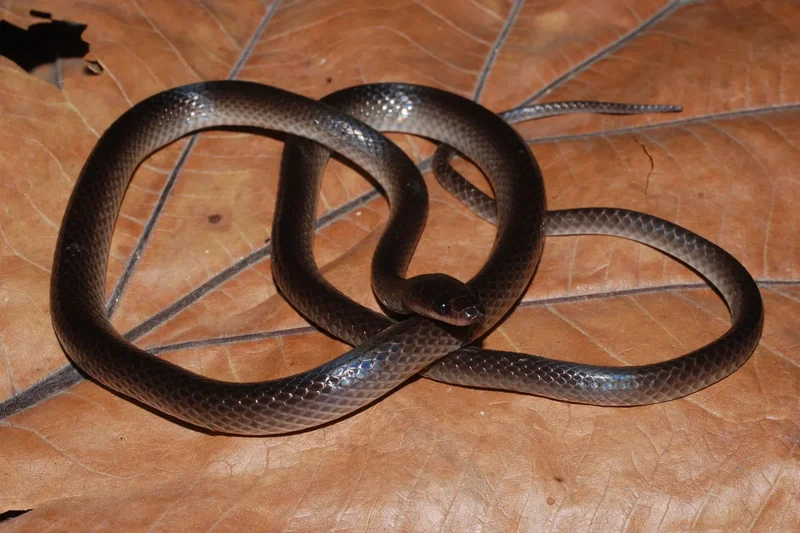
A new snake species discovered in the forests of New Guinea has been named after Guns N’ Roses guitarist Slash.
The reddish-brown ground snake, measuring about 71cm (28in) in length, has been named Lielaphis slashi, honouring Slash’s lifelong support for reptiles, zoos, museums, and natural-history education.
"As a longtime herpetophile, I am extremely honoured and humbled to have Lielaphis slashi from New Guinea named after me,” Slash, aka Saul Hudson, said in a statement.
“I never would have imagined this moment would arrive," he said.
Chicago Field Museum herpetologist Sara Ruane said she’s had a fascination for snakes and a love for Guns N' Roses from a very young age.
"Guns N' Roses has been one of my favourite bands since I was in first grade, and by fifth grade, I had already told my teacher that I wanted to be a herpetologist when I grew up," Dr Ruane said.
"So when I was 12 years old and got my copy of Reptiles Magazine in the mail, and it had a picture of Slash holding his pet reticulated python on the cover, I thought, 'This guy is so cool.’,” she said.
New Guinea’s landmass is divided between Indonesia and Papua New Guinea, with dense tropical forests containing untold biodiversity that have not been well studied by scientists.
In 2006, researchers conducting fieldwork in New Guinea came across an unfamiliar snake.
Then, a decade later, scientists conducted more extensive fieldwork to better study the poorly known snakes of New Guinea.
"These New Guinea ground snakes are nocturnal, so the best way to find them is at night. They are typically found just after sunset at the base of large trees, where they are looking for something to eat,” said Chris Austin, one of the authors of the new study published in the journal Zootaxa.
"When working at night in New Guinea, you need to be very careful, as there are several highly venomous species that look very similar to the nonvenomous ground snakes,” Dr Austin said.
The new snake's appearance alone didn’t make it clear whether it belonged to a new species.
"Using multiple cutting-edge genetic analyses, we found that L. slashi is genetically distinct from other similar snakes in the same genus," said Tianqi Huang, study co-author and a postdoctoral researcher at the Field Museum.
"The combination of physical characteristics, like differences in the number of scales compared with other species, and the genetic evidence led us to realise that it is an entirely new species,” Dr Huang said.
Slashi's preferred habitat and feeding style were also found to differ from those of similar snakes.
"Snakes in this genus often have large teeth in the back of their mouths, which New Guinea ground snakes may use to grab and eat small, slippery-scaled lizards and the eggs of other reptiles; this snake isn't grasping and squeezing its prey like a boa constrictor,” Dr Ruane said.
L. slashi does not produce any venom that could seriously harm a person, scientists noted.
While the snake does not pose a threat to humans, human activity seems to spell disaster for it.
"The habitats that Slash's ground snake is from are under threat from industries like coffee farming and mining," Dr Ruane said.
"That's part of why describing the species that live there is important. Every species should be recognised in order for us to better understand how ecosystems work, how everything fits into the environment,” she said.