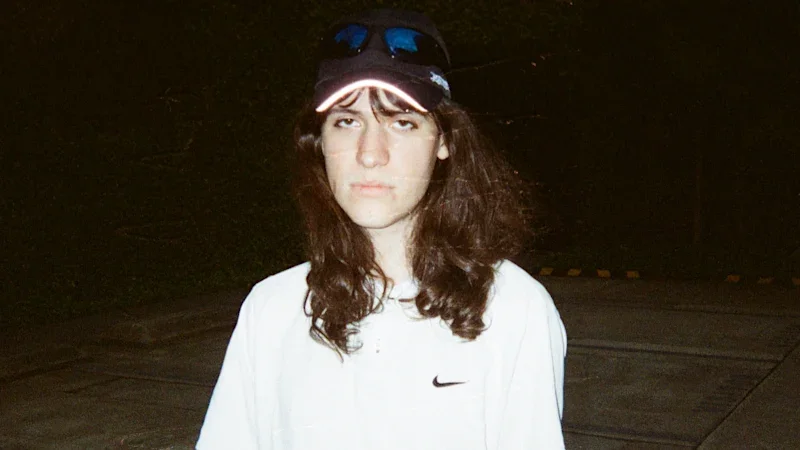
We must start at the “c---.” The c-word is, after all, the title of the remarkable new album from local “trans adlay” rapper Sidney Phillips.
For Phillips, the word – a staple in “adlay” and “eshay” culture, and especially in “lad rap” or “gutter rap”, where everyone is either a “sick c---” or a “dumb c---” – is appropriately loaded.
“It’s definitely provocative,” Phillips admits, a mischievous smile peering behind her shaggy bangs. “It’s a big word but it’s emblematic of Australian culture, whether you love it or hate it.”
Earlier this year, a music journalist counted the number of “c---s” Phillips uttered on her 2024 album, Penance; it was 88. I haven’t put in such journalistic rigour yet, but surely stamping it across the top of the new project trumps any number.
“It’s a cool word,” says Phillips. “I like it because it can be positive or negative. I can relate to it as a rapper, as an Australian, and also because it’s been used by the LGBT community that I’m also a part of, where things are ‘c---y’ and stuff like that. I like the multiple meanings.”
At 23, Phillips is the shining light of Australian underground hip-hop. A prolific artist, C--- is her sixth album in about five years – following her breakout and bona fide classic, 2023’s I’m So Tired of Being Staunchly, and a never-ending stream of singles and collaborations with her wider crew stealthyn00b.
Pairing the crispest of trends in internet rap with Gen-Z references (“c--- I’m Effy, c--- I’m Cassie”), unique Australianisms – her viral freestyle on Triple J’s Bars included nods to Webjet and The Big Lez Show, for example – and her slurry melodic delivery, she’s become an iconoclast to a generation of very online locals, earning acclaim at home and overseas. Does she recognise her impact?
“Um, yes,” Phillips says with a droll laugh. “I don’t like to make a thing of it because I don’t want people to think I’m up myself. But at the same time, I get scared that if I don’t talk about it then people won’t realise it’s the truth, you know?
“Doing adlay rap over PluggnB and digicore beats, with the Aussie accent and talking about Aussie culture? Ain’t nobody was doing that before me. All of a sudden, there’s so many kids doing it. It’s fresh. I’m not saying they copied me or that I invented it, but can I say I popularised it? Maybe.”
Phillips has also helped steer Australian hip-hop – which, especially in its connection to lad culture and eshay culture, is traditionally quite masculine (and often toxically so) – to a more inclusive bent.
“I think that’s a generational thing and it’s online culture,” says Phillips of the new open-mindedness in hip-hop. She’s part of a generation of rap fans who grew up with forward-thinking influences throughout the 2010s, including Young Thug, who famously wore a ruffled dress on his Jeffery album cover; the “based God” Lil B, who rapped about being a “pretty boy” in skinny jeans; and Lil Uzi Vert, a non-binary alien who cites Paramore’s Hayley Williams as a prime influence.
“What I loved about it is the attitude, doing what you want and other people can f--- off,” says Phillips. “So while there has been a rise of right-wing ideology in the youth, I think in the past 20 years there’s also been a rise in acceptance of LGBT stuff, in hip-hop specifically.”
Phillips was 11 when she started questioning her own gender identity. “I’d kind of had a misunderstanding about it and I got it explained to me: if you could choose one or the other [gender] to be born as, or neither, and it’s not the one you were born as, then you’re probably trans. I was like, damn, that’s interesting because if I could choose I’d probably want to be a girl. So what does that mean for me?” Phillips recalls.
“Socialising with my mates at high school, there were times I’d get really upset, just thinking, ‘Man, I like my mates and I want my mates to like me, but I feel like if they really knew this about me, they’d think I’m weird and they wouldn’t want to be friends any more.’ It’s an isolating experience, feeling like you can’t really be your true self.”
Her affinity with lad culture compounded the confusion. “When you’re an adlay, it’s because you’re kind of pushed to the edges of society. And I identified with that, with feeling like the system doesn’t care about me, that you’ve gotta sort out shit your own way, ‘f--- the police’ and all that. Plus I loved Nike TNs, I loved rap music, I was already wearing Ralph Lauren. Like, it all made sense to me,” Phillips laughs.
“But then it can be very homophobic and toxic because it’s such a macho thing. But even when I was a teenager, 14 or 15, there was this chick I knew who was a lesbian, full butch, and she dressed like an adlay and was just totally accepted as one of the lads. I always thought that was interesting because growing up, I’d known adlays that were terrible people, really rude and who would just mess with people for no reason.
“So, for a bit, I was really confused. I was like, ‘Man, lads are all really mean and shit,’ but then I also have some really nice lad mates. So I realised it’s not being a lad that’s a problem, you know? It’s just whether you’re a good person or a bad person. So I was like, I’m just gonna take the parts I like about being a lad and I don’t have to be misogynistic or homophobic.
“It’s the same with rap music. I’ve always loved rap music and some of it is really misogynistic and homophobic, but I just think we don’t have to keep that going into the new music. You take the bits that you love about it, and forget all the rest.”
Phillips’ friends were not immediately accepting of her trans identity. She came out after finishing year 12, thinking she could avoid bullying once school was over. “I’ve had mates hit me up since, like ‘What the f---, c---?’ and bully me and unfollow me, but it is what it is,” says Phillips.
“I was just sick of it, and it was probably being just out of high school and rebellious where I was like, ‘Man, I don’t give a f--- any more, either they’re with me or against me!’ Now I’m a bit more shy with it, but I look back at myself and I’m proud that I was so brazen. I was just like, f--- all these c---s if they don’t want to stay mates with me after coming out. And I found new mates that liked me for who I am, and that’s what it is.”
Phillips is speaking from her bare-boned spare bedroom in Melbourne, where she moved to just over a year-and-a-half ago after moving out of her childhood home in Morayfield in the suburbs north of Brisbane. She’s got her tools of the trade with her – a laptop, a microphone and FL Studio – and a Queenslander’s work ethic.
“Writing and recording brings me joy, so I do it whenever I can. I wish I could make 10 songs every day, but the creative juices don’t flow that hard every day. Sometimes I’ll do three songs in a day or five songs in a week, and then sometimes it might be two weeks where I don’t write because I’ve got stuff on or I don’t have anything to write about and I need to live some more life. But I’m lucky I’ve been able to get inspired semi-frequently over the past five years.”
Despite its charged title, C--- might be Phillips’ most tender work yet. Downbeat and cohesive and built with her producer Rapallo with a palette of autotuned vocals, minimal drums and woozy synths – Phillips calls it “sad robot music” – it was inspired by Swedish rapper Bladee, Kanye West’s 808s & Heartbreaks, and Phillips’ struggles with “mental stuff”.
HaHaHa might be the saddest party anthem you’ll ever hear, a celebration song where Phillips raps about her off-kilter relationship with substances, a recurring refrain across her work. Where’s she at with her battle with the “devil on my shoulder”, as she puts it in the song?
“I’m doing well. I still smoke weed, I still like a beer, but I don’t partake in pills any more. It’s just no good and I don’t want to promote that. It’s not a good lifestyle to have. I had my fun, but I would never encourage anybody to do that, and I don’t do it any more. No, no, no.”
Listening to the music, it doesn’t sound fun, I tell her. Phillips laughs. “That’s the message I’m trying to portray. As much as I like my fun drug music, I just can’t with good conscience make it any more.”
Mums might be the album’s most heartfelt moment, Phillips’ addition to a hip-hop canon that includes 2Pac’s Dear Mama and Lil B’s Best Mom Ever, where she recalls after-school runs with her mum to Gloria Jeans for TimTam Chillers. “TimTam Chillers! I forgot I mentioned that. That’s OG as. I don’t even know if they still exist. Do they still do TimTam Chillers?” asks Phillips.
I had to Google it to see if it’s still around. Surprisingly, it’s still on the menu. Even more surprisingly, Gloria Jeans still has stores. The reference speaks to Phillips’ world-building appeal, as does the vulnerability on display in the song. Phillips’ mum is a language teacher in Japanese and German; her dad has worked in construction his whole life. Their record collection – from Duran Duran to Whitney Houston, pub rock to Tammy Wynette – informed Phillips’ eclectic music taste.
“We were sitting in the studio trying to think what should the next song be about, and my mate was like, ‘You should do a tribute song to your mum.’ I was like, oh yeah, that’s nice. But just doing it to Mum felt weird, so I had to chuck Dad in there too, even though the song’s called Mums.”
Has she played it for them? “Not yet. The thing with my parents is they don’t like music with swear words,” Phillips laughs, suddenly aware of the task at hand. “I might have to cover up the album name, but I definitely plan on playing it for them. I’m aiming for some tears.”
Sidney Phillips’ new album C--- is out now. She will perform at Brisbane’s The Triffid on November 26, Melbourne’s Prince Bandroom on November 27, and Sydney’s Manning Bar on November 29.
Want more music stories and reviews?
- Phoebe Bridgers:The generational songwriter’s new album is the finest expression of the mess of grief you’re likely to hear.
- Peking Duk:Almost 20 years on, the local dance heroes have made their debut album. Why now?
- Slayyyter:After a decade in the doldrums, she was on the verge of quitting music. Now Slayyyter is the year’s breakout pop star.
- Ariana Grande:In the face of public scrutiny, the singer’s defiant new album is unconvincing.
- The Durutti Column:Too strange to enter the British pop canon in his time, Vini Reilly came back from the brink to win over a new generation.