On the outer walls of the Chennakeshava temple in Belur, built by the Hoysala kings in the 12th century, stands a woman holding betel leaves. But the tambula or betel appears nowhere in the Vedic Samhitas, the Ramayana or the Mahabharata. It was not part of that world.
It arrived much later, carried on trading vessels from the Indonesian archipelago and the Malay Peninsula, entering India during the Gupta period (around 4th century CE) through the eastern coast. Its presence, carved in stone into a temple wall in Karnataka, however, reveals how quickly the leaf had ceased to be a foreign import. No Hindu ceremony was considered complete without it.
Mapped onto the divine
The betel leaf and areca nut were popular in East and South India before Sanskrit documentation. Tamil Sangam poetry reveals a world from 2,000 years ago that was familiar with them. Poems such as Pattinappalai describes the busy markets of Puhar, where betel leaves were sold; Maduraikanchi highlights the cultivation and sale of the leaves; while Kuruntogai reveals how the offering of the leaf with the areca nut was a symbol of hospitality and affection.
After meals, a quid of betel leaf wrapped around some areca nut and lime, perfumed with cardamom, clove, nutmeg, mace, and camphor — the five aromatics known collectively as pancha-sugandha — served to aid digestion and sweeten the breath. Ayurvedic physicians found additional uses: betel entered their pharmacopoeia as a treatment for filarial infection, obesity, skin diseases, and headaches. Singers were advised to consume it regularly, the belief being that it enhanced the voice. Traditional medicine found uses even for the parts of the plant that religion condemned. The stalk of the leaf, smeared with oil, was applied in remedies for constipation and abdominal bloating in children.
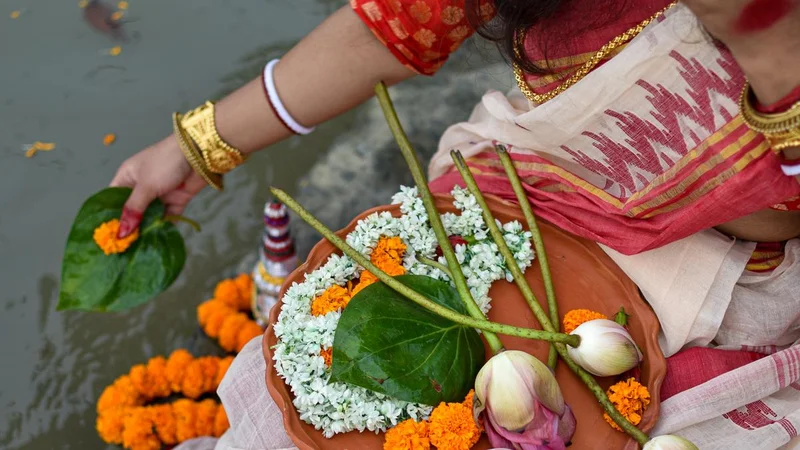
Religion absorbed tambula with equal thoroughness. It was used to sprinkle holy water, offered to deities, and included in the daksina paid to priests. Medieval South Indian temples incorporated it into daily liturgy. Theologians found in the betel quid a symbol of the Hindu Trinity: the areca nut representing Brahma the Creator, the leaf representing Vishnu the Preserver, and the lime representing Shiva the Destroyer.
The anatomy of the leaf itself was mapped onto the divine. The goddess Lakshmi dwells on the left, and Saraswati on the right. Yama, the lord of death, resides in the stalk, and the tip — and therefore both are discarded before the leaf is prepared. What remains is auspicious, to be shared between husband and wife, god and goddess, host and guest.
Secret code of the paan
Tambula became a complete social language, capable of signalling welcome, rank, and departure through the same leaf. In Assam, betel nut was the first thing placed before any visitor. In Bhutan, the phrase doma zhes, meaning ‘please have betel leaf and areca nut’, was spoken every time two people met. In formal ceremonies, the host presented betel with both hands. To chew in the presence of others without offering it was a recognised breach of etiquette. In caste-based Indian society, where people did not share food, it was easy to share a paan. It became part of medieval court ritual adopted by Sultans and Nawabs, too.
Between welcome and farewell, betel communicated rank. A king received 32 leaves, a prince 24, a learned man 12, an ordinary man four. Royal courts made the betel-bag bearer, the hadapavala, a prestigious office conferred on men of high rank. To receive betel from the royal hand was public acknowledgment of loyalty. In certain courtly contexts, being compelled to accept it from a rival was experienced as humiliation.
Caste extended this logic further: a preparation handled by a person of impure caste was considered polluting to a higher-caste recipient. A woman offering paan to a man was seen as soliciting. The Kama Sutra listed betel among the necessary adjuncts to romantic life. Among mercantile communities, receiving tambula from another party bound both sides to an agreement as surely as any written deed.
A plant that arrived by sea from distant islands, absent from the Vedas, present on the walls of Hoysala temples, became a symbol of the Trinity, a vehicle for Lakshmi and Yama simultaneously, and a grammar of human relations. That is how India has always absorbed the foreign: completely, and without memory of the absorption.
Devdutt Pattanaik is the author of 50 books on mythology, art and culture.
Published - August 21, 2026 06:06 am IST