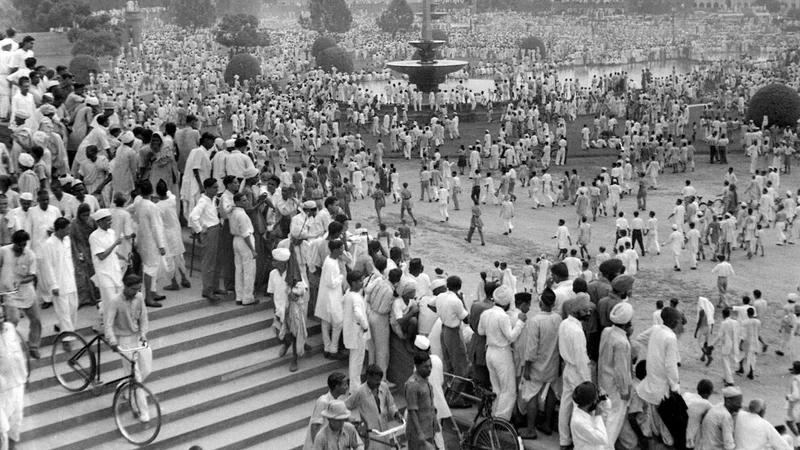
Imagine thousands marching through the streets before India became independent — no microphones, no loudspeakers. Yet one voice would start singing, and hundreds would join in, until the whole crowd sang as one.
These songs were far more than music — they carried courage, hope and resilience. At a time when newspapers were censored and political meetings restricted, poems and songs became powerful tools that united people across languages and regions.
Why songs mattered so much
In the early 1900s, not everyone could read pamphlets or newspapers carrying nationalist ideas — but almost everyone could listen. A simple tune and a few memorable lines travelled far beyond the cities, echoing through village squares, marketplaces and protest marches, turning quiet ideas into a national movement.
Music also bridged language barriers. India was, and is, home to hundreds of languages, and while people might not follow every word of a speech, they could connect with the emotion and rhythm of a song. Patriotic verses were translated and adapted into local folk tunes, letting the spirit of the freedom movement reach across the country.
Songs also turned individual voices into a collective one. Whether at a protest or during early-morning prabhat pheris (processions), singing together reminded people they were part of something larger than themselves. These dawn processions also allowed neighbourhoods to gather peacefully before the day’s work began, filling the streets with patriotic songs.
The British administration recognised this power. In some cases, patriotic books, pamphlets and songs were seized or banned under colonial laws, forcing many verses to spread by memory and word of mouth instead. Public performances of patriotic songs were closely watched, and some gatherings faced restrictions or police action. They understood a simple truth: a speech ends when the speaker leaves, but a song lives on, ready to be sung again. In many ways, these songs became India’s first “viral” messages — travelling by memory instead of algorithms.
Songs that became symbols
Each region had its own voices, but a few songs came to symbolise the spirit of the freedom movement across generations.
“Vande Mataram”: A rallying cry
Written by Bankim Chandra Chattopadhyay in the 1870s and included in his novel Anandamath (1882), “Vande Mataram” imagines the nation as a nurturing mother. As the freedom movement grew, it became a rallying cry echoing through meetings and marches, with freedom fighters often greeting one another using its words. The British discouraged its singing at political gatherings, fearing it would strengthen nationalist sentiment, but this only deepened its symbolic power. In 1950, it was recognised as India’s National Song.
Ekla Chalo Re: The courage to walk alone
Written by Rabindranath Tagore in 1905 during the Swadeshi Movement, “Ekla Chalo Re” carries a simple but powerful message: if no one answers your call, keep walking alone. It celebrated the courage to stand by one’s principles and is widely believed to have resonated with Mahatma Gandhi’s philosophy of steadfast, peaceful resistance. More than a century later, it continues to inspire people in schools, cultural events and moments of personal challenge.
Achamillai Achamillai :A song of fearlessness
Subramania Bharati’s “Achamillai Achamillai” (”I Have No Fear”) urged people to face injustice with courage. For Bharati, freedom meant more than ending colonial rule — he envisioned an India without caste discrimination, with equal rights for women and greater access to education. The poem’s stirring refrain made it a favourite at public gatherings, and it continues to be recited in schools and literary festivals today.
Did you know?
Sarfaroshi Ki Tamanna: A promise of sacrifice
Written by Bismil Azimabadi in 1921, “Sarfaroshi Ki Tamanna” became closely associated with revolutionary Ram Prasad Bismil, who frequently recited it. Its stirring verses inspired young revolutionaries to place the nation’s freedom above personal safety, echoing through protests, secret meetings and even prisons. Today, it remains one of the best-known symbols of India’s freedom struggle.
When the singing didn’t stop
Independence in 1947 didn’t end the tradition — it simply changed the questions. Instead of asking how to win freedom, poets and musicians began asking how that freedom could be made more equal, inclusive and meaningful. Across different languages, they wrote about workers, farmers, marginalised communities, the environment and constitutional rights. Like the freedom poets before them, they did not always agree with those in power, reminding people that poetry in a democracy is not only about celebrating freedom but also about questioning, reflecting and imagining a better future.
Gaddar: People’s balladeer
The Telugu folk singer and poet Gaddar became one of the defining voices of public movements in Telangana and Andhra Pradesh. Performing in simple attire to the beat of the dappu drum, he took his songs to village squares rather than concert stages, singing about farmers, workers and marginalised communities. His performances were as much theatre as music, inviting audiences to clap, sing and participate. Closely associated with left-wing people’s movements, his work sparked both admiration and debate, but his influence on Telugu folk music and protest culture remains widely recognised.
O.N.V. Kurup: Poetry that inspired change with compassion
Jnanpith Award-winning Malayalam poet O.N.V. Kurup showed that poetry could inspire change through empathy rather than protest alone. His verses on human dignity, ordinary lives, nature and democracy reached millions through both literature and Malayalam cinema. He believed poetry could awaken conscience by appealing to shared humanity, showing that meaningful change can also begin with reflection.
Older songs continue to inspire too. The Hindi song “Hum Honge Kaamyab”, adapted by poet Girija Kumar Mathur from the American civil rights anthem We Shall Overcome, has been sung in schools and public gatherings for decades, carrying a message of hope, perseverance and collective action. From handwritten verses to viral reels, the platforms may have changed, but the power of songs to inspire and unite remains timeless. Unlike speeches, songs don’t need to be remembered word for word. A simple chorus can be learned in minutes, sung by hundreds and passed on for years.
Published - August 15, 2026 07:30 am IST