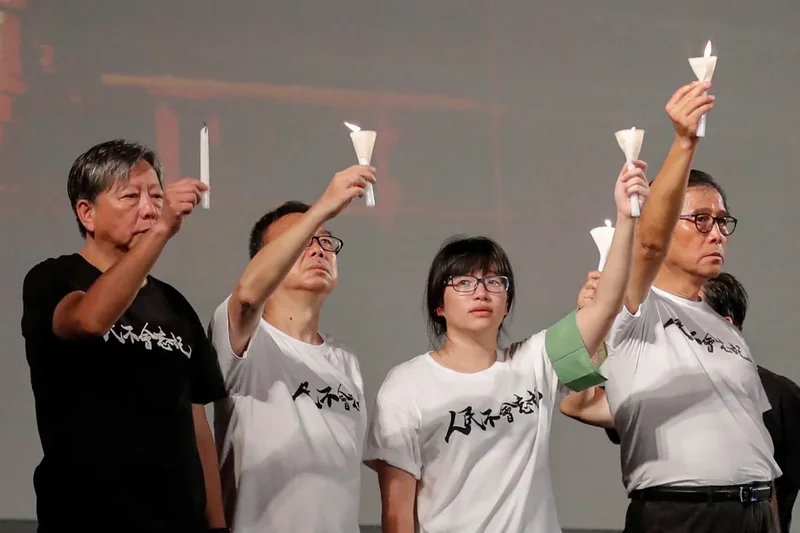
Two former leaders of Hong Kong's annual Tiananmen Square vigil have been convicted of inciting subversion after judges ruled that their campaign to “end one-party dictatorship” amounted to encouraging the overthrow of China's Communist Party.
Lee Cheuk-yan and Chow Hang-tung, former leaders of the now-disbanded Hong Kong Alliance in Support of Patriotic Democratic Movements of China, were found guilty on Friday alongside the organisation itself under Beijing's sweeping national security law.
The pair, who have been in custody since 2021, had pleaded not guilty and face a maximum sentence of 10 years in prison.
They are due to be sentenced at a later date. A third defendant, former vice-chairman Albert Ho, pleaded guilty when the trial began in January.
According to a court summary provided to reporters, three government-approved judges found that the alliance's call to “end one-party dictatorship” was not a demand for greater political participation within China's constitutional system, but an attempt to strip the Communist Party of its constitutionally protected leadership role.
The judges concluded that the word “end” in the alliance's slogan carried the meaning of “overthrowing” and “undermining”, and that the defendants had intentionally encouraged supporters to pursue the goal through unlawful means when the opportunity arose.
The alliance had organised Hong Kong's annual candlelight vigil marking the bloody military crackdown on pro-democracy protesters around Beijing's Tiananmen Square on 4 June 1989.
For three decades, the event was the only large-scale public commemoration of the crackdown held on Chinese soil, drawing tens of thousands of people to Victoria Park each year.
Hundreds of people were killed when Chinese troops moved into central Beijing to suppress the protests.
The crackdown became a defining moment in modern Chinese history, ensuring that the country's economic transformation would not be accompanied by political liberalisation.
Hong Kong authorities banned the vigil in 2020, citing Covid restrictions, weeks before Beijing imposed the national security law following the city's mass anti-government protests of 2019. The alliance disbanded the following year amid a wider crackdown on civil society groups and pro-democracy activists.
During the trial, prosecutors argued that the alliance had used its annual commemorations, publications, website, and 4 June museum to build support for removing the Communist Party from power.
The court said the defendants had continued to promote the goal of “end one-party dictatorship” after the national security law came into force, stirring hostility towards the ruling party and undermining public confidence in its leadership.
The judges acknowledged that the alliance had not proposed a specific method or timetable for achieving its objective and had not advocated violence. But they found that the continued promotion of the goal, combined with the group's criticism of Beijing and comparisons between the 1989 crackdown and Hong Kong's 2019 unrest, constituted incitement to subversion.
Lee, a former lawmaker, had told the court that the alliance's demand was about democratic reform and allowing people to choose their leaders, rather than removing the Communist Party's leadership. Chow, a barrister who represented herself, argued that “ending one-party rule” meant ending unrestricted power and that pursuing democratic change should not be criminalised.
The court rejected those arguments, finding that the defendants sought to overthrow or undermine the party's leadership rather than simply broaden political participation.
Chow had struck a defiant note before the verdict.
Recalling being taken from prison to court in handcuffs and waist and ankle chains, she said correctional officers walked her “like a dog".
“Justice lives in the hearts of the people. There is no need to look up to this kind of top-down ruling, and one verdict doesn’t matter much,” she said.
The convictions drew condemnation from Amnesty International. It said the verdict demonstrated how Hong Kong's security law was being used against people involved in peacefully remembering the Tiananmen crackdown.
“Chow Hang-tung and Lee Cheuk-yan have not committed any recognisable crime; they have been convicted solely for their role in organising peaceful commemorations of the people killed by the Chinese authorities on 4 June 1989,” the rights group said.
“The Hong Kong authorities should quash these convictions and end the ongoing persecution of people seeking to keep the memory of Tiananmen alive.
“Chow Hang-tung and Lee Cheuk-yan are prisoners of conscience who should never have been prosecuted in the first place. They must be released immediately and unconditionally.”
Outside the court, supporters gathered despite a heavy police presence. Lee and Chow smiled and waved at the public gallery before leaving the courtroom.