Imagine what your home means to you. How you grew roots, bloomed into an adult, surrounded by bonds you have worked continuously on, in a safe environment that understands you in all your states. Imagine how you found peace within those four walls of your humble little room whenever the world came crashing down around you. Think of the houseplant that knows your touch, the street cat that answers to your calls, and that little cosy corner on your terrace only you know about. Now imagine abandoning it all one fine day — millions of people around the globe eventually move out of their homes, in search of better lives or a new world. Now, this reality takes a darker turn for the majority of women in our society. After their wedding, they must not only move away from their family and home, but also lose their identity and dreams and become a “dutiful daughter-in-law” or a “homely wife.”
This normalised ill-fated reality is the subject of the latest Tamil rom-com, Pyaar Prema Kalyanam, directed by Elan and currently streaming on Netflix. In his third feature film as a director, Elan attempts a pulpy, accessible, and entertaining message film. Unfortunately, the filmmaker seems ill-equipped to handle that style of cinema. He trades bite for some cheap pleasures and a candy-flossy outlook, and the result is a harmless, well-intentioned yet shallow film.
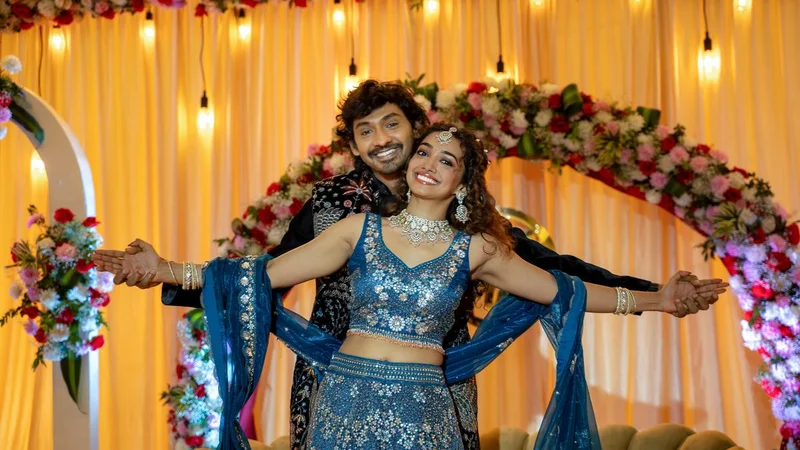
After the cheery wedding festivities of Elan (played by the actor-director) and Pavithra (Saanve Megghana), the newlywed bride is expected to hop into the car and be taken away to her in-laws’ house. But something clicks in Pavi’s head. She jumps out of the car and dashes out of the venue, as her helpless new husband runs after her in utter confusion. This is the very scene with which PPK kicks off, and over the next two hours, we see how the pair met and fell in love, why Pavi chose not to move to Elan’s house, and, as revealed by the trailer, what happens when Elan chooses to flip the switch and becomes a househusband at Pavi’s.
Everything about this snappy one-liner makes you sit right up. Even the way we are introduced to the flashbacks of Elan and Pavi speaks so much about who they are and who they end up as. Through a long, uninterrupted shot, we see how ‘Purple’ Pavi, a famous influencer, goes about her day at home, tending to her parents, her grandfather, and a pet dog, before hitting her cosy bed and speaking to her internet family. Pavi approaches her responsibilities as the working adult of the family with utmost love and pride. Meanwhile, we meet Elan, a bored civil engineer in Dubai, who willingly jeopardises his job to return home and eat his mother’s crispy dosas; home means a lot to Elan as well, but unlike Pavi, this man reeks of incompetence.
Much of the first 30-40 minutes of the film goes so smoothly as you see a rather unusual meet-cute transpire between the lead pair. They then get married, and we know what happens. Now, in another film, one might wonder how a couple in love (especially after engagement) wouldn’t have discussed something as basic as how they would lead their lives post-marriage. However, the fact that they never quite got to that part tells you how ingrained it is in Elan that he assumes his beloved would readily take up the automated life that awaits her — and how comfortably Pavi has been leading her life that she never even imagined letting go of it until the push came to shove.
Pyaar Prema Kalyanam (Tamil)
Director: Elan
Cast: Elan, Saanve Megghana, Radikaa Sarathkumar, Elango Kumaravel
Runtime: 126 minutes
Storyline: A newlywed couple’s life takes an unexpected turn when the bride chooses to stay at her home, leaving her husband to embrace the role of a househusband
PPK turns dull quickly enough. Once Elan enters Pavi’s house, the film attempts heavy-handed humour by exaggerating the notion that a man’s respect will be intact only if he has a job. We see how Pavi’s mother (Radikaa Sarathkumar) treats Elan with utmost reverence when his employment prospects are strong, and quickly mistreats him when he loses a job. On the surface, this might seem like a harmless jab, but this makes you wonder what stance the rest of the film is about to take — after all, you wouldn’t see any humour in a woman treating her daughter-in-law as such. Moreover, this would have been a drastically different critique had the film explicitly shown this as an abusive trait of Pavi’s mother; however, it treats it so flippantly for daily soap-y humour that you begin to question how the film expects us to read these ideas.
Many of these portions rightfully critique men’s incompetence. Still, the way the scenes are written does a great disservice to housewives and househusbands by treating the gender subversion like a party trick. In another instance, Pavi, who otherwise espouses feminist ideals, starts shaming her husband for wearing shorts in his house in the presence of a neighbouring woman. Again, this isn’t a serious dramatic moment that reveals Pavi’s shortfalls, but part of a long and abysmal track between Elan and Pavi’s mother, who wage wars like a stereotypical Tamil cinema mother-in-law and daughter-in-law. Also, how does a man who earned a living in Dubai all alone for 1.5 years not know that the money allocated from his wife’s monthly income for household expenditure is for the whole month?
For a big stretch — when Yuvan Shankar Raja’s superb ‘Love Is Beautiful’ track (sung by GV Prakash Kumar) plays — it seems the film might redeem these issues. This is before Elan’s mother, upon seeing her son at his in-laws washing vessels, visualises him in a woman’s attire. It’s a crass idea that reinforces that a simple act of washing vessels is a woman’s job and questions the masculinity of competent, secure household men. Of course, you might argue that the film eventually speaks to how unfairly the world treats househusbands, but by then, Elan becomes the butt of the joke — and the message sent to men is that this might be their reality should they try their hand at roles traditionally assigned to women.
In the two-hour film, only a handful of scenes click. Early on, the famous television interview from Shankar’s Mudhalvan becomes a motif mirroring a television interview Pavi participates in. The idea sounds inventive, but the scene-writing doesn’t live up to its potential, which shows when the late legendary Raghuvaran’s dialogue — “You be the CM for one day and see for yourself” — plays at an apt moment.
In his acting debut, Elan looks and plays the part ably, but it is Saanve who stands out with her anchored performance as a woman who stands up for herself and her desire to lead her life on her terms. Yogi Babu plays a character equivalent to Karunaas’ in the Gatta Kusthi films, a typical male chauvinist who demands his wife be subservient; neither does Yogi bring in any memorable humour, nor does his arc feel organically written.
Seemingly written for the reel-viewing generation, PPK ends up as a glossy film whose good intentions rarely make a mark. It becomes even more apparent in the safe route it takes to resolve the conflict.
In an early scene, when a character wonders if there are caste differences between Pavi and Elan, someone replies, “Love is their caste.” If this reads like a sweet sentiment to you, perhaps PPK could become a harmless streaming watch. If you are someone who understands the sentiment behind that dialogue but shudders at the thought of love being equated to something like ‘caste,’ there might be other offerings for you .
Pyaar Prema Kalyanam is currently streaming on Netflix
Published - August 21, 2026 12:33 pm IST