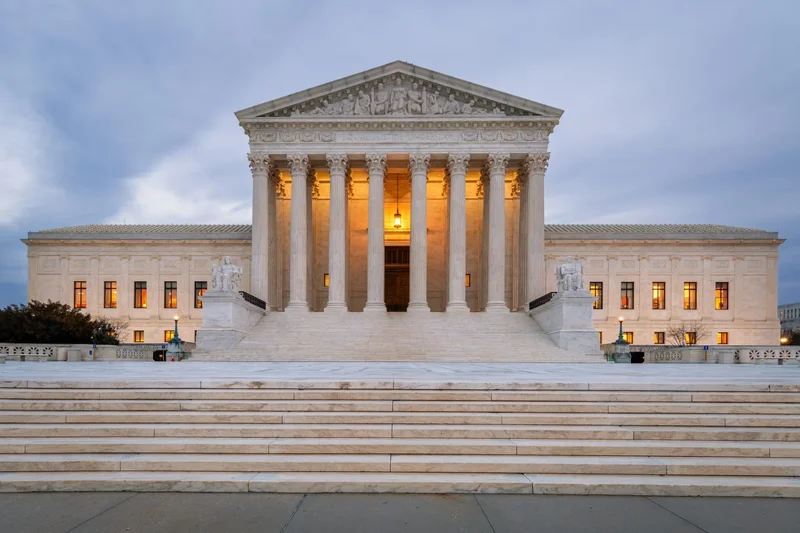
Prediction markets are headed for a legal reckoning. The Commodity Futures Trading Commission and state regulators are battling over who gets to police the fast-growing platforms, a conflict that could force the Supreme Court to settle the question before the end of next year, according to Flip Pidot, a prediction market executive with nearly 20 years of experience in the industry.
“When you have a high-stakes intergovernmental conflict where a federal regulator like the CFTC is opposed in their position to a supermajority of state attorneys general… then that can get the Supreme Court’s attention,” Pidot, the Chief Strategy Officer at PredictIt, told Fortune.
In April, the U.S. Court of Appeals for the Third Circuit sided with Kalshi in its dispute with New Jersey, finding that federal commodities law overrode the state’s gambling laws for the platform’s contracts. The ruling affirmed a lower-court decision allowing Kalshi to continue operating in the state.
Several pending cases could produce rulings more favorable to state regulators. Earlier this year, a Ninth Circuit panel heard arguments over Nevada’s effort to enforce its gambling laws against event contract platforms. The judges appeared skeptical of the arguments made by three prediction market companies. Over the past two months, Kalshi has also appealed to the Second Circuit in response to adverse rulings by federal judges in New York and Connecticut.
If just one of these appeals courts side with the states over Kalshi, it will create a circuit split that will likely prompt the Supreme Court to step in. Pidot expects that to occur as soon as November and, if the Supreme Court does choose to hear the case, a ruling would likely come next June. (Pidot first made the remark at a prediction markets event in New York City this week).
The legal tussle comes as prediction markets have proliferated in the United States over the past two years. Under the Trump administration, the CFTC has taken a more accommodating stance toward the platforms, arguing that event contracts traded on CFTC-registered exchanges fall under its exclusive authority. States have pushed back, saying that contracts tied to sports amount to unlicensed wagering. The conflict carries especially high stakes in states that rely heavily on gaming revenue.
Economic stakes
Beyond a circuit split, other factors make Supreme Court review of the prediction markets regulatory dispute nearly inevitable, according to Stephen Piepgrass, a prediction markets lawyer and partner at law firm Troutman Pepper Locke.
Those factors include the fact that the dispute raises constitutional questions. In 2018, the Supreme Court ruled that the federal government could not prevent states from allowing sports betting because doing so violated the Tenth Amendment. The decision allowed each state to decide whether and how to regulate sports betting. Since prediction market contracts resemble sports bets, states have argued that the CFTC is taking away their power to regulate them. In response, the CFTC has said that the Commodity Exchange Act gives it sole power over swaps and futures contracts, preempting state laws.
Prediction markets’ rapid growth has also raised economic stakes that could draw the Supreme Court’s attention. The platforms threaten established gambling businesses like casinos and disrupt Native American economies that rely heavily on gaming revenue. At the same time, companies and institutions are increasingly exploring prediction markets as financial tools for hedging risk.
“This is top of mind for so many Americans… It has a huge potential impact on the economy, and we’ve only scratched the surface of it,” Piepgrass said.
breaks the traditional barrier between audience and newsroom. The show transforms
Fortune DailyFortune’s trusted reporting into actionable, conversational, and entertaining insights for an emerging class of business leaders.
Watch here.