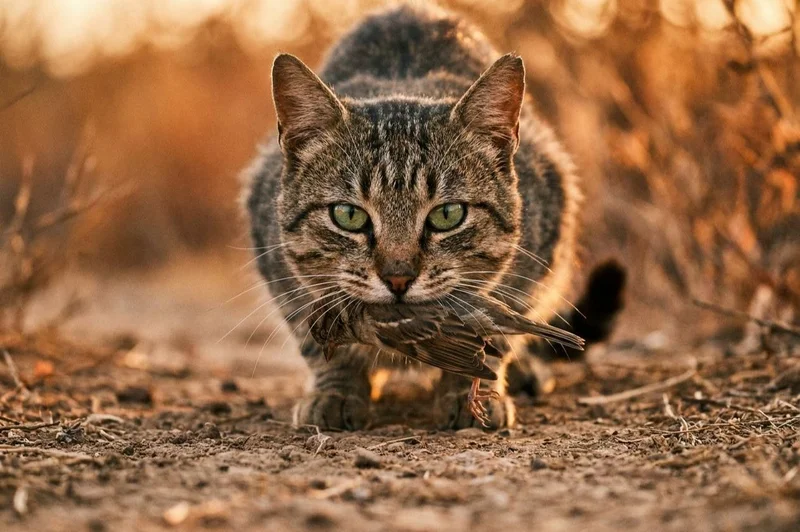
Top ecologist argues culling lacks scientific evidence as competing petitions reach the National Assembly
As debate intensified over a YouTuber's campaign to ban the feeding of stray cats and reduce their population through culling, Choe Jae-chun, a chair professor at Ewha Womans University and one of Korea's leading ecologists, publicly rejected the proposal.
Choe warned that the campaign lacks academic evidence applicable to Korea's ecosystem, making it impossible to conclude that reducing the feline population protects endangered species or aids the environment.
Speaking Thursday on his YouTube channel, Choe Jae-chun's Amazon, Choe said the government now needs to respond because a petition informally dubbed the "Cat Mom Ban Law" and a counter-petition opposing it have each drawn more than 50,000 signatures.
The YouTuber behind the channel Korean Birder filed the petition on July 10 to prohibit residents from feeding stray cats. The petitioner claims stray cats destroy bird species designated as natural monuments under Korea's heritage protection system, arguing that authorities must replace trap-neuter-return programs, or TNR, with culling. The ban proposal gathered over 50,000 signatures, while a counter-petition opposing the feeding restrictions drew nearly 90,000 signatures.
Under Korean parliamentary rules, a petition filed through the National Assembly's online petition system qualifies for formal submission and review by a standing committee if it receives 50,000 signatures within 30 days.
Choe said he did not reply to two private messages from the YouTuber because an ecologist cannot recommend intervening in an ecosystem without long-term research using a carefully controlled experimental design.
"Despite ongoing concerns about stray cat populations, the issue has not been rigorously studied in Korea," Choe said, distancing himself from the petitioner's claims. He rejected the petitioner's reliance on foreign research from countries like Australia. "The same ecological principle can produce vastly different outcomes depending on the region," he said.
Global bird population declines stem from complex factors, including habitat destruction, environmental pollution and climate-driven shifts in seasonal timing among interacting species, Choe said. Isolated observations of cats hunting birds do not prove that felines cause population-level declines, he added.
Choe said systematic ecological researches are essential to identify the true drivers of bird population declines in Korean cities.
"I understand your passion for birds, but asserting that another living creature must be eliminated is a misguided form of love," Choe said, addressing the YouTuber.
This article from the Hankook Ilbo, the sister publication of The Korea Times, is translated by a generative AI system and edited by The Korea Times.
Explore More
- Q.
- Q.
- Q.