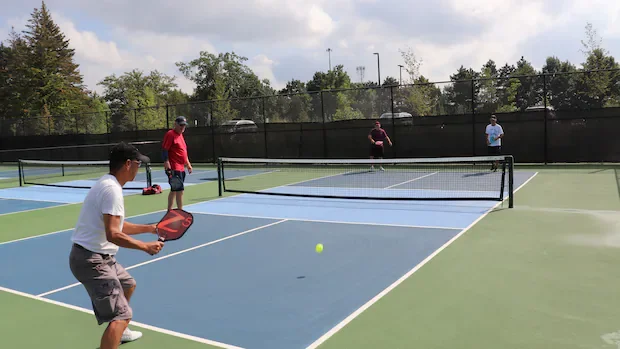
What will unite tennis and pickleball players? A whole lot more courts
Planners and sports policy experts say there aren't enough recreational facilities for any sport
LISTEN | What the court wars reveal about our relationship with public space:Nearly anywhere you go in this country, tennis and pickleball players are locked in a fierce competition for court time.
When two public tennis courts in Scarborough, Ont., were converted into six pickleball courts late last year, for example, one local tennis player launched a petition calling on the city to reverse course.
On the more extreme end of things, a conflict between pickleball and tennis players over access to public courts on Mayne Island, B.C., went all the way to B.C.'s Supreme Court.
But these local squabbles are "just a microcosm of what's happening right across the landscape of sports and recreation," says Matti Siemiatycki, a professor of geography and planning at the University of Toronto. Also the director of the university's Infrastructure Institute, Siemiatycki says there are not enough public recreational facilities for any sport.
"Whether it's a hockey arena space, which is always at a premium, whether it's tennis space, whether it is park space, all of the swimming pool space — all of this is fiercely contested and how we're allocating it is both challenging and in some cases creating inequalities," he told CBC's The Sunday Magazine.
Experts in planning and sports policy say the answer is not to leave sports communities to duke it out over who has access to the publicly owned facilities, and nor is it to leave sport entirely in the hands of for-profit organizations and those who can afford to pay. The answer, they say, is to try to address the supply problem instead.
To that end, housing developers should have to build more recreational facilities than the current rules demand, says Peter Donnelly, a University of Toronto professor emeritus who directed the Centre for Sports Policy Studies before he retired.
"I'd love to see them get back to the same kind of public housing policies that were in place after the Second World War, where Canada built hundreds of thousands of homes across the country and did so, very often, with including parks and recreational space and community centres as a part of that development," Donnelly said.
"I think the developers just won the war on that."
WATCH | Three Quebec investors
transform one empty church into pickleball courts:Should developers do more?
Here's how things have typically worked until fairly recently.
Housing developers who wanted approval for a project that had, say, taller towers than the land was zoned for, had to enter into a negotiation with the municipality, which usually involved some level of community consultation as well, said Siemiatycki.
Planning legislation in the provinces and territories tended to give municipalities quite a bit of power to determine how much the developers would pay for things like recreational facilities, parkland dedication, daycare spaces and public art.
But in response to the housing crisis, these governments have started to reduce how much municipalities can charge developers, says Siemiatycki. That's because of concerns these charges were bogging down the process of getting houses built, and that developers were passing those costs on to new homeowners, elevating prices even more, he says.
In Ontario, changes that came into effect in September 2022 capped community benefits charges at four per cent of the appraised value of the land at the time the building permit is issued.
"What it means is that, in practice, there's going to be less money for some of these park and recreation spaces," said Siemiatycki.
Growth in pickleball and tennis
These changes happened while more people were picking up racket sports.
"There's been a huge explosion in interest in pickleball over the last number of years and really a recommitment to tennis since the pandemic," said Siemiatycki.
Both games fit the bill for sports you can play outdoors and in a socially-distanced fashion.
Though CBC is unable to verify their figures, both Tennis Canada and Pickleball Canada claim that participation has grown significantly in the last few years.
Jonathan Moody, president of Pickleball Ontario, says the game is ideally played on smaller courts with slightly lower nets. But in most cities, outdoor players usually "make do" on tennis courts, he says.
Public-private partnerships?
A host of pickleball businesses have sprouted up in response to demand. Amen Pickleball converted an empty church in the Montreal suburb of Chambly, Que., U.S. chain Pickler opened its first Canadian location in a Winnipeg business park in January. A company called Fairgrounds opened locations in several provinces, some in empty shopping mall spaces.
Lyndsay Hayhurst is an associate professor at York University's School of Kinesiology and Health Science in Toronto whose research interests include sport and gender, as well as how sports can contribute to community engagement and development.
Hayhurst said while there's been "a lot of excitement" about the privately-owned pickleball businesses, "when you look at who can actually afford it long term, it's not an equity denied individual who's living below the poverty line."
But Hayhurst says she sees potential for city recreation departments to partner with these businesses to offer some memberships for free, or to bring in youth from nearby schools.
The tax angle
Property taxes are one of the few mechanisms that municipalities have to raise funds for local facilities. But increasing property taxes can be a political hot potato for local governments.
Some places have tried a "sin tax" approach, says Siemiatycki. In the U.K., for example, a portion of lottery money is used for local infrastructure and facilities.
Unfortunately, he says, there's no magic funding model that's just waiting to be discovered.
When cities are trying to tangle with major problems like housing affordability, things like recreation space can slip down the priority list.
"Public spaces can often seem low stakes," said Siemiatycki, "but really how they're used and who has access can really shape how a community sees itself."
As sports policy expert Peter Donnelly puts it, parks and rec departments are "treated as kind of the toy department of most city councils and it's just become a huge problem."
Donnelly says it's time for cities to take recreation more seriously. "I go back to the bottom line on this. Active healthy communities are really good places to live."
Audio produced by Andrea Hoang