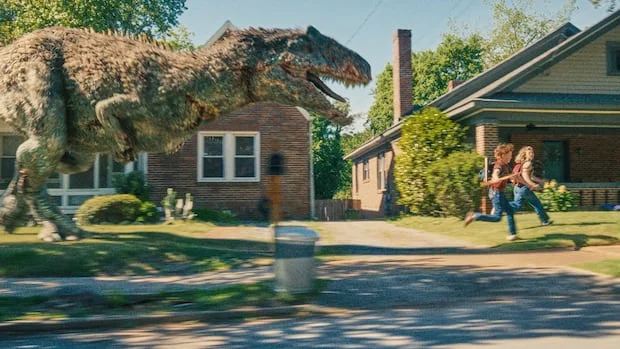
The dinosaur sex in The End of Oak Street is odd. The reality is far more confusing
Fur, feathers and more are featured in latest dinosaur movie. Experts explain the science behind it all
A giant snake-like creature crawls from a neighbour's pool. Feathered lizards chase a family down their driveway. Two furry, building-sized animals lean against a house and … get it on?
This is The End of Oak Street, the latest movie to barrel into theatres on the backs of dinosaurs and a nostalgic love for Jurassic Park.
But despite a long entrenched Hollywood history, these prehistoric creatures look noticeably different from their Hollywood predecessors — representing a long-awaited update from the perspective of paleontologists. Here, CBC News asked experts about the feathers and fauna the movie gets right, and where filmmakers have filled gaps in a fossil record that still leaves some surprisingly basic questions unanswered.
And most importantly, is that really how dinosaurs had sex?
WATCH | The End of Oak Street review:But from a scientist's perspective, that's not the most interesting part.
"It was actually pretty refreshing to see a lot of feathers and fluff on a lot of the dinosaurs in the movie, because that's really different from what we tended to see, even in the more recent Jurassic World movies," said Victoria Arbour, a paleontologist at the Royal B.C. Museum.
Hollywood's depiction of dinosaurs has long lagged behind the science. Researchers have suspected a close relationship between dinosaurs and birds since soon after the theory of evolution was established. If you've ever seen the logo for the Canadian brand Arc'teryx, you've seen the fossil of the world's first bird that suggested the link.
But fossil discoveries beginning in the 1990s dramatically expanded the evidence that many non-avian dinosaurs had feathers.
- The 'Jurassic Park effect': How a generation fell in love with dinosaurs
- Young tyrannosaur found with baby dinosaurs in its stomach
One important discovery was Sinosauropteryx prima in China, the first non-avian dinosaur with clear evidence of feathers. That and subsequent discoveries helped transform how scientists pictured dinosaurs, a revelation largely impeded in pop-culture due to movies imitating the scaly creatures made famous by Steven Spielberg's Jurassic Park.
"That's really in the past 20 years that we've started to realize, 'Oh, these are feathered animals,'" said Caelan Libke, a PhD student at Carleton University researching dinosaurs. "And so I think Jurassic Park was on the cusp, right when we were starting to figure out that they may have been feathered — and so that's why they're still scaly."
From plausible to pure invention
The End of Oak Street goes all-in on feathers in a way few dinosaur movies ever have. Its Allosaurus — which some movie-goers may mistake for a T. rex — is feathered, a choice Libke called plausible because the species is "closer to the base of the group that eventually evolved into birds."
A smaller feathered creature fills the stereotypical "velociraptor role" familiar from other dinosaur movies. Arbour said it appears largely invented for the film, but resembles an Elaphrosaurus, a lightweight, three-toed, meat-eating dinosaur.
Libke suggested Coelophysis, a smaller dinosaur from the late Triassic, as another possible inspiration. Neither has direct fossil evidence proving feathers, but their position within the theropod group makes Oak Street's depiction plausible.
Other animals seem to have been constructed with more creative liberties. The enormous legless, aquatic animal could have been inspired by the giant prehistoric snake Titanoboa, Libke said. Arbour pointed to the still-living worm-shaped amphibians caecilians as another possible jumping-off point.
But in either case, the animal shown onscreen is not one scientists know to have existed.
"We have literally nothing in the fossil record that matches that. It does not exist," Arbour said. "There are some genuinely large snakes in the fossil record; they are not that big."
Flights of fancy
Other artistic inventions are the fluffy, furry sauropods — a group of dinosaurs familiar to those who grew up with The Land Before Time and that includes the scientifically controversial Brontosaurus. In reality, they were likely much less furry.
"The main reason being that they're just so big, they wouldn't need a lot of fur like that because they already have trouble getting rid of heat," Libke said. "So they would just bake in their own fur, just because of their size."
The fur may be implausible. What the sauropods do next is much harder to judge.
One scene depicts the enormous animals mating, positioned not unlike dogs — a somewhat bizarre scenario for creatures that would have weighed tens of thousands of kilograms.
Director David Robert Mitchell has said he wrote the scene quickly and without much scientific consideration, but as a way of showing that dinosaurs had full lives and did more than hunt. Yet simply modelling their behaviour after living animals may not be as scientifically far-fetched as it appears.
"Dinosaur mating has been a mystery, and it's still most likely going to be a mystery because behaviours don't really fossilize very well," Libke said.
WATCH | How dinosaurs may have healed:Beyond knowing that dinosaurs must have done it, scientists have struggled to determine exactly how they did. Skeletons fossilize much more readily than soft tissue, meaning skin, feathers and reproductive anatomy are rarely preserved.
Experts still struggle to determine whether individual dinosaur specimens were male or female. Only about half a decade ago, scientists reconstructed the first preserved genital opening for a non-avian dinosaur — evidence so rare it only recently lent serious credence to the still-unproven hypothesis that some dinosaurs had penises.
With knowledge that sparse, it's unsurprising the mechanics are still shrouded in mystery. Especially as direct observation is impossible, and paleontologists often have to reconstruct entire species from a small number of incomplete skeletons. That means they have to be circumspect about their subjects' bedroom antics.
For animals weighing several tonnes, they would have had to be incredibly careful in how they buddied up. A recent Canadian-aided study examining recurring tail injuries in hadrosaurid dinosaurs suggested some may have been caused by mating behaviour.
Exactly how dinosaur sex worked will likely always remain a titillating secret. When it comes to how The End of Oak Street depicted it, neither Arbour nor Libke saw anything that crossed the line from uncertainty into impossibility.
"For me, at least, it didn't seem fully out of line, and especially in the context of the movie, it really didn't bother me," Arbour said.