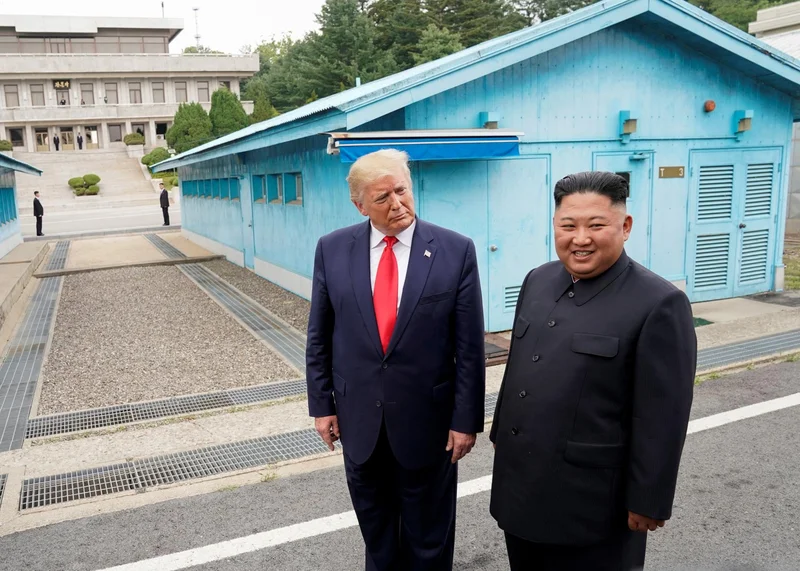
South Korea wants a potential resumption of U.S.-North Korea dialogue to serve as a gateway to broader four-party talks on establishing a peace regime on the Korean Peninsula, stressing that Seoul must have a seat at the table as a direct stakeholder.
Unification Minister Chung Dong-young said renewed talks between Pyongyang and Washington would mark a fundamental shift in the long-running deadlock on the Korean Peninsula.
“While it is too early to draw conclusions, this is more than a passing spark. I feel the tectonic plates of Northeast Asia are beginning to shift,” Chung said Friday.
A senior unification ministry official also noted that renewed dialogue between Washington and Pyongyang should not end with bilateral talks, but should ultimately draw South Korea and China into discussions aimed at replacing the decades-old armistice system with a permanent peace framework.
“North Korea-U.S. talks should not end just as talks. They must become an opportunity to open the way toward a transition to a peace regime,” the official told reporters on Friday. “North Korea-U.S. dialogue could set four-party talks in motion.”
The remarks outline the Lee Jae Myung administration’s envisioned role as U.S. President Donald Trump pushes to revive summit diplomacy with North Korean leader Kim Jong-un, raising questions over where Seoul would fit into negotiations largely driven by Washington and Pyongyang.
The official stressed that South Korea should not be sidelined from a process directly affecting the peninsula.
“South Korea should be involved in the talks because South Korea is a stakeholder,” the official said.
The government sees a potential Trump-Kim dialogue as a first step rather than an end in itself, with cooperation from China and eventually other regional players needed to build a durable peace framework.
“A peace regime must proceed in parallel with efforts to resolve the nuclear issue. North Korea, the U.S. and China have already put forward a dual-track approach … As talks have only just begun, South Korea will actively work to help move them forward,” the official said, adding that communications and improving relations among relevant countries such as China, Russia and Japan are as important.
The remarks followed a recent exchange of signals over a possible Trump-Kim meeting. Trump said he expects to meet Kim later this year, while Kim Yo-jong said she was unaware of any recent contact but described the two leaders’ relationship as “excellent.” Their last summit, in Hanoi in 2019, ended without a deal.
According to the official, Trump’s moves appears responsive to North Korea’s two key demands: recognition as a nuclear state and the lifting of sanctions to enable Pyongyang to ensure its survival and develop its economy.
"From North Korea’s perspective, if it meets with Trump, it has made clear that it will not hold talks if denuclearization is on the agenda. Therefore, any meeting would amount to a de-facto recognition of North Korea as a nuclear state," the official said.
"North Korea has two needs: the right to survival and the right to development. Its survival would require regime guarantees and the abandonment of the hostile policy toward the country, while its development requires the easing or lifting of sanctions to improve its economy. North Korea’s strategic demand is stronger than anything. The greatest threat to the regime would likely be internal unrest resulting from opening up the country."
China could also be pivotal to Seoul’s envisioned four-party talks.
While Beijing has largely avoided directly challenging North Korea over its nuclear weapons, Seoul’s foreign ministry sees that China's policy toward the Korean Peninsula remains unchanged.
During his visit to Seoul this week, Chinese Foreign Minister Wang Yi said China would continue to play a constructive role in promoting peace and stability, but stressed that Washington must abandon what Beijing calls its hostile policy toward North Korea.
For the Lee administration, that leaves a diplomatic challenge: encouraging Trump and Kim to restart negotiations without allowing South Korea to become a bystander in talks that could reshape the security order on the peninsula.
Critics, particularly from the conservative opposition, have accused the government of adopting an overly optimistic approach toward North Korea, warning that Seoul could be sidelined if Trump pursues direct diplomacy with Kim.
Asked how South Korea could concretely act as a “pacemaker” for renewed talks, the ministry official didn’t offer specific plans but said Lee has been persuading Trump and explaining Seoul's phased approach to denuclearization, as well as the need to measures to improve inter-Korean relations, including the reopening of the Kaesong Industrial Complex.
Explore More
- Q.
- Q.
- Q.