The East Midlands of the 1970s was flat and unremarkable; tinned food and Tupperware, shiny Formica surfaces – and silence. The town where I was raised wasn’t on the way to anywhere, nor were its inhabitants.
Our parents were a working-class couple who had both left school in their mid-teens but had strived to raise and educate us all. A bookish child, I decided early on I was going to be a Great Writer. When I hit my teens, I thought I’d try being tortured and difficult. I ran away twice, but the police brought me back in a panda car. I experimented with smoking and drinking but both made me sick. I would say I discovered boys, but it was more that men discovered me and that wasn’t really rebellion, just common or garden exploitation. At the age of 16 I took a load of pills in a school toilet and ended up having my stomach pumped in the local cottage hospital.
At some point during all this, my father sat me down and, in a sincere attempt to demonstrate that all early lives are troubled, confessed to me that he had been married to someone else before he met our mother. It had been a disaster.
I was thrilled. ‘Did you have children with her?’ I asked, hoping for some siblings who would be improvements on the ones I already had.
‘No,’ he said. ‘You are my only ones.’
‘What was she like?’ I asked.
‘She was very beautiful and very hard.’
That was the beginning and end of the conversation: his sombre tone made it clear it was never to be mentioned again. The nearest my mother and I ever came to discussing it would be some years later, when we were talking about what I might wear to a friend’s wedding and I asked, ‘Were you upset you couldn’t have a white wedding?’
She paused before replying softly, ‘Yes, I was.’
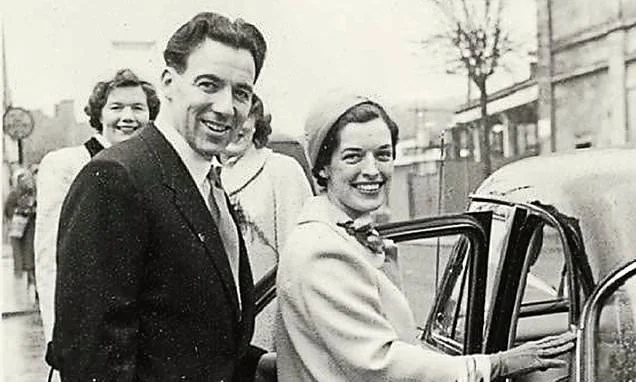
Louise’s parents Avis and Ken on their wedding day, March 1959
So that explained why there had never been any wedding photos on display when we were growing up. It was only after we had all left home that a picture of Mum and Dad outside a registry office had appeared on the sideboard; Dad in a dark suit and tie, Mum in a skirt and jacket with a little matching hat. I wondered how long
Dad had been divorced when he and Mum had met, and why.
Our parents married in 1959 and remained dedicated to each other until our father’s death, from Alzheimer’s, in 2012. Nearly 60 years of love and devotion ended in the saddest of ways, Dad with his memory blasted, succumbing to psychotic rages in which he believed that Mum, and all of us, were trying to kill him. Mum nursed him heroically until the end, dying suddenly of heart disease in 2014 after two years of lonely widowhood. It is a common story, but one that upsets me still; such a harshly undeserved ending to their story.
They had never moved from the bungalow where we were raised, and so after Mum’s death, my brother, sister and I began the lengthy process of emptying it out. Our parents had been tidy, well-organised people, but we underestimated the amount of storage they had: cupboards everywhere, a huge garage and attic… It was only at the end of our excavations that I found, and opened, the black suitcase.
It had been buried at the bottom of Mum’s wardrobe and at first the rusted clasps refused to budge. I nearly put it out by the bins, but opted to dump it in my old bedroom, where we were piling up stuff that needed a closer look. When I finally opened it, I thought it contained junk – a few small cardboard boxes, scrap paper, dust – and could have easily closed the lid and thrown it away. Then I turned over one of the pieces of paper and read, in my father’s hand…
‘My Dearest Avis, I suppose you know what this letter will say before reading the contents – at last, at long last, I am resolved enough to make a decision, and have decided that I shall not see you again…’
There was no date on the letter, nor on the scores of others written by my father and mother, letters that I would eventually attempt to put in sequence. But there were also letters from two firms of solicitors dated 1955, four years before our parents had married. They made it clear that, when our parents met, Mum was a teenage village lass, Dad ten years older and still married, deeply unhappily, to his first wife.
It is easy to forget how in the postwar era, the social opprobrium around divorce was widespread. In 1955, Princess Margaret had been forced to relinquish the love of her life, Group Captain Peter Townsend, because he was divorced. Our parents met at the engineering firm where they both worked in the market town of Melton Mowbray, the kind of place where everyone knew everybody else’s business. Dad was already partially separated from his first wife, who had opted to stay in Peterborough, where they married. Nonetheless, the neighbours would have had something to say about a single woman entering a man’s home unchaperoned.
‘Darling,’ Mum wrote, ‘I beg you don’t make me struggle with this’
‘Darling,’ Mum wrote, in answer to a plea from Dad, ‘I can’t come to the house. Please, Ken, I beg you don’t make me struggle with myself over this… I feel sick and cold with nerves when I have to walk up the hill past all those hateful watching people.’ The net curtains would have twitched all along the way.
Mum was no pushover, though, and kept her chin high. ‘I did have the satisfaction of making the fair-haired girl feel very uncomfortable last night,’ she wrote in another letter. ‘I left here at 5.35, and she came along Nottingham Road towards me. There was no one else near us, and I just walked towards her, looking her steadily in the eyes, and she couldn’t face me… It’s amazing how much that girl and I have said with our eyes, and I don’t even know her name!’
But at some stage, the pressure of disapproval, the moral conflict, clearly became too much for them, hence our father’s letter ending it all.
‘If you really want this darling,’ Mum wrote in response, ‘I shan’t attempt to do anything about it… I’ll help you in the only way I can, by staying away from you.’ Again and again, the letters show them trying to do ‘the right thing’, although Mum’s letters are full of yearning not just for the man she loves, but for the children she so desperately wants by him. When Ken seems resolved to stay in an unhappy marriage, she replies, ‘I only ask one thing. That you don’t give her our children until you are quite sure that it can last.’
She was the youngest of three, her brother and sister already married. ‘I’ve been staying with Edna’s children again this evening, and I went up to them at about ten when they were both fast asleep. I just stood and looked at them, dreaming that you were beside me, and that they were our children.’ When she wrote that letter, Mum could have had no idea that us three were waiting for her in her future, let alone that in decades to come, one of those children would be a middle-aged writer holding that letter and wishing that the living could haunt the dead.
Eventually, the end of Dad’s first marriage came after a final, bitter row between him and then first wife – when even she realised the misery could no longer continue. They had married in 1946, at the age of 21 – but he did not obtain a divorce until a decade later and only remarried nearly four years after that. I’ve often wondered what became of her. She would be 100 now, if she was still alive. I didn’t try too hard to trace her; it seemed intrusive to pursue her down the decades, but I hope she found happiness eventually, as our parents did.
Despite the travails of their early love, Mum and Dad were together through thick and thin, until the end. Finding out about their early passion after their deaths put our grief in perspective in the most poignant way possible. I think of those letters now as our parents’ final gift to us, a treasure worth more than any inheritance, for although there is yearning and sadness in them, there is also joy, spirit and love. Our little Mum, who we had always viewed as entirely ours, an East Midlands housewife with no ambition, turns out to be spirited and brave and determined. Our father, often bossy and opinionated, is revealed as a man with intense vulnerabilities. They were able to make a life for themselves, eventually, and having little formal education, both gave everything to ensure their children were raised with advantages they never had. They succeeded – and the memoir I have written about their love affair is probably my most important work, not because of any of the words I have written in it, but because of theirs.
- On This Spot Fell One Tear Of Love by Louise Doughty will be published by Phoenix on Thursday, £20
- To pre-order a copy for £17 until September 6, go to mailshop.co.uk/books or call 020 3176 2937. Free UK delivery on orders over £25