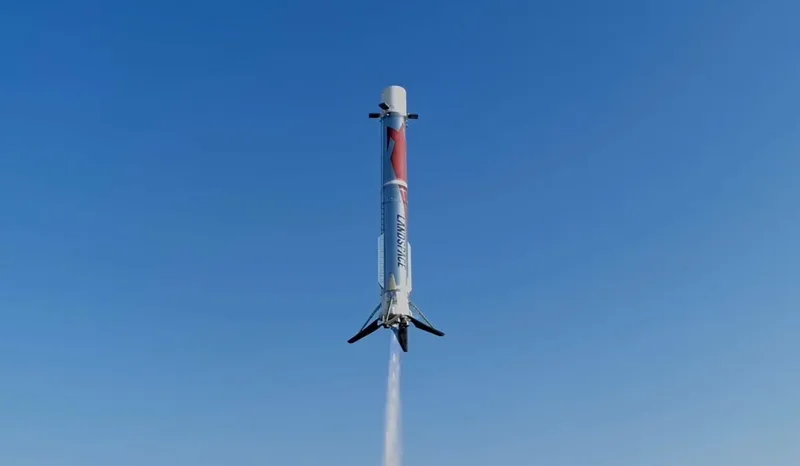
HELSINKI — Chinese commercial launch firm Landspace is targeting a reflight of its Zhuque-3 first stage in months, following its historic successful vertical landing Aug. 18.
A company representative told Chinese financial outlet STAR Market Daily that the firm plans to conduct a reflight test of the recovered stage within six months. The statement came hours after Zhuque-3’s second flight delivered the Honghu-03 satellite to orbit and brought the rocket’s first stage back for a vertical landing at a recovery site in Minqin County, Gansu province, roughly 390 kilometers downrange from the Jiuquan launch site.
The touchdown made Landspace the third entity worldwide, after SpaceX and Blue Origin, to land an orbital-class booster on legs, and the first Chinese company to recover a booster on land. The success followed China’s first-ever orbital booster recovery in July, when a state-owned Long March 10B was caught by a net-equipped vessel at sea.
The Zhuque-3 Y2 booster landing comes eight and a half months after the debut flight of the Zhuque-3, which reached orbit, but the first stage recovery attempt ended in failure during the latter stages of powered descent.
Landspace made a number of technical changes in the wake of the failed landing attempt with the first Zhuque-3, including a reduced number of engines used in the landing burn, which simplified the system and improved reliability, adding a “predicted landing point” to the onboard autonomous safety control system, and improved thermal protection to handle the extreme reentry heating and structural loads.
The second Zhuque-3 flight also carried a secondary technology demonstration in the form of China Mobile’s “Space-Based Intelligent Computing Payload 1.0,” flown with the Honghu-03 satellite. Developed jointly with the Chinese Academy of Sciences’ Institute of Computing Technology and Hongqing Technology—Landspace’s satellite manufacturing affiliate—the payload runs a domestically sourced lightweight satellite-borne core network and onboard “agent” software, and represents China Mobile’s first payload aimed at distributed edge computing in orbit.
The flight adds China Mobile to a growing list of Chinese entities pursuing orbital computing infrastructure, including ADA Space’s Three-Body constellation and Orbital Chenguang.
The reflight plan means lots of work ahead for Landspace in validating their plans for sustained launch cadence. The company’s own design target calls for a Zhuque-3 first stage to be reusable at least 20 times, with a long period expected before ramping up to anywhere near close to Falcon 9 rates.
Landspace is, alongside CASC, just one of a number of Chinese launch entities pursuing reusable rocket capabilities, including Space Pioneer, Galactic Energy, Deep Blue Aerospace, Orienspace, CAS Space and iSpace, with newer, leapfrogging companies such as Astronstone and Cosmoleap also active.