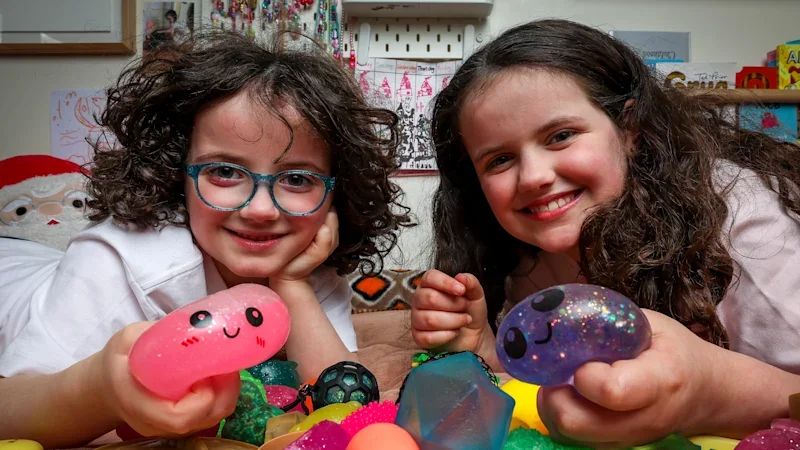
Australia’s Border Force has been asked to seize fake NeeDoh toys, as its manufacturer takes extraordinary steps to stop a barrage of dupes copying the global children’s squishy toy craze from flooding the local market.
The gel-like cubes, dumplings and assorted fruit – all “squishies”, which kicked off from the original and most popular brand, NeeDoh – have children obsessed. Parents are baffled. But with viral popularity comes increasing scrutiny. What’s in the toys? Are they safe?
Several children globally, including a 10-year-old Australian girl, have reported serious injuries from squishies exploding and burning them, and now NeeDoh’s manufacturer is facing a US class action alleging it failed to warn consumers about the risks of the toys when exposed to heat.
This masthead can reveal that Schylling, the US company that manufactures NeeDoh, and its licensed Australian distributor, William Valentine, have approached Australian Border Force, raided factories in China and issued cease-and-desist letters to retailers selling fakes as they try to stop an influx of fake squishies coming in “thick and fast”.
Schylling’s ultimate owner, listed US-based private equity company Gladstone Investment Corporation, also invests in an American defence company that says: “The United States and its allies must be ready to fight and win – anywhere, anytime.”
They went ‘absolutely mental’
Squishies have probably been around since humans learnt to work with the sap of the rubber tree. In a simpler age, kids filled balloons with rice to make malleable balls. Now, thanks to the modern chemical industry, squishies come in all shapes and varieties: blue, green, soap, chicken. Schylling, the 51-year-old Massachusetts-based toy maker, launched NeeDoh in 2017, and the toy sold reasonably well.
Then, in January, “it just went absolutely mental,” recalls Adele Dyson, owner of Adventure Awaits in the northern Victorian town of Numurkah. “We sold a thousand units in like two days.”
In early 2026, Schylling released an advent-calendar-style multipack – and the toys suddenly became viral hits.
“Everyone is just obsessed with them,” says Katie Hennessey, a Brisbane-based 18-year-old who has amassed more than 200,000 followers on TikTok with posts showing her unboxing squishies. “I don’t know why – they come in so many fun textures, shapes and colours. You want to collect all the different textures … which just makes it really fun.”
Dyson says “every single primary-aged kid or teenager, they want one, and they are harassing their parents, the stores, the staff to get one. It is next level. Some of the messages we have received have been out of control – begging for NeeDohs.” She’s had people come to her shop from as far as Darwin trying to get NeeDohs.
Schylling has been struggling to get new stock out to retailers. A pop-up on its website says it has closed its own online store. “Demand for NeeDoh and our other products is exceptionally high right now, so we’re taking a short pause on new orders.”
Jumping on the trend, other brands produce squishies too, including Smooshos Mystery Dumplings and Mushykinz Jelleez, which are also popular.
Google search volume for NeeDoh is up 2800 per cent on 2025, and “squishie” is up 5000 per cent. Some schools have had to ban the toys because kids were spending too long trading them, says Hennessey.
And when a pallet last arrived at Dyson’s shop, it sold out online in four minutes, despite a limit of one per customer.
”We got a whole barrage of emails from parents saying ‘I’ve got three kids … my daughter is dying of cancer, send me NeeDohs’,” says Dyson. “One kid sent me 50 messages in one day: ‘give me NeeDoh. I have to have it’.”
While NeeDohs remain elusive, Schylling and its Australian distributor, William Valentine, have gone to great lengths to halt dupes from undercutting their brand and sales.
An email sent in June to retailers stocking NeeDoh, seen by this masthead, said: “Counterfeit product and websites are coming through thick and fast for NeeDoh.”
Business owners were told Schylling and William Valentine are “running a three-pronged approach” to stop the flood of dupes.
“Schylling is working closely with their Chinese trademark attorney and the Chinese consulate to do factory raids on any offenders,” the email states.
“Last month they conducted raids on 11 counterfeit factories in unison, confiscating millions of fake units, machines, cash and in turn shutting down the factory in the process.
“This one is obviously a game of whack-a-mole due to the sheer scale of factories in China.”
As well, retailers were told a “notice of objection form” is being lodged with Australian Border Force.
“I’m currently lodging documentation with Australian Customs which allows them to seize goods at the Australian border for any importer other than us,” the email states. “This should also drastically slow down any of this product reaching the stores.”
There are also plans to send “cease-and-desist” letters to stop retailers from selling fake NeeDoh products, and Schylling has urged business owners to dob in any outlets doing do.
Shopping centre mania
At Mint My Desk in Parramatta, in Sydney’s west, worker Kai Takakura said squishies have become popular due to TikTok.
“A lot of younger people come here and ask me about the squishies, and then recently dumpling squishies are really popular,” she said. “It’s a blind box, so … let’s say, [the] customer wants to get pink, but when they open it, it’s not pink, so they want to buy more until they get a pink one.”
It’s a similar story in Preston, in Melbourne’s north, where Kid Stuff employee Emily Oppedisano said the squishies craze started at the end of last year.
“[NeeDoh products] were constantly selling out. They were selling out within two hours when we got them in,” she said.
She said there is a limit of one or two squishies per person, as children come through the doors and ask when stocks will be replenished.
Alexander Mazniovski, 11, was buying a squishy from Toyworld at Northland shopping centre in Preston with his dad Tony Mazniovski this week. “They are fun to play with when you’re bored. They are all over social media,” he said.
His dad said the toys are also a “calming tool”, particularly for his other son, who has autism. “They serve more than one purpose,” Mazniovski said. “They serve him well when he is overloaded with different emotions.”
Toyworld moved to place the bulk of their squishy stock behind the counter, due to the swarms of kids coming in wanting to touch and play with them. Instead, they have installed a “demo box” in front of the counter.
Melbourne mother of two, Elena, said her daughters Audrey, 9, and Vanessa, 6, have both requested squishies for their birthdays in October and November. “They are taking over my household,” said Elena, who requested her last name remain private. Her elder daughter trades them with her cousin, so they can play with new shapes.
Elena says she is conscious of safety when it comes to the toys, and has paid for the more expensive squishies in the hope that they are not toxic. She also insists on buying the branded toys.
“We try to get the premium dumpling [squishies]. We have ordered a mega dumpling from an Australian store in Queensland, on the understanding it is the real deal. I’m not comfortable with buying them on Amazon,” she said.
Are they safe?
Seven-year-old Hinata Morris loves squishies – she already has nine and is hoping to get more – but there’s been a recent change that has made her and her parents cautious about purchasing the viral toys: a strong chemical smell.
“There’s a little bit of fear of all the soft ones, so now we’re always smelling things before we buy,” Hinata’s father, Brendan Morris, said.
The family, who lives in Cobbitty in Sydney’s south-west, said they’ve noticed an increase in fake squishies being sold across Sydney at places like market stands and at the front of petrol stations. Morris said he once bought a squishy toy for Hinata and, on his way out of the store, squeezed it and it immediately popped.
“It can be really easy to buy one and then be really nervous later that it doesn’t smell right,” he said. “It just makes us really aware of where we buy them from and, where possible, buying the better brands just to have a bit more peace of mind.”
In June, 10-year-old Gold Coaster Violet Zerbst placed her NeeDoh Nice Cube in the microwave for a few seconds. She pulled the warm cube out, gave it a squish – and then it exploded in her hands, covering her face with red-hot goo.
Violet spent a week in hospital with superficial burns across her face. “It’s a toffee-like substance, it was scolding and sticky and it stuck to her face,” her father Jody Zerbst told The Gold Coast Bulletin. “All the skin had sort of peeled off – it was really gruesome.”
Violet is one of several children globally injured by hot, exploding squish-toys.
US-based Consumer Reports in 2025 found some squishies reached almost 95 degrees Celsius and exploded after just 15 seconds in a microwave.
Schylling now warns on its website against heating or microwaving NeeDoh. But a NeeDoh Nice Cube obtained by this masthead only warns against leaving the product in the car or direct sun.
NeeDoh is no longer the only player. As the toys have exploded in popularity, counterfeits and knock-offs have followed.
In a shop in Parramatta, squishy fan Girlie Agaran points out which of the toys in front of her are fake and real. When asked how she can spot the difference, she shrugs and says it can be hard to tell. The fake toys are more affordable, and now more available, than the real ones, Agaran said.
“Some of my squishies are from Shein, it’s quite cheap there … but there’s a lot of places like malls. They put up pop-up shops and they just sell NeeDoh’s for $10, $5,” she said.
In 2018, Denmark’s Environmental Protection Agency tested eight “squishie” toys, finding about 100 different chemicals in each, mostly a range of plastics and fragrances. Several of these were at high enough concentrations that prolonged exposure – like sleeping with a squishie, or keeping a large number in a small room – could cause irritation, the agency found.
Australian testing by consumer protection agencies in South Australia and Western Australia found much lower levels of chemicals, and they were “unlikely to pose a risk”, spokespeople told this masthead.
Still, Kidsafe advises parents to sniff their squishies. “Avoid any squishy toy that exhibits a strong chemical odour, an oily residue, or visible damage such as cracks, punctures, or leaks,” said Kidsafe Victoria chief executive Sarah Sexton.
This masthead purchased a range of squishies from Northland shopping centre. Some came in boxes with warnings not to leave them in direct sun. Some came with choking-hazard warnings. A squishable Jumbo Duck came in a plastic bag with only a warning about being given to children under three. None, other than the NeeDoh, declared what they were made of.
“That one most definitely smells like chemicals. It smells like you’re at a petrol station,” said Professor Blair Kuys, a consultant toy designer and executive dean of Swinburne University’s School of Design and Architecture, upon getting a whiff of the Jumbo Duck.
When this masthead sliced off Jumbo Duck’s head with a knife, a thick white cream smelling strongly of petrol came oozing out. “Looks gross,” said Kuys. “It may be some type of gel that, I doubt, would comply with safety standards.”
The warning labels on the boxes were so small that Kuys struggled to read them. Jumbo Duck has almost no warning labels at all, and comes in “a plastic bag you can choke on”.
“I don’t feel good about the production quality,” he said. “My biggest concern is a young kid stretching it open, bursting it, and eating it.”
The makers of NeeDoh argue those concerns don’t apply to their products, which are made of a thermoplastic rubber skin encasing different fillings, including polyvinyl alcohol (a type of plastic), maltose (a sugar), or cornstarch.
“I have no idea what malt extract is doing in plastic toys,” said Adelaide University molecular pharmacologist Dr Ian Musgrave. “It’s a food, generally recognised as safe. It’s basically concentrated sugar syrup. I wouldn’t eat if it leaked out, though.”
A class action
NeeDoh toys are manufactured by US toy company Schylling. Schylling’s parent is also US-based private equity investment company Gladstone Investment Corporation.
Gladstone Investment Corporation is listed on the NASDAQ, and acquired Schylling in 2013 in a deal that saw it partner with another private equity company Crofton Capital.
According to the latest full-year results for Gladstone in the year to March 31, Schylling is one of the company’s key investments.
Gladstone’s investment portfolio is made up of 29 companies with an aggregate value of $US1.3 billion ($1.83 billion). It is also invested in other industries like defence. In 2024, Gladstone acquired Detroit Defense, an engineering and logistics provider that “empower(s) the warfighter”.
It does not explicitly say it is a weapons manufacturer, but says it provides “systems engineering, systems integration, and integrated logistics services to the US Department of Defense and its allies”.
Schylling is listed as one of five of Gladstone’s “largest portfolio investments”. Collectively, they comprise $US582.6 million, or 44.5 per cent, of the company’s total investment portfolio at fair value as of March 31, 2026, their latest results reported.
According to its latest results, Gladstone valued its stake in Schylling at $US66.4 million in equity in the year to March 31. It’s up from $US20.5 million in the previous year to March 31, 2025.
Despite Schylling’s positive financial results – probably buoyed by the viral NeeDoh products – the company was hit with a class action in the US in late July.
Lead plaintiff Cristiana Mendoza alleged a NeeDoh Nice Cube exploded when she squeezed it and expelled “extremely hot inside filler” onto her leg.
“The NeeDoh did not feel hot to touch, but exploded when she squeezed it and expelled extremely hot inside filler onto plaintiff’s leg, burning her and causing blistering, painful red skin and irritation,” she alleged in her lawsuit filed in the northern district of California.
Her complaint alleged Schylling’s warnings are incomplete, and don’t provide adequate storage instructions. The class action is seeking compensation and an order that Schylling should “conspicuously disclose the risks”.
Mendoza, a behavioral technician who works with autistic children, alleged the cube was inside on her TV stand near a window when she picked it up on May 15 this year.
It had not been microwaved or frozen.
“A reasonable purchaser of a child-oriented sensory toy does not expect that leaving it indoors near a window, in a car, in a classroom, or in another foreseeable location may convert the toy into a pressurised container capable of rupturing and expelling dangerously hot, adhesive filling,” she alleged.
Schylling has warned the products may become hot if left in a car or in direct sunlight, and informed consumers heating, freezing or microwaving can cause personal injury.
The court documents report the “proposed class action contains at least 100 members”, but the exact number is not known because incident complaints, returns and insurance claims are controlled by Schylling and third parties, according to the claim.
Schylling was contacted for comment by this masthead with questions about the safety of their products and if they intend to defend the class action. The company did not respond before deadline.