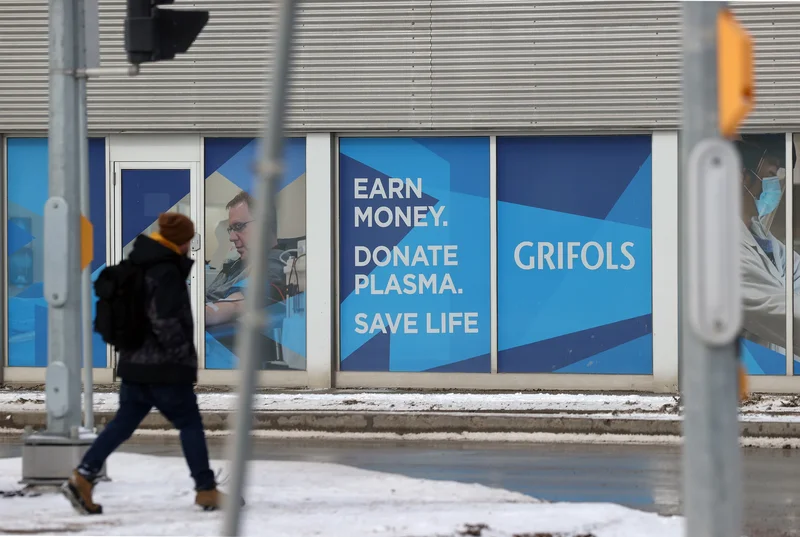
After months of growing scrutiny over the deaths of two people who donated plasma, Canada’s largest for-profit plasma collector temporarily halted collection at its centres across the country last week.
Reporting by The Globe and Mail has shed light on the recurring safety and operations issues Health Canada identified at Grifols over the past year, but questions remain about the circumstances of the deaths.
The saga has also called attention to the push to expand plasma collection in Canada as demand for plasma-based medications rises.
Here’s what we know so far about Grifols’s practices and Health Canada’s concerns.
What is Grifols?
Grifols is the only major commercial collector of blood plasma in Canada. The pharmaceutical company, based in Spain, has a factory in Montreal and runs 17 private collection sites in six provinces.
Plasma is a protein-rich fluid found in blood that is collected and processed into medicine. Grifols has operated in partnership with Canadian Blood Services since 2022, when it signed a 15-year deal to expand plasma collection to meet the growing need for plasma-based medicines such as immunoglobulins. However, unlike at CBS’s own plasma donation centres, Grifols pays its donors.
What is plasma collection and how does it work?
Plasma is collected through a process called plasmapheresis. While a donor’s blood is being drawn, a plasmapheresis machine separates the blood into red blood cells and plasma. The red blood cells, mixed with a substance such as saline or a plasma substitute, is returned to the donor’s bloodstream.
The actual plasma collection takes about one hour, according to Grifols’s website, and in total removes up to 18 per cent of your blood volume in a standard donation, according to Canadian Blood Services. Because plasma replenishes much more quickly than whole blood, plasma donors may be eligible for collection up to twice a week.
Why did Grifols pause plasma collection?
Grifols decided to temporarily halt plasma collection following months of public scrutiny and – as revealed by the Globe’s reporting – mounting pressure from Health Canada to address safety issues. The company called the choice the result of “unfounded attention.”
“The temporary pause will allow Grifols to work with Health Canada and Canadian Blood Services on the framework needed to support the continued development of a sustainable and robust plasma collection network in Canada,” the company said in its statement last week.
Grifols said it informed Health Canada of its decision on Aug. 12, the same day the federal agency issued Grifols a formal notice of non-compliance for failing to abide by blood regulations, a senior official with close knowledge of the issue told The Globe. Health Canada had sent two letters in July requesting Grifols immediately address regulatory deficiencies, according to the official, but the company did not comply.
“Canadians’ safety must always come first, and we welcome Grifols’s decision to temporarily close its plasma collection sites,” Emilie Gauduchon-Campbell, a spokesperson for Health Minister Marjorie Michel, said in a statement last week. “Health Canada will continue to work collaboratively with Grifols to ensure these concerns are addressed before any plasma collection sites can be reopened.”
Grifols maintains that donor safety and the quality of the plasma collected have “never been compromised.” The company said it is at the disposal of Health Canada and hopes to resume operations as soon as possible.
How many deaths and injuries have been reported?
Two people died after donating plasma at Grifols centres in the past year. Both deaths occurred in Winnipeg, and were not disclosed for months until The Globe and Mail and CBC reported them in March, prompting public concerns about the for-profit plasma collector.
University student Rodiyat Alabede, 22, died of a sudden cardiac issue in October, 2025. Her heart problems began about 45 minutes into a plasma donation at Grifols’s Taylor Avenue site and an ambulance rushed her to hospital, where she was pronounced dead. In April, Health Canada said it believed there was “no linkage” between Alabede’s death and the donation process, but internal documents obtained by her family have raised questions about how the agency reached that conclusion.
Another plasma donor died in January, 2026, after using a different clinic in the city on Innovation Drive. The details of that incident and the identity of the donor are not public. Another person died at the same clinic in 2018, before it was owned and operated by Grifols.
Health Canada had previously said there were 25 serious injuries or deaths at commercial collection centres now owned by Grifols since 2018, including the three deaths in Winnipeg. But this week, Grifols revised the total number of serious events to six after it said a review of past reports found that most incidents did not meet the definition of a serious adverse reaction – a hospitalization, persistent disability or incapacity, life-threatening condition or death – under Health Canada’s blood regulations.
The federal regulator has accepted the new numbers, which include five incidents in Winnipeg and one in Saskatoon. One of those appears to correspond with a lawsuit by a Manitoba man who alleges he suffered an acute kidney injury as a result of donating at the Taylor Avenue location – the same site where Alabede died – in 2023. Grifols said in a statement of defence that donors are made aware of risks of the procedure, and the case has not yet been decided in court.
Who investigated and what did they find?
Questions remain about the deaths of Alabede and the unnamed second donor who died.
Grifols, Health Canada and Manitoba’s Office of the Chief Medical Examiner have each completed investigations into Alabede’s death, but her family has urged the provincial and federal governments to re-open the probes because of discrepancies in the reports. MPs on the House of Common’s public health committee also requested documents from Health Canada in relation to the deaths. Members of the committee also questioned Grifols’s vice-president of sales in Canada, Mary Hughes, in March when she testified as part of the committee’s larger study on pharmaceutical sovereignty, an appearance that had been scheduled before the news of the deaths broke.
Grifols’s internal investigation of Alabede’s death concluded that “all procedures were followed appropriately, that equipment was functioning properly and that supplies used were suitable for use,” according to documents obtained by Alabede’s family and subsequently shared with The Globe.
That isn’t consistent with an earlier report by Health Canada inspectors in December that found deficiencies at the Winnipeg collection site, such as staff not terminating Alabede’s donation after the plasmapheresis machine displayed multiple alerts related to blood pressure and blood flow. One of those alerts should have resulted in her donation being terminated, according to the machine’s instructions.
However, in a medical summary sent to MPs, Health Canada said equipment function, staff training and emergency response “were all found to be compliant” with applicable standard operating procedures, contradicting the letters prepared by Health Canada’s own inspectors. The agency said in July it did not consult the inspectors’ work when writing the summary.
Manitoba’s Chief Medical Examiner initially said an autopsy revealed Alabede had an enlarged heart but said nothing about whether her death was connected to the plasma donation. However, in an amended report in May, the Chief Medical Examiner said Alabede’s body showed no signs that would have indicated she had experienced either or both of two common possible reactions to plasma donation. “While a complication from plasma donation cannot entirely be excluded from contributing to death, in this case it is unlikely,” the updated report said.
What safety concerns has Health Canada raised?
Over the past year, Health Canada inspections identified several recurring safety and operations concerns at multiple Grifols sites, including the one Alabede visited. As a result, the agency imposed limitations on the company’s license in April 2026.
The concerns, details of which were first revealed by The Globe this spring, include an inadequate ratio of staff to patients, insufficient training and lack of oversight. In some cases, Grifols staff didn’t properly respond to alarms on donation machines and some donors were deemed eligible to donate despite carrying disease risk.
In July, Grifols told The Globe the deficiencies noted by Health Canada inspectors did not meet the company’s standards and it was taking corrective action.
Is plasma donation still available in Canada?
Yes, Canadian Blood Services is still accepting plasma donations, as is Héma-Québec. CBS and Héma-Québec do not pay for plasma.
With reports from Chris Hannay and Alanna Smith