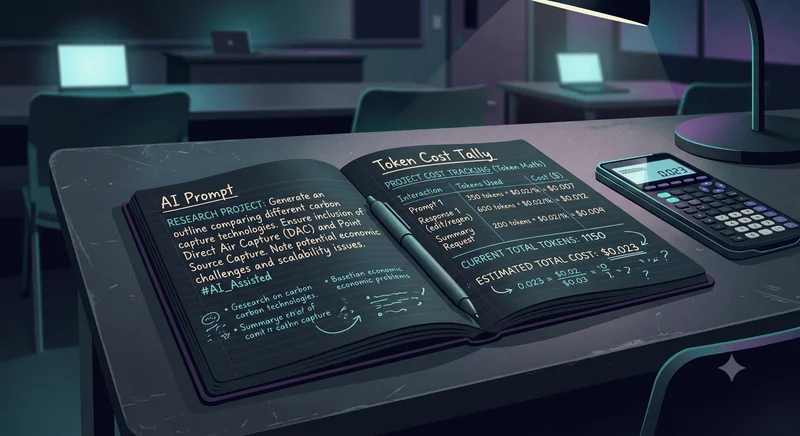
I have a contrarian bet that drives my research and my writing. Token economics, cost per inference, and carbon footprint will determine which AI programs survive past 2027. Boring infrastructure math, not model capability, will sort the winners from the failures.
If that bet is right, we are teaching the next generation of builders the wrong half of the skill. Every AI curriculum I see teaches prompting. Almost none teaches what a prompt costs. A student can graduate able to coax a clever answer out of a model and unable to tell you whether that answer cost a hundredth of a cent or a dollar.
That gap matters because the economics are about to bite. LLM inference prices fell roughly 80% between early 2025 and early 2026, driven by model efficiency gains and provider competition [1][2]. That sounds like the problem is solving itself. It is doing the opposite. Cheap inference means students build habits of spending tokens carelessly, and those habits hit a wall the moment they ship something real at scale or when pricing pressure eases.
I write this as someone whose day job is enterprise CPQ, where every transaction has a cost and someone watches it. I also mentor students and peer-review research. The two worlds tell me the same thing. Cost literacy is a foundational skill, and we are skipping it.
The stakes are not abstract. A 2025 MIT NANDA study of 300 enterprise AI deployments found that despite $30 to $40 billion in enterprise generative AI spending, 95% of pilots delivered no measurable P&L impact [3][4]. The report does not attribute the issue to model quality. It points to systems that never learned the actual workflow and were never measured against their running costs. Students who never learn to measure cost are being trained into the same blind spot.
What token-budget literacy really means
It is the ability to estimate, measure, and reduce the cost of an AI interaction before and after you run it. Three habits:
- Estimate:before running a prompt, guess the input and output token count and the dollar cost.
- Measure:after running it, check the real token usage against the estimate.
- Reduce:find the cheapest version of the prompt or architecture that still gives an acceptable answer.
A student who does this for a semester defaults to cheap, efficient design. A student who never does it defaults to waste, and waste is invisible until the bill or the carbon number arrives.
The real numbers students should hold
Concrete prices make this teachable. As of August 2026, here is the spread, per million tokens, input and output:
- Anthropic's frontier-tier model, Claude Opus, charges $5 per input and $25 per output [5][6].
- Anthropic's mid-tier model, Claude Sonnet, runs $2 to $3 per input and $10 to $15 per output, depending on the specific release and whether introductory pricing is active [5][6].
- Google's efficient-tier model, Gemini 2.5 Flash-Lite, runs $0.10 input and $0.40 output [7].
- DeepSeek's efficient-tier model, DeepSeek V4-Flash, runs $0.14 input and $0.28 output on standard rates, with an off-peak discount of roughly 50% during low-demand hours [8].
Comparing the highest listed rate (Claude Opus) to the lowest (DeepSeek V4-Flash) yields a spread of roughly 36 times on input and 89 times on output, based on my own calculation from the cited prices above [5][6][8]. That is the lesson in one line. The same task, answered acceptably, can cost dozens of times more depending only on which model and prompt a student chooses.
Two more facts students should know, because they change behavior:
- Anthropic prices a cache hit at 10% of the standard input rate, a savings of up to 90% on repeated context [9].
- Batch processing cuts costs by 50% for both input and output when an instant response is not required, a discount offered by Anthropic and other major providers [9][10].
A student who knows these facts designs differently. They reach for the small model first, cache the repeated parts, and batch what can wait.
A one-period classroom exercise
This fits a single 50-minute class and needs nothing but a current pricing sheet and a calculator.
- Give every student the same task. Example: summarize a 2-page article and answer 3 questions about it.
- Before running anything, each student estimates the input tokens, output tokens, and dollar cost on three different models from the list above.
- Students run the task on all three.
- They record the real token counts and costs, and compare the answers for quality.
- Class discussion: which model gave the best answer per dollar? Where did the expensive model earn its price, and where did it not?
The result is consistent with the pricing data above. The frontier model rarely wins on value for a routine task. Students see it themselves, with their own numbers, and the lesson sticks because they computed it.
For a follow-up, have them re-run the cheapest model with a tighter prompt and caching enabled, and watch the cost drop again. Now they have done all three habits: estimate, measure, reduce.
Why this ties to sustainability, not just budgets
Tokens are not only dollars. They are compute, and compute is energy and carbon. A student who learns to cut tokens is learning to cut emissions, whether or not anyone frames it that way. The same efficiency gains that drove the roughly 80% decline in inference prices came from smaller, better-optimized models doing more per unit of compute [1][2], and less compute per answer means less energy per answer. I research CO2-aware inference, and the practical result holds across that work: the cheapest prompt and the lowest-carbon prompt are usually the same.
So token-budget literacy is two lessons in one. Build cheaper. Build cleaner. The habit serves both, and both will matter more every year.
What I would put on the syllabus
If I designed an AI unit for high school or early college, cost would not be an advanced topic at the end. It would be week one, next to the first prompt. The sequence I would teach:
- What a token is, and how to count one.
- How does model pricing work with the current spread?
- Estimate before you run.
- Measure after you run.
- Reduce: smaller model, tighter prompt, caching, batching.
- The carbon side: why cheaper is usually cleaner.
None of this requires expensive tools. It requires treating cost as a first-class part of the skill, the way a CPQ team treats price as part of every quote.
The builders who will matter after 2027 are the ones who design for cost from the first prompt. We can teach that now, cheaply, in one class period. The students who learn it will build systems that survive the economy. The ones who do not will keep being surprised by the bill.
Sources:
[1] Epoch AI, “LLM inference prices have fallen rapidly but unequally across tasks”
[2] CloudZero, “LLM API Pricing Comparison in 2026”
[3] MIT NANDA, “The GenAI Divide: State of AI in Business 2025” (full report PDF)
[4] Fortune, “MIT report: 95% of generative AI pilots at companies are failing”
[5] Anthropic, official Claude API pricing page
[6] PE Collective, “Anthropic API Pricing 2026: Official Token Rates for Every Claude Model”
[7] Google AI for Developers, Gemini API pricing page
[8] DeepSeek, official API pricing page
[9] Anthropic, prompt caching and Batch API documentation
[10] BenchLM, “Claude API Pricing (August 2026): Model & Token Costs”