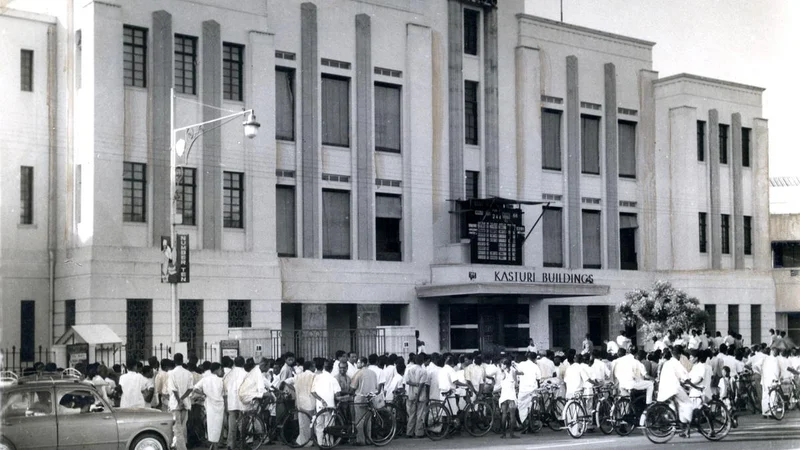
Sweeping cantilever canopies, ornate grilles catching the light, and fluted columns.
Did you know that one of Chennai’s finest examples of Art Deco heritage lies not in a theatre or an apartment block? It takes the shape of a newspaper office.
My office to be precise.
K Purnachandran, one of The Hindu’s most familiar faces in the security department, says that he distinctly remembers the emotion that swept over him on his first day at work 20 years ago. “When I walked into this cream-white office after spending 17 years in the Army, I thought that it looked stately. Like a colonial-era administrative building.”
KG Gurumurthy, who heads the pre-press department, says when he was a junior employee, the premises looked like a venerated institution — one that demanded reverence. “I still feel that way when I enter the space,” he says.
Call it deference, call it prejudice. The fact remains — Kasturi Buildings, home of The Hindu since 1939, dotting the arterial Mount Road stretch, is one of Chennai’s few commercial Art Deco heritage structures, still in active use.
An article from the newspaper’s archives dated December 7, 1939, two weeks after the newspaper shifted its base to the location from its first home down the road (since 1878), states that H Fellowes Prynne, the architect of the building intended to create a soft charm and a quiet dignity — one that would hold the eye of the visitor and delight the heart.
Its beauty, hence, lies not just in its enormity but also in its clean-cut vertical lines; extensive use of geometric patterns; ability to usher in light; and allowing for perfect symmetry. If you observe with a keen eye, and let yourself indulge in a Midnight in Paris-esque moment of transporting yourself back to the Roaring 20s, you might see much of Chennai going back to the days where new buildings were replete with columns, sunbursts, and motifs. Some prominent remnants continue to line the city’s central business district, reminding us of an architectural style that marked the beginning of a global, capitalistic innovation.
Deconstruction
Art Deco was born in Paris in 1925, celebrating modern design and concrete. Through the late 1920s and ‘30s, it swept the world.
Tahaer Zoyab, architect and co-founder of Madras Inherited, explains that the Art Deco movement celebrated the possibilities opened up by reinforced cement concrete and steel-frame construction, and drew on the era’s fascination with motorised travel — ocean liners and early aviation. “You’ll see vertical lines accentuated, plaster bands, portholes like the ones on airplanes and ships, and geometry. This was possible because cement could be cast and moulded,” he says.
In India, it landed first in Bombay (Mumbai), shaping cinemas and seafront apartments along the Marine Drive. Today, the business capital of India has the second largest collection of Art Deco buildings after Miami, USA. UNESCO added the Victorian Gothic and Art Deco Ensembles of Mumbai to the World Heritage list in 2018.
By the late 1930s, the style had travelled South, and in Madras, it found one of its most striking expressions through the stretch in George Town.
Chennai’s Art Deco heritage today is centered around Parry’s Corner, the Esplanade, and NSC Bose Road, led by the iconic Dare House (currently housing the Murugappa Group’s offices); Oriental Insurance Building on Armenian Street (designed by an Indian architect, LM Chitale); National Insurance Building, State Bank of Mysore; Bombay Mutual Building along NSC Bose Road, the United India Building; and Tamil Isai Sangam. Other prominent examples include the Royapettah and Mint Clock Towers — both standalone Art Deco landmarks, and further sparsely surviving examples like the Casino Cinema Hall, and Curzon & Co — though much of this heritage has faded amid rapid urbanisation.
Sujatha Shankar, architect and convenor, INTACH, Chennai Chapter, says that picking her favourite Art Deco building in the city is like having to pick a favourite child. “I really like the LIC Building on Esplanade. It’s got symmetry, a tall elegant entrance, soaring verticals, fins, ziggurat-like crowning feature, Aztec-like features. It’s an amazing rendering of Art Deco,” she says, adding that Dare House in Parry’s is another favourite. “This building has the curved corner where two roads (here NSC Bose Road and Rajaji Salai) now meet. It has pins and pistons on top, both fabulous elements, indicating the industrialisation of the era.”
Ashmitha Athreya, trustee, Madras Inherited, says that when people come on walks that the organisation conducts, they are often surprised by the sheer number of buildings that Chennai continues to host.
She adds that when it comes to Madras particularly, it is not the European version of Art Deco but rather the North American version called Streamline Moderne that is extensively used. She adds that Art Deco can be found in several houses across Chennai although these are disappearing too.
However, people find several ways to customise the Art Deco buildings to suit Indian sensibilities. “I have seen a house in Mylapore where there is a central bust of Mahatma Gandhi on the facade. It is because the style flourished during India’s freedom struggle. This is just one such example,” she says.
Bespoke
Kapil Chitale, grandson of LM Chitale and proprietor, Chitale and Sons, one of Chennai’s oldest architecture firms, says that when his grandfather built the Tamil Isai Mandram on Esplanade, he found ways to integrate a most wonderful temple-sensibility at the site.
“The hall was constructed to celebrate Tamil music. It was a movement to challenge the Sanskrit and Telugu music performed at many other sabhas like the Music Academy. It is why the motifs and the embellishments on the pillars would be distinctly Tamil in nature,” says Sujatha.
Thirupurasundari Sevvel, architect, and historian, says that one can find such examples back at The Hindu office too. “If we really think about it, Kasturi Buildings is an Indo-deco structure. Several customisations have taken place, keeping with the style of the original building. It is why the grandeur of the structure remains. Inside The Hindu office, you will find mixed floors, polished stairways, and hallways that carry its own colour and mood. A mint green, pink, and a gold, each suited for a different floor,” she says.
After spending a day hunting for Art Deco elements on The Hindu office’s premises and pouring through the archives at Chitale and Sons, a couple of conclusions clearly emerge. Bold black glass piers banded in cream, grilles catching the light, a sweeping cantilever canopy jutting out to greet visitors, geometric iron work too, clean confident lines — it is the same grammar that you will spot across Chennai’s Art Deco buildings even today. The style that eventually gave way to the international style or modernism, continues to delight.
Even today, behind the ornamental front, lie halls full of journalists, bankers, agents, and employees, spending hours, hoping to provide meaning to their big little lives.
The truth is that Art Deco was never just about decoration. It was about function and and how a city tells its stories.
Peer into the past
The Hindu’s headquarters on Anna Salai to revel in its Art Deco heritage, and to check out Madras On Stage, an archival photo exhibition drawn from
The Hindu‘s vast archives till September 10. The exhibition traces Chennai’s cultural life through performances, conversations, festivals, and everyday gatherings.
Entry is free. To register, log onto madeofchennai.thehindu.com
Published - August 21, 2026 04:00 pm IST