U.S. deporting thousands of Mexican migrants to other Central American countries
Mexico expresses opposition, with deportations to Guatemala, Honduras increasing since April
The United States has deported nearly 2,300 Mexicans to Guatemala this year and sent at least dozens more to Honduras, according to official data, a shift from the beginning of U.S. President Donald Trump's second term when such transfers were minimal.
Until recently, only a handful of Mexicans had been expelled from the U.S. to countries other than Mexico, as it had adhered to the principle of non-refoulement in both domestic immigration law and through international treaties. That refers to an obligation not to return migrants to countries of origin or third-party countries where their human rights, or even their lives or freedom, could be threatened for reasons of race, religion or nationality.
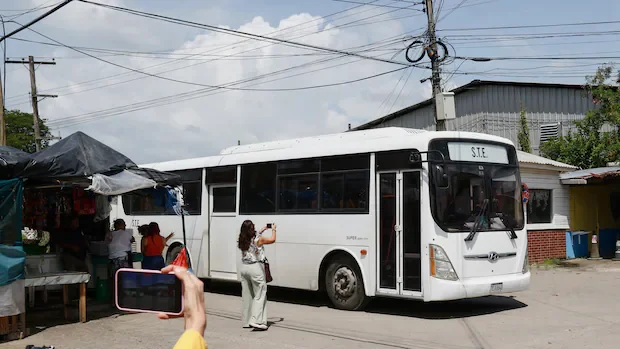
Mexico's National Migration Institute (INM) confirmed to The Associated Press in a brief message that Mexicans have been deported by the Trump administration to Guatemala and Honduras, primarily since April, and are then transported by bus to southern Mexico.
"The Mexican government has expressed its opposition to this practice to U.S. authorities and has reiterated that every Mexican citizen has the right to enter the country," the Mexican Foreign Ministry said in a statement on Thursday.
The flow of migrants through Mexico and across the southern U.S. border has frequently led to friction between the countries. In the second Trump administration, Mexican President Claudia Sheinbaum's government has also protested the deaths of 17 Mexicans in U.S. immigration custody or during enforcement operations.
Asked about why the Mexicans were sent to Central America and not their own country, the U.S. Department of Homeland Security, which oversees immigration enforcement, said in an emailed statement that the administration "is utilizing all lawful options to carry out the largest deportation operation in history, just as President Trump promised."
LISTEN | The Atlantic's Michael Scherer on Stephen Miller's impact on deportations:## U.S. accused of exploiting loophole
Guatemalan President Bernardo Arévalo confirmed Wednesday night that, so far this year, 2,284 Mexicans deported from the U.S. have arrived in the country as part of a "transit stopover" before being taken to Mexico as part of an "arrangement" with the Mexican government, and without these individuals being under any refugee or asylum status.
"They are arriving on planes carrying Guatemalan returnees, and what we have done is bring them in transit so that, in co-ordination with Mexican immigration authorities, we can return them to Mexican territory within 24 hours of their arrival in the country," he said at a press conference.
Authorities in Honduras also did not respond to requests for comment, but according to official documents from the country accessed by The Associated Press, 82 Mexicans deported from the United States arrived in the Honduran city of San Pedro Sula on two flights on Aug. 13 and 15. An additional 35 arrived on Thursday.
Another 165 Mexicans were deported to Honduras between May and mid-July, according to the website Third Country Deportation Watch, run by the NGOs Human Rights First and Refugees International, which track U.S. deportation flights to third countries.
WATCH | Trump's transformation of ICE:Immigration lawyers believe that the Trump administration is using deportations to third countries as a legal loophole to indirectly force asylum seekers to return to Mexico when the government cannot send them there because it would violate court orders from immigration judges that recognize the dangers.
The deportation tactic "seems to be to put pressure on the Mexican government," said Savitri Arvey of Human Rights First. "They really don't want any Mexicans crossing the border."
At the beginning of his second term, with immigration control as one of his priorities, Trump reached agreements with Mexico, Guatemala, El Salvador, Honduras, Costa Rica and Panama to act as "bridge" or destination countries for migrants from third countries expelled from U.S. territory. These agreements gradually expanded to more countries, including some African ones, most recently Liberia.
The U.S. on Thursday carried out its first deportation under an agreement for Liberia to accept up to 1,200 people who are not from that country. The 20 deportees arrived at Roberts International Airport outside Monrovia.
- Liberia to begin accepting up to 1,200 deportees from the U.S.
- Canada urged to welcome Haitians fleeing U.S. deportations as Trump ends protected status
Deportees will include African nationals as well as nationals from North America, South America and the Caribbean, according to Liberian Information Minister Jerolinmek Piah. Liberian Justice Minister Natu Oswald Tweh has said they could seek asylum in the West African country if they wished.
The U.S. State Department said it was "unwavering in our commitment to end illegal and mass immigration and bolster America's border security."
With files from CBC News