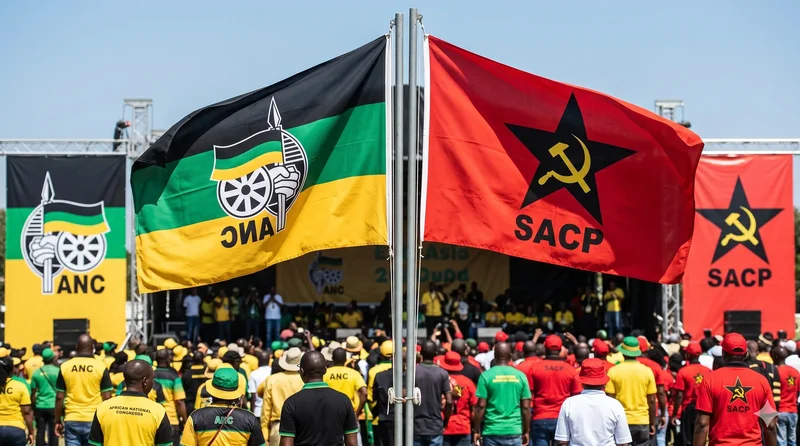
Despite SACP-ANC relations having shown further signs of deterioration this week, an expert has pooh-poohed the development as “nothing new”. The latest political spectre is unsettling the Tripartite Alliance just three months before the country’s local government elections.
Addressing the three-day Police and Prisons Civil Rights Union (Popcru) central executive committee (CEC) meeting, which is ending in Boksburg on Saturday, SACP general secretary Solly Mapaila was scathing in his unhappiness with the austerity measures, the composition of the government of national unity, the influence of capital in government, the soaring unemployment rate and the impact of the ANC subscribing to neo-liberal economic policies.
The governing party has reversed the gains of liberation from apartheid, says Mapaila, supported by labour federation Cosatu president Zingiswa Lose and Popcru leader Thulani Ngwenya. The comment comes amid the odds stacked against the ANC in the run-up to the November polls because of poor governance, service delivery and rampant corruption.
Commenting on the resurgence of tension in the alliance, political economist Dale McKinley likened the SACP-ANC scenario to a “a merry-go-round”.
“We have witnessed the same thing over again, having lost count in the past 15 years of how many times the SACP has criticised the ANC.
“Despite the SACP having said the alliance was not working, threatening to break ties, nothing tangible has happened,” maintained McKinley.
“In the past two years, the SACP has said it would contest the local government elections separately and that has now gone quiet. The SACP refuses to leave the ANC – always wanting to have its cake and eat it too. The key reason is because the ANC is the SACP’s economic survival.”
To appear politically relevant, McKinley said, the SACP “has to try to appear to be ideologically consistent with its own rhetorical critique of the system and the ANC”.
“I see the latest SACP-ANC open spat emerging from the Popcru gathering as the latest version of the continuation of what we have heard before, with different degrees of intensity.
“We have, for the past 20 years, been asking whether this could be the end of the alliance.
“As long as there is another SACP critique and slanging match, it does not mean much until the party makes an official announcement of leaving the alliance.
“This whole matter deflects people’s focus from the reality, which is that the SACP is not willing to become independent – to represent itself and break ties with the ANC.”
On what to expect in the ANC polls performance, McKinley predicted that the party was set to take “another big black eye in the metros”.
“The ANC will still be the largest party in many rural areas of Limpopo, North West, the Eastern Cape and Mpumalanga but in the Western Cape, KZN and Gauteng, the ANC is probably going to lose ground – likely to forge coalitions in the metros. People are simply angry and it is not as if there is an alternative. In KZN and Gauteng, the ANC is going to take a bigger blow,” McKinley said.
Amid thunderous applause from Pocru delegates, Mapaila said the national democratic revolution (NDR) has achieved “nominal political liberation”.
“Despite the achievement of this nominal political liberation, the principal contradiction remains that of capital and working class,” said Mapaila.
The state, he said, “has been captured by capitalist forces”.
“No one in the ANC can say this is not true. No one in the alliance can say this is not true, unless they are just naive. The state has become a front for capital – something we must sort out.”
Mapaila said the principal danger facing the NDR was “the consolidation of neoliberal bloc and the reactionary capitalist class”.
“This reactionary capitalist class and this neoliberal capitalist bloc inside the movement are now seeking to co-opt the trade union movement. We say: ‘Be cautious.’
“The NDR itself has been attacked by a low-intensity counter-revolution, which has exposed itself over the past three years. Unless the movement sits down to deal with these questions, we are going nowhere.”
He said the SACP was “entering the elections question” because “the working class, which needs its own representation, has lost its voice in government”.
The SACP was entering the local government polls to “rescue the working class from a crisis of representation — from a crisis of collapsing municipalities”.
There was no longer respect among leaders in the Tripartite Alliance.
“I'm not even able to meet with the ANC president on a one-on-one basis. The Alliance Summit has not taken place for a long time and things should not even reach this level. The alliance serves to give guidance on the political direction that our movement should be taking. But the movement is now taking us into deeper trouble – producing policy documents without consultation,” he said.
Delivering a message of support to the Popcru CEC on behalf of ANC secretary-general Fikile Mbalula, party national executive committee (NEC) member Cassel Mathale, conceded that there was instability in the alliance.
Mathale said: “I will not stand on this platform and pretend that our alliance is passing through an easy moment because this movement has never survived 114 years by believing in falsehoods.
“Cosatu’s own central committee has called for the unity of the alliance, as it went through real tension. We all know that the SACP — our oldest ally and a fraternal organisation this movement continues to respect — has taken the decision to contest the coming local government elections under its own banner, rather than the ANC's banner.
“Comrades who share a common enemy in poverty, joblessness and the special inequality that still confines our people to township, cannot afford to let a single tactical disagreement become a permanent rupture. But respect for a partner's independent decision is not the same thing as indifference.”
Referring to the upcoming polls, Mathale said the ANC believed the organised working class was “not strongest not when it scatters its vote in a search of ideological purity”.
“It is only strongest when it concentrates its power behind the movement with the national reach and historic legitimacy – despite being constrained by the GNU. We have demonstrated capacity to turn workers' demands into laws, budgets and delivered services.
“We remain steadfast in our commitment to this alliance that has withstood the test of time. “We believe the best way to build that unity is not for the working class to divide its vote between fraternal organisations but voting to advance the national democratic revolution and use state power to make a better life for all a lived reality for our people,” he said.