Five years after the fall of Kabul, 'war on terror' ghosts have come home
Five years ago, the world watched in stunned disbelief as the final American military aircraft left Kabul, bringing a chaotic and humiliating end to a 20-year occupation.
The images of desperate people clinging to the fuselages of US military transport planes departing the Afghan capital mirrored the panic of Saigon in 1975, cementing a visual legacy of imperial overreach.
Western media outlets trained their lenses almost exclusively on the runway of Hamid Karzai International Airport, hyper-focusing on the frenzy to manufacture a narrative of total, apocalyptic collapse.
Yet step outside the airport gates, and the reality on the streets of Kabul told a completely different story. The capital did not fall to the sounds of heavy artillery or bloody urban warfare. Instead, the transition of power to the Islamic Emirate was remarkably orderly and peaceful.
For me, this quiet transition was the ultimate historical bookend. When I was forced to leave Afghanistan with my family in 2001, we fled a country shaking under the terrifying weight of western military might - shattered by Tomahawk cruise missiles, pounded by B-52 bombers, and rattled by the catastrophic shockwaves of 15,000-pound “daisy cutter” bombs.
To see the city return to those who had been targeted by the world’s most sophisticated weaponry - not through a bloody siege, but with a calm that defied decades of western propaganda - was a profound testament to the limits of raw military subjugation.
For the West, it was a strategic failure of historic proportions. But for those of us who have witnessed the reality of the global “war on terror” from the inside, this outcome was a predictable end. The Afghan resistance did what it has always done: outlasted an invading superpower.
Historical humiliations
This latest defeat was entirely avoidable, had western powers bothered to read their own history books.
This was not the first time a global empire was broken in the Hindu Kush. Britain launched three disastrous wars in Afghanistan between 1839 and 1919. Much blood was spilled to protect the commercial interests of the East India Company - arguably the largest state-backed drug cartel in human history, which reaped fortunes from the forced opium trade.
Each of those incursions ended in British retreat, slaughter and geopolitical humiliation - yet no historical lessons were learned. Generation after generation, western architects of war remain blinded by their own arrogance, believing they can subjugate a people whose very identity is forged in resistance to foreign rule.
Even the modern military elites cannot hide behind their usual corporate euphemisms. While some top brass try to spin the narrative by claiming they were “never defeated on the battlefield”, Britain’s own House of Commons defence committee and former senior commanders, such as General Sir Richard Barrons, have been forced to admit the blunt reality: the Taliban won, the West suffered a total strategic failure, and the entire 20-year project ended in definitive defeat.
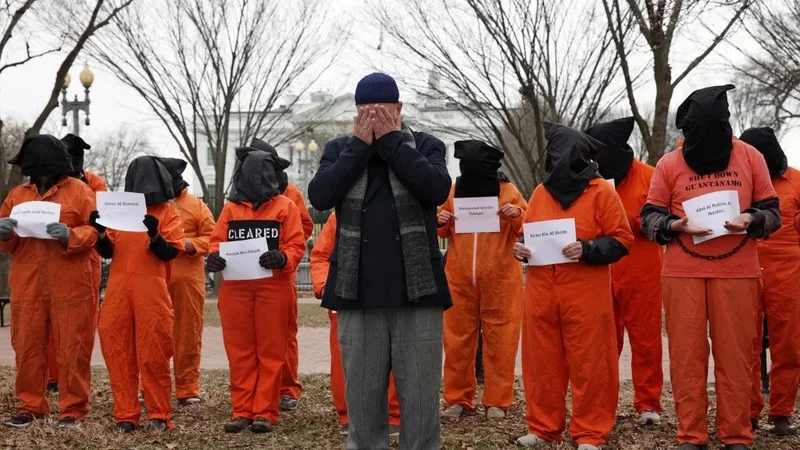
Today, those who once wore the orange jumpsuits of American cages are the ones shaping the destiny of their nation
The supreme irony of the modern western narrative is its short memory regarding the concept of resistance. Today, the West demonises terms like jihad and mujahideen, twisting them into synonyms for global terror. Yet it was the massive, shattering sacrifices of the Afghan mujahideen that brought about the collapse of the Soviet Union.
Throughout the 1980s, these fighters took on the West’s ultimate Cold War adversary, enduring unimaginable brutality to break the Red Army. At the time, western leaders hailed them as freedom fighters.
Once their sacrifice served western geopolitical goals, however, the narrative shifted. The very concept of righteous struggle was criminalised to justify the post-9/11 invasion.
The subsequent occupation ran entirely on a cycle of exploitation and abandonment that continues to this day. Western commentators hyper-focus on the thousands of asylum claims submitted by Afghans who once fought alongside British forces under the Afghan Relocations and Assistance Policy, weaponising their exodus to paint a picture of ongoing peril.
But this narrative ignores that the Islamic Emirate declared a general amnesty from day one, consciously steering the country away from the mass retributive bloodbaths predicted by western intelligence. It also masks a deep economic truth: the desperation to leave is fuelled primarily by the devastating, artificial poverty manufactured by western economic blockades.
Grim reminder
Even as thousands try to exit this starvation economy, they face the ultimate indignity from their former masters. The British defence ministry has routinely discarded its former local proxies, issuing bulk, bureaucratic rejections to thousands of elite Afghan commandos who bled for the British Crown.
To compound this betrayal, those few who do manage to reach western shores are met with a wave of visceral, far-right, anti-migrant hatred. The bitter irony of men who fought for western militaries now being vilified on the streets of Britain - where xenophobic mobs have gathered outside their places of asylum to literally burn them out - should serve as a stark cautionary tale for all.
It is a grim reminder that in the eyes of the empire and its internal security state, native collaborators are entirely disposable - first used as cannon fodder abroad, and then left to the mercy of violent fascists at home, once their utility expires.
My relationship with Afghanistan is deeply personal. I lived in Kabul with my family before the 2001 invasion, working to build schools and water pumps for a society already ravaged by conflict. When the bombs began to fall, my life was upended.
I was later abducted in Pakistan, hooded, shackled, and delivered into the hands of the US military. I spent a brutal year at the Bagram Theatre Internment Facility - a Soviet-built warehouse converted into a laboratory of torture - before being transferred to Guantanamo Bay. I saw firsthand the depths to which western nations would sink under the guise of “national security”.
When I return to Kabul today, my visits are made easier by an extraordinary twist of historical irony: many senior ministers running the current Afghan government are my fellow former Guantanamo prisoners. Afghans constituted the largest national group held in Gitmo, enduring years of lawless detention.
Today, those who once wore the orange jumpsuits of American cages are the ones shaping the destiny of their nation.
The physical sites of our torment have been completely repurposed. Bagram Airfield, once the nerve centre of US military might and home to the lawless detention facilities where we were brutalised, now stands as a monument to foreign defeat. Its dark cells have been flung open, and the prisoners are long free.
Every summer, the runways that once launched devastating drone strikes are now used by the government to showcase its military arsenal during celebratory parades marking the anniversary of the American withdrawal.
The fight continues
The ongoing conversation around the nation’s governance requires a willingness to speak hard truths to both sides. While I disagree with the corrosive impediment on female university education in Afghanistan - a policy that restricts the true potential of society - I know too the profound hypocrisy of the western finger-pointing that accompanies this issue.
The occupation forces, who now pose as champions of Afghan women, were perfectly happy to leave millions of women utterly destitute after tens of thousands of their men were slaughtered or disappeared into cages at facilities like Bagram.
To weep for a woman’s right to a degree, while systematically wiping out or locking away her family, and then starving her children through economic sanctions, is the ultimate manifestation of imperial gaslighting.
During one of my many recent visits to Kabul earlier this year, my focus remained steadfast on uncovering the truth and demanding justice for those the “war on terror” left behind. I have been deeply involved in investigating the ongoing, tragic case of Aafia Siddiqui, while simultaneously working towards the release of the remaining prisoners still languishing in Guantanamo, including Muhammad Rahim and Nashwan al-Tamir.
The fight to close that illegal offshore prison camp and secure freedom for its final victims is far from over.
The geographical reach of this post-occupation reality hit me with staggering clarity on a recent trip. On the very morning I left Kabul, I found myself in Damascus by the afternoon. There, in Syria, I walked through another country recently liberated by those who had once occupied US torture cells in Iraq.
The parallels are impossible to ignore; from Bagram to Camp Bucca, the brutal carceral laboratories of western powers inadvertently forged the leaderships that would ultimately dismantle their imperial presence.
While in Syria, I visited Sednaya prison and the infamous Palestine Branch. These were the very places where CIA agents in Bagram had threatened to send me years ago if I refused to cooperate with them.
Yet, having lost these wars militarily, the US and its allies continue to wage economic warfare. By freezing billions of dollars of Afghan central bank assets and imposing sweeping sanctions, the West has collectively punished millions of ordinary citizens, forcing them into artificial poverty and starvation. It is the height of hypocrisy to lecture these nations on human rights, while actively engineering economic catastrophes that deprive children of food and medicine.
The fifth anniversary of the western withdrawal from Afghanistan should not be a moment for distant geopolitical analysis; it must be a moment for accountability. True justice requires the West to look into the mirror, acknowledge the generational trauma it inflicted, end its punitive sanctions, and allow these liberated nations the space to breathe, rebuild and determine their own destinies.
The views expressed in this article belong to the author and do not necessarily reflect the editorial policy of Middle East Eye.