Community Control Of Kauaʻi Fishery In Hawaii Is Showing ‘Remarkable’ Results
Community Control Of Kauaʻi Fishery In Hawaii Is Showing ‘Remarkable’ Results
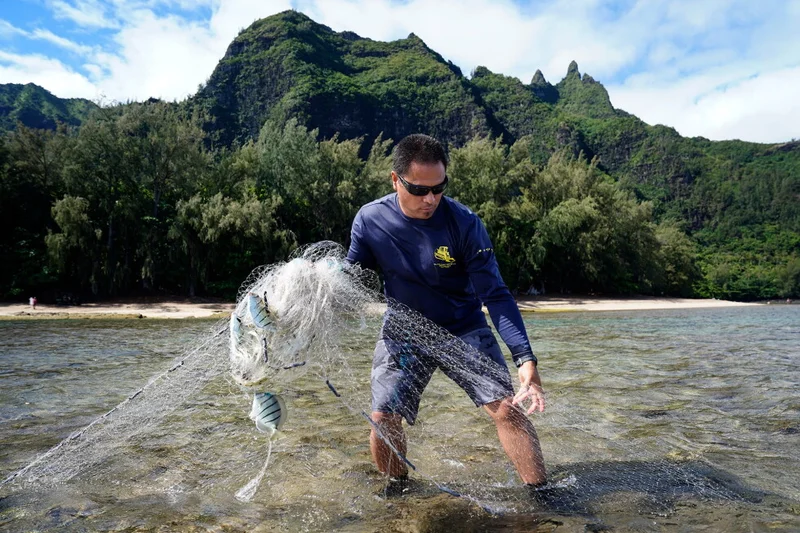
Waves gently roll over a reef in Hā‘ena as Kanoe Alapa‘i-Hashimoto and his father, Keli‘i Alapa‘i, search for limu in the ankle-deep water with fishing nets wrapped around their waists and shoulders. The seaweed is food for manini, a small light-greenish yellow fish with black stripes.
Alapa‘i-Hashimoto looks to his left where the water ripples, a sign of the fish grazing on the reef’s edge. He spends the next 15 minutes treading lightly, mindful that his shadow and footsteps won’t scare the fish, before throwing his net, which spirals out and sinks.
When he pulls it up, it reveals that he caught a dozen manini – enough to feed his family.
Alapa‘i-Hashimoto and Alapa‘i are lawai‘a, or subsistence fishermen, who practice as their kūpuna taught them. That means taking only what they need, using traditional techniques such as throwing net, and being mindful of how their activities impact the nearshore ecosystem. The ocean has been their family’s icebox for generations.
“You take care of the ocean like you will take care of your little child,” Alapa‘i said.
Eleven years ago, they and other community members got Hā’ena’s waters from the shoreline to 1 mile offshore designated as a Community-Based Subsistence Fishing Area to protect the resource for future generations and return to traditional resource management.
“I’ve seen quite a bit of fish that’s come back — you know, moi, mullet, we get palani, kala, akule — those are really the main fish that we grew up on,” Alapa‘i said. “But as far as population wise, since the CBSFA took effect, it’s amazing.”
Data that scientists have been gathering over the past decade preliminarily show that fish populations appear to be healthier and more diverse.
CBSFAs are one of several marine management tools in the state but are unique in that they’re designed to protect and perpetuate Native Hawaiian fishing practices and values. Getting the first CBSFA established meant overcoming opposition from commercial fishermen who argued that the designation’s rules compromised their livelihoods and, more recently, a legislative attempt to restrict its lifespan.
Now, many other communities around the state are hoping to follow Hā’ena’s model.
Level The Playing Field
Located in the northern moku, or district, of Halele‘a, Hā‘ena is home to towering cliffs, verdant valleys and reefs that stretch across almost the entire length of the ahupua‘a, or land division from the uplands to the sea. He‘e (octopus), nenue (chub fish), kala (unicorn fish), manini (convict tang) and many other species reside in the nearshore waters.
Those nearshore waters comprise the state’s first permanent CBSFA, a marine area that’s co-managed by the local community and the state Department of Land and Natural Resource’s Division of Aquatic Resources.
Communities were granted the ability to pursue this designation under a 2005 law after Mo‘omomi on Moloka‘i piloted it in the 1990s. In addition to Hā‘ena, Miloli‘i on Hawai‘i island and Kīpāhulu on Maui also have CBSFAs.
Anyone can fish in Hā’ena so long as they follow the CBSFA’s rules, which were informed by how the community’s kūpuna, or ancestors, fished. Don’t use spear guns, don’t sell the fish or marine life you take from the area, don’t go night diving when the fish are asleep, and abide by bag limits for certain species, among other rules.
Using three-prong spears, instead of spear guns that can pierce fish from feet away, helps “level the playing field more, right? The fish have a better chance of escaping,” said Chipper Wichman, a lineal descendent and founding member of Hui Maka‘āina o Makana.
The nonprofit spent 10 years leading the community’s push for the CBSFA, holding over 60 community meetings and going through more than 10 rounds of rule revisions and agency review. Today, the group manages the area with the support of the state.
Another rule is specific to octopus, which make its homes on the reef by fortifying natural crevices with discarded shells or rocks. Spears would destroy the home, so fishermen can only use sticks to tease the he‘e out — preserving the home for another he‘e to occupy.
Alapa‘i, who grew up in Hā’ena and is the hui’s former vice president, said some people would also set nets in the water and leave them unattended overnight, which wasted a lot of fish. Many people, he said, want to take more fish than they can eat.
“That’s the whole idea of this – take what you need,” he said.
Early Trends In Fish Abundance
Alapa‘i-Hashimoto and Alapa‘i can tell what fish are in the water and how many just by observing the water. But as they approach the shoreline, they also take note of the ’ōhiki, or sand crabs, that leave piles of sand on the beach, what the coral looks like, and whether any limu is growing.
That’s because their kūpuna taught them that everything in the marine ecosystem is connected. Even if he doesn’t catch any fish, it’s enough to know that he’s seeing signs of a healthy ecosystem, said Alapa‘i-Hashimoto as his reef shoe-covered toes touched the water.
He represents his family on the hui’s ‘ohana council, which is made up of the families who lived in Hā‘ena prior to 1955. Between 1875 and 1955, a group called Hui Kuʻai o Hāʻena, made up of 38 Native Hawaiian families from the area, owned the entire ahupua‘a. The council sets the guiding directives and principles for the group’s board and staff.
The CBSFA is meant to bring back the abundance of fish that their kūpuna saw when they were growing up — such as larger schools of bigger-sized fish and bigger fish coming to shore more frequently.
Wichman said those large schools disappeared as people from other parts of the island caught them with large nets and boats in the 1970s and as dozens of commercial tour boats operated out of Hanalei Bay in the ’80s and ‘90s. Those boats left oily films that damaged Hā’ena’s nearshore fishery and limu on their way to the Nāpali coast, Wichman said.
“What we saw was this over-extraction from our resource and our kūpuna telling us, you know, ‘When we were growing up, when we were fishing, we never had this,’” he said.
Hā’ena received its CBSFA designation in 2015. In its first five-year review, which focused on 2016 to 2020, researchers with the Hawai‘i Institute for Marine Biology and DLNR found that the number of fish, fish species and fish biomass were consistently higher inside the CBSFA compared to outside it. The pu‘uhonua, or protected fish nursery, also saw increases in fish density and biomass.
However, the record-setting April 2018 storm negatively affected the number of fish and sea urchins and caused more coral bleaching that year.
Heather Ylitalo-Ward, Kaua‘i district biologist with DAR, said the Kaua‘i DAR team is still conducting fish surveys for the CBSFA’s second assessment, which will cover from 2016 to 2026. It hopes to publish in the late fall.
She said it’s too early to share exactly what their data has found, but her team has seen fish and coral that they don’t normally see in other parts of the island and general high fish abundance. She added that it takes at least 10 years — but more likely 30 – for trends to be detected in most marine protected areas around the world.
“The first five years were showing a positive trend, so we’re hopeful that things will continue in that way,” she said.
Some of Hā’ena’s fishermen and community members have their own anecdotes, like seeing more akule, or bigeye scad, coming into the shallow, nearshore reef instead of staying in deeper waters, and once again seeing some larger schools of fish in general, rather than just a few here and there.
Wichman said he’ll snorkel at Makua, commonly known as Tunnels, and see lots of fish coming out of the pu‘uhonua on the inside of the reef.
“The abundance on the outside of that reef is remarkable,” he said. “It’s really working.”
‘There’s A Heavy Kuleana’
Many eyes are on the Hā’ena community because it’s the first CBSFA.
“When you’re the first, there’s a heavy kuleana that rests on your shoulders, because if you don’t succeed, you’ve just slammed the door shut for everybody who wants to follow,” Wichman said.
But being the first also comes with its own set of difficulties, such as figuring out monitoring and enforcement and managing the resource in a truly adaptive way.
The hui’s community monitoring has gone through different iterations as they learn what works best for their people and resources. Emily Cadiz, the group’s education specialist and community liaison, said it’s hard for the community to sustain monitoring efforts alone, so partnerships, such as the one the hui has with DAR to do fish surveys, are essential.
Some monitoring is also done by the hui’s Makai Watch coordinator, who is working on training up volunteers. Makai Watch is a program under DLNR that helps state officials keep tabs on unlawful fishing on the coasts.
They’ll document the number of people within the CBSFA and the activities they do, whether it’s snorkeling, foil boarding or laying on the beach. They’ll also catalogue the marine resources they see, like fish, limu and monk seals, and help educate visitors and community members about the CBSFA.
That monitoring can eventually help inform conversations about whether any of the CBSFA’s rules need to change. Billy Kinney, a lineal descendent and assistant director for the hui, said the goal is for the CBSFA area to be adaptively managed — like instituting rest periods on ’ōpihi or other resources based on the trends they’re seeing.
The hui would need to go through the same, extensive process it went through to establish the CBSFA’s rules to make any changes. That process requires public hearings and reviews by the state Department of the Attorney General, governor and mayor.
“It was set up to be adaptive, but the system is still not adaptive,” Cadiz said.
Being on the North Shore, Hā’ena’s waters get rougher in the winter, which helps enforce the CBSFA. But the calmer waves in the summer sometimes invite unwanted behavior.
No individuals or vessels are allowed to enter the pu‘uhonua without a permit, and boats with prohibited fishing gear must stay 1,000 feet to 2,300 feet offshore, outside the vessel transit boundary. But some recreational boats still come too close, and people sometimes swim into the pu‘uhonua.
Christopher Gandeza, assistant chief for the Kauaʻi district of Division of Conservation and Resource Enforcement — or DOCARE — said in an email that officers must catch boaters in restricted areas. Sometimes, they’ll respond to a call, but the boaters will have left by the time they arrive. Officers can investigate, but only if they have leads, like the vessel registration number.
Wichman said the hui has talked with commercial boaters who, in the past, drove through an area in the CBSFA where akule like to gather. The boaters were happy to avoid the akule when the hui asked.
But it’s been harder to educate recreational boaters who may only spend a day in Hā‘ena in the summer. The hui has been talking with DAR about putting up buoys around the pu‘uhonua with signs to tell boaters and people it’s a protected area.
“That’s a tough one because you can’t expect recreational boaters to really understand that and know about that,” he said.
Gandeza added that the community’s involvement in educating ocean users about the CBSFA’s rules has meant fewer violations.
“The need for DOCARE enforcement has been reduced because now they have community education and people know that the Hā’ena community is watching them,” he said.
Opening The Door
The fact that Hā‘ena’s CBSFA has persisted has opened the door for other communities interested in the designation or other forms of community-based management, Wichman said. The hui also manages Hā’ena State Park with another nonprofit and the Division of State Parks.
Hui members say over a dozen other fishing communities around the state are considering pursuing CBSFAs. One effort aims to designate East Maui’s Ko‘olau, Hāna, Kīpahulu and Kaupō moku, or land divisions, as a single CBSFA.
DLNR manages Hawai‘i’s 1.3 million acres of public lands, beaches and coastal waters and 750 miles of coastline with roughly 1.6% of the state operating budget.
Wichman said the CBSFA movement is also bolstered by the recent passage of a law that enables the Board of Land and Natural Resources to enter into co-management agreements of up to 65 years with community-based organizations.
“It’ll give it new leverage and give communities more of an equal say in terms of how their resources are managed,” he said.
Kinney sits in the shade by the hui’s lo‘i just minutes from Kē‘ē Beach. Coming from a fishing family and a fisherman himself, he said the CBSFA shows how important it is for Hawai‘i to have communities co-manage the resources they’ve relied on and have stewarded for generations.
For Hā’ena specifically, the CBSFA has been a mechanism to ensure that the area’s families continue to have fish on their tables, but it’s also had the benefit of educating people — both from in and outside the region — about traditional practices.
“If you’re providing food for the tables of families, if you’re changing and making fishermen and the general public more aware of traditional resource management practices specific to place,” he said, “you hit two of the biggest objectives of a CBSFA.”
Civil Beat’s reporting on Kauaʻi is supported in part by a grant from the G. N. Wilcox Trust.Civil Beat’s coverage of climate change and the environment is supported by The Healy Foundation, the Marisla Fund of the Hawai‘i Community Foundation and the Frost Family Foundation.“ Hawai‘i Grown ” is funded in part by grants from the Stupski Foundation, Ulupono Fund at the Hawai‘i Community Foundation and the Frost Family Foundation.
This story was originally published by Honolulu Civil Beat and distributed through a partnership with The Associated Press.