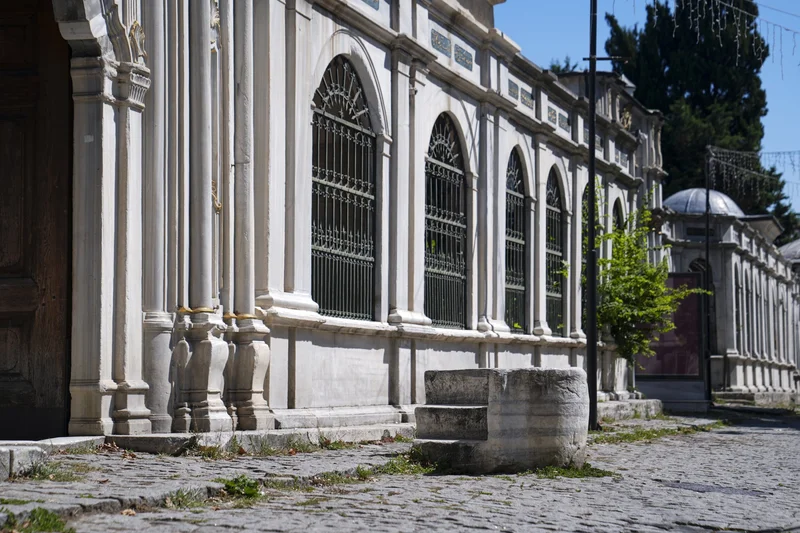
Small stone structures once used to help people mount horses are quietly preserving traces of Istanbul’s Ottoman-era transportation culture, although many have disappeared as the city modernized.
Known as “binek taşları” (mounting stones), the structures were generally positioned at roughly the same height as a horse’s stirrups, allowing riders to mount and dismount more easily. They were used along routes frequented by sultans, members of the imperial family and state officials, as well as outside the homes of prominent figures.
Their presence reflected the importance of horses in Ottoman society, where the animals were associated not only with transportation but also with power, prestige and social status.
Notable surviving examples can be found at several historic sites across Istanbul, including Aya Irini, Babüsselam, Eyüp Sultan Mosque, Cülus Road, Fatih Mosque, Süleymaniye Mosque and Üsküdar Kara Davud Pasha Mosque.
Kubilay Arpacı, a research assistant in the Department of Art History at Istanbul Medeniyet University, explained that the stones were primarily functional architectural elements designed to make it easier for people to mount horses and horse-drawn carriages.
He said they were generally constructed at the same level as a horse’s stirrups, providing riders with a practical step.
Arpacı said the spread of mounting stones was linked to both the importance of horses and the transportation needs of Ottoman cities.
“Horses were important animals for sultans, members of the dynasty and state officials. They became symbols of power, prestige and authority,” he said.
He pointed to Sultan Osman II, also known as Young Osman, who had a gravestone erected in Üsküdar for his deceased horse, “Sisli Kır,” as an example of the importance attached to horses during the period.
In Istanbul, mounting stones were often positioned along routes used by state officials to facilitate their movement through the capital, Arpacı said.
Not all mounting stones had the same design. Some were stepped structures, while others consisted of single blocks of stone or pieces of columns raised above ground level. Arpacı said stepped examples, such as the one along Cülus Road, were specifically designed to make mounting easier.
The tradition was not exclusive to Istanbul. Similar examples can also be found in other parts of Türkiye, including the central Anatolian city of Eskişehir and the western city of Izmir, he said.
Mounting stones were also associated with the homes of wealthy and prominent residents.
“These stones are mostly found in front of the homes of prominent local figures. Because horses were also a source of prestige, these stones were an indication of the wealth of local notables,” Arpacı said.
The practical role of mounting stones gradually disappeared as Istanbul underwent modernization and new forms of transportation became widespread.
The arrival and expansion of trains and trams reduced reliance on horses, while damage and urban development contributed to the disappearance of many of the stones.
“Very few mounting stones have survived to the present day. This is because they gradually lost their functionality as the city modernized, while others disappeared due to damage and various other factors,” Arpacı said.
He described the remaining examples as reflections of the functional character of Ottoman architecture and its attention to everyday needs.
“Mounting stones are a reflection of the functional character and rich detailing of Ottoman architecture,” he said.
Some have become so integrated into Istanbul’s modern urban landscape that they can easily escape notice.
The examples in front of Eyüp Sultan Mosque and Üsküdar Kara Davud Pasha Mosque are relatively easy to identify because of their distinctive forms. Others, including those at Babüsselam and the Türbeler Gate of Fatih Mosque, blend into the surrounding architecture and can be difficult to recognize.
Yet, these modest stones offer a glimpse into a time when even the simple act of mounting a horse was incorporated into the design of Istanbul’s streets and buildings, leaving behind small but tangible reminders of how Ottoman residents moved through and experienced the city.