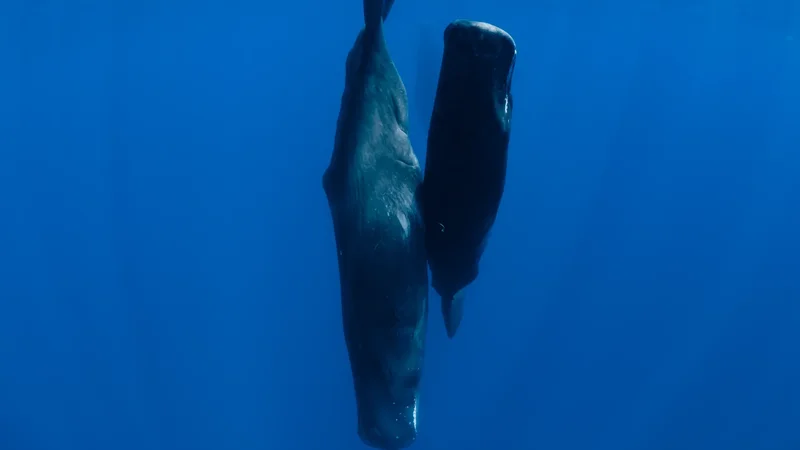
A growing body of research is revealing surprisingly human characteristics in sperm whales (Physeter macrocephalus)—they might have an alphabet and they even employ vowels like humans in their communication. Now, researchers have investigated another highly familiar behavior in this marine mammal: sleeping.
Researchers theorize that sperm whales nap for 10 to 15 minutes at a time underwater, in a vertical position with their heads pointing upwards. By sleeping this year, they are out of the reach of tumultuous surface waters, but sufficiently close to pop up when they need to take a breath. But their heads are huge and buoyant, so how do these cetaceans avoid floating up in their sleep? Researchers writing in a Journal of Experimental Biology paper suggest that the answer is blowing bubbles.
Lead author Noémie Freymond tells Popular Science that fellow co-author Patrick Miller, “provided the first detailed description of sperm whale resting behavior. He observed that sperm whales release bubbles while sleeping, but it had never been demonstrated why they do so.” Freymond conducted her master’s thesis research on sperm whale resting behavior. She is now a PhD student at the University of Neuchâtel, where she studies sleep in chimpanzees. Miller is a researcher at the University of St Andrews’s School of Biology.
The team monitored 42 sperm whales in Norway’s Lofoten Islands using devices that record whale bubble sounds. They noted each whale’s depth and the body orientation, which signaled when the whales were sleeping. The devices were suctioned to the whales, and the team collected them after they detached from the whales and floated up to the surface of the water. Then it was off to the lab.
Sperm whales can rest in three various ways. They can slowly sink around 26 feet deep, tail-first. They can also dive, head first, not too far before their buoyant heads turn up again. Or they can dive deeply—more than 656 feet—and rest as they float back up.
In this context, the team discovered that whales resting closer to the surface of the water released more bubbles while sleeping. Specifically, they blew bubbles around 11 times in each nap. The sperm whales resting as they floated up from greater profundity blew bubbles just three or four times throughout their ascending nap.
Blowing bubbles allows the sperm whales to control their buoyancy, the researchers argue. The whales napping close to the surface of the water blow out some of the air in their lungs, which then prevents them from floating back up. Deep-diving naps require more oxygen, so you’d think they have to release more air to prevent buoyancy, but that’s actually not how it works. The water pressure at greater depths makes the whales less buoyant, even if they have more air in their lungs, so they don’t need to release as many bubbles to keep themselves underwater.
“We were lucky to have access to such a large dataset with many tag deployments, because the main challenge is that a deployment must last long enough to capture resting behaviour,” explains Freymond. “This allowed us to show that sperm whales release bubbles to regulate their buoyancy while resting.”
What the team still can’t definitively say is whether sperm whales blow bubbles in their sleep consciously or unconsciously. When a dolphin sleeps, half of its brain is still awake—is that how sperm whales are, too? Or are they completely asleep, like humans? Releasing air to control buoyancy necessitates an awareness of the environment, after all.
It remains to be seen what future research will burst this bubble. More importantly, scientists should not investigate whether whales blowing bubbles in their sleep counts as cetacean snoring.