I went to China in search of my Teochew lineage. What I found was much more
Inspired by her Teochew grandmother, Jariel Ann Tan traced her lineage via an Indonesian island near Singapore back to a village in southern China that her great-grandfather left forever as an 11-year-old*. *
Growing up with two working parents, I spent most days in the care of my paternal grandmother.
Her Teochew-ness became part of the texture of my childhood. It lived in the rituals of her home and in the food on her dinner table: stir-fried bittergourd with eggs, a vat of pork belly and tau kwa stewed in dark soy, a whole steamed fish washed down with a bowl of fishball soup.
It was the language my grandmother used when she called me to eat, nagged me to do my chores, or told me a story. Not once did I think to ask where it had come from.
As I got older, I began to see my grandmother differently. She was no longer just the strict, formidable woman whose thumb I had grown up under – she was a woman who had overcome immense odds to raise five children and, later, her grandchildren.
I began asking questions I never did before: What was my late grandfather like? How did my grandparents meet? What did their youth look like? Where did our family come from?
Gradually, the story of how my family came to be in Singapore unfolded in fragments, names, anecdotes, food, language and half-remembered stories shared over casual conversations.
And somewhere in those fragments was a village in China that none of us had ever seen.
IN SEARCH OF THE PLACE EVERYONE ELSE LEFT
My grandfather, Tan Kwan Lok (陈光禄), was born in what is now Indonesia to a first-generation immigrant from China, and his wife, a local Indonesian-Chinese woman. But beyond this, we didn't know much about how his father – my great-grandfather – had come to be in Indonesia in the first place.
My dad called upon a relative in Indonesia, asking if they could take a photograph of my great-grandfather's grave in Tanjung Balai Karimun, in Riau Islands province, not far to the south-west of Singapore.
The inscription had been worn down with time, but it still bore the name of the village in China where he was born.
Unable to decipher the fading characters on our own, we put the photograph through an AI tool. That pointed us towards Chao'an, in Guangdong province. From there, we were able to narrow it down to the town of Caitang and, eventually, Sha Long village.
It was our first real lead.
I started calling Teochew associations in Singapore, hoping that their records might connect us to Tan families still living in the village.
Nothing came up. Our branch of the family had never been recorded with them.
A friend of my dad's, who visits Chao'an often, put us in touch with a local driver. The driver agreed to take us into the village – but that was as much as he could promise. We didn't know whether the village was actually ours, or if anyone would recognise the names we carried with us
It was enough for my parents and me. We booked the flights, packed our bags and hoped for the best.
The first thing I noticed about Caitang, Chao'an was the heat. It was July, the peak of summer. Even at 9am, it was sweltering.
Our car turned into a narrow alleyway, and the driver remarked that just a few years ago he would have had space to park his car. Now, the villagers drove electric cars instead of scooters, with the bigger vehicles taking up all available space.
We eventually stopped beside a grey stone courtyard. Across from us sat a pond, framed by dense greenery, and beyond it, rows of old houses.
We had arrived, but where? Was this really our ancestral village?
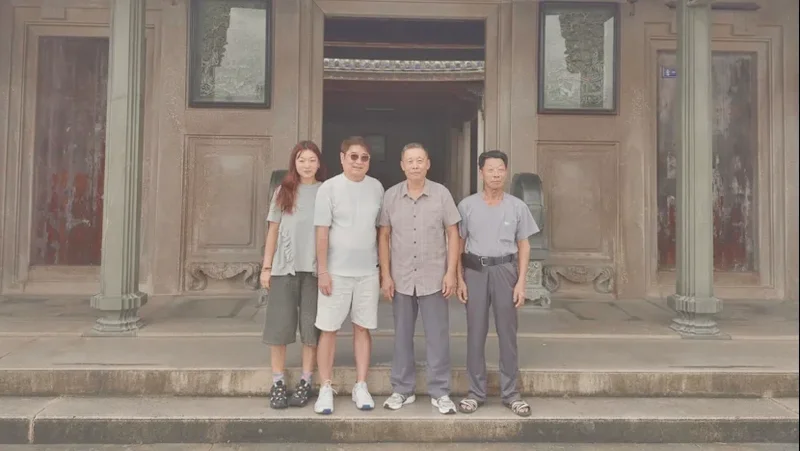
We approached the village's ancestral hall, a building that bore the marks of time. The grey brick walls had weathered, the paint had long since faded, and parts of the structure had begun to crumble.
Yet above it all, the intricate stone carvings remained astonishingly intact. Dragons and flowers still stretched across the roofline. Next to the hall was a tree and a flowing river.
Two men in their 60s sat at the entrance sharing kungfu tea. These were village elders responsible for looking after the hall.
When I explained why I had come in my broken Teochew, the men turned to each other and laughed. They spoke among themselves, too rapidly for me to catch everything.
An old genealogy book (族谱) was brought out.
The elders leafed through records detailing lineages and clan pictures with practised ease. Within minutes, they had connected the branches of my family tree that I had spent months trying to piece together.
It was dreamlike being guided by these strangers through lists of names translated from Mandarin to Teochew, all of them my relatives.
One of these names belonged to my great-grandfather.
We had found his birthplace.
NEVER TO RETURN
During the late 19th and early 20th centuries, thousands of Teochews left villages across Chao'an, Raoping and the wider Chaozhou region for Nanyang, as Southeast Asia was known to them.
Poverty, famine, political instability and the promise of work abroad pushed young men onto ships bound for places now known as Thailand, Indonesia, Malaysia and Singapore. Most intended to come home upon earning enough.
My great-grandfather, Tan Siak Kiang (陈锡乾), left Chao'an when he was 11 years old. Like many of his countrymen, he never returned.
I was caught up in questions about what that must have been like for him. Had he travelled alone? What did the red-headed boat smell like – did anyone hold his hand as he boarded it?
Had he understood that the journey to Indonesia would take several weeks? Did he make any friends on the journey, or were there few other children on the boat to play with?
As a boy, had he been given any say in whether he wanted to leave his home?
What must it have been like to land in the Riau islands Who met him there? How does an 11-year-old begin a new life in a place where he doesn't speak the language?
Throughout my time in Chao'an, I kept looking for recognition. An inherited memory, a neighbour's descendant with a story to tell. Something in the unfamiliar landscape that would explain the beginning of my family's story.
All I found was an old building and a book of names.
HOLDING ONTO FAMILY TIES
Before coming to Chao'an, I had imagined my ancestors as figures in history, defined by the enormity of their decisions.
There, in my great-grandfather's birthplace, he stopped being this grand, almost mythological being. He was just an 11-year-old boy who had to leave everything he knew.
The Teochews have a saying: "有海水处就有华侨,有华侨处就有潮人". Translation: "Wherever there flows sea water, there dwell overseas Chinese; wherever there live overseas Chinese, there stand people from the Chaoshan region."
It speaks to a people defined as much by movement as by a physical place.
Some families pass down heirlooms and trades through the generations. I've since realised that migration might be the closest thing my family has to an inheritance.
After my great-grandfather married my great-grandmother, they went on to have six children together. Then, at just 35 years old, he died, leaving behind his young family – including my grandfather. His cause of death remains unclear to us.
At the age of nine, it was my grandfather's turn to leave his home. He got on a boat of his own to head to Singapore via the Strait of Riau.
I often wonder whether he grew up hearing stories about Chao'an, or whether his father's journey had already become too painful to speak of.
Did migration feel like a deliberate choice to his family at the time, or had it just become the language they understood best?
Some families pass down heirlooms and trades through the generations. I've since realised that migration might be the closest thing my family has to an inheritance.
I made my own "crossing" in June 2015, leaving Singapore for the United Kingdom.
I wasn't forced to leave my home. I wasn't battling poverty or famine. I did it because I wanted to.
I'm aware that the opportunities I treat as choices today exist only because the people who came before me had to treat them as necessities.
And yet, I feel like my move has brought me even closer to my grandfather and great-grandfather.
Like them, I had never visited my destination of choice before moving there. Like them, I had no real understanding of what life there would look like – just a rough idea from internet resources.
There was something strangely familiar about leaving for somewhere I had never seen, with no real understanding of what life there would look like.
Of course, the circumstances were entirely different. I left Singapore with a passport and a return ticket. I had the privilege of leaving home knowing that it would remain open to me, if and when I ever wanted to return.
And yet, in the most basic sense, the instincts felt familiar: Find work. Don't complain. Adapt. Assimilate. Do your best.
Maybe these skills and sensibilities were my true inheritance.
Before leaving Chao'an, I turned back for one last look at the ancestral hall. The village elders stood at the entrance, waving us onwards as though sending off relatives rather than strangers.
More than a century ago, my great-great-grandmother stood in the same village watching her only son leave for Southeast Asia, believing he would one day return.
He never did.
But now, more than 100 years later, here we were in his place.
Perhaps this was homecoming enough.
Jariel Ann Tan is a Singapore-based multidisciplinary creative, cultural practitioner and educator. She is the founder of VESSELS, a creative practice exploring materiality and contemporary object-making, with a wider interest in culture, identity and heritage.