GEOJE, South Gyeongsang Province ― The men at the next table did not ask for a long conversation. They simply reached over, set down a few freshly shucked conch with a few words and a shy chuckle, then went back to their soju as if nothing had happened.
This was Gohyeon Market on a recent Monday afternoon, and this reporter, a stranger from Seoul with a plate of raw sea bass, had just been adopted for an hour by a table of middle-aged men of South Gyeongsang Province.
People from this southeastern province carry a reputation, even among Koreans, for being gruff, blunt, allergic to compliments and small talk. What those conch delivered instead was something closer to the opposite: a simple, unsentimental welcome that asked for nothing back.
It is the kind that no K-pop music video can stage, and on Geoje, an island of 230,000 people off Korea's southeastern coast better known for building supertankers than for making memories, it turned out to be everywhere.
The island drew thousands of local tourists as a K-pop rookie born on the island has become a YouTube influencer with her vlogs and memes. Geoje is betting that the world is about to find out.
Small city, big bet
That K-pop moves tourists is no longer a theory. When boy band BTS played the Busan leg of its ongoing "ARIRANG" world tour on June 12 and 13, some 110,000 fans converged on the southeastern port city, and more than 30,000 international travelers passed through the city's Gimhae International Airport over three days. Medium-size hotel bookings surged 245 percent, and 2,300 English-language copies of the city's dining guidebook vanished entirely.
What Busan did with the biggest K-pop act on the planet, Geoje is now attempting with a rookie girl group and a YouTube meme.
The catchphrase came first, and not from city hall. "Geoje yaho" was an ad-libbed cheer by Japanese bandmate Minami on the personal YouTube channel of Woni, K-pop girl group RESCENE's 22-year-old leader and the first idol out of Geoje ever to debut.
The clip swept short-form platforms into one of the defining Korean memes of early 2026, and the channel blew past 700,000 subscribers within months of launching.
Geoje was quick to chase the wave. The city's official account joined the meme in the comments, then named the five-member group its promotional ambassador on May 22, skipping the ceremony entirely and releasing the appointment as a short-form video of its own.
So this reporter took the bus south to see what fans will find when they follow her home.
**Hands-on Geoje experience **
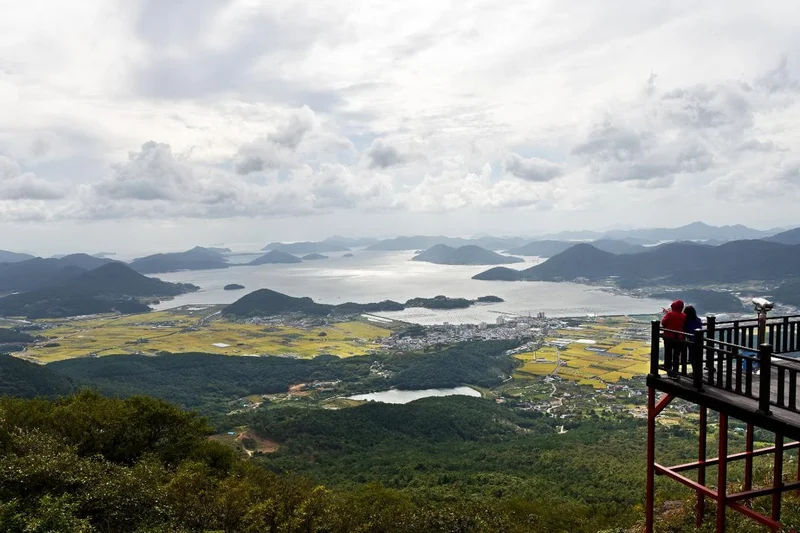
Geoje is Korea's second-largest island after Jeju, hanging off the southeastern corner of the peninsula.
Unlike Jeju, it requires no flight and no ferry — bridges tie it to the mainland on two sides, including the Geoga Bridge, an 8.2-kilometer sequence of cable-stayed spans and an undersea tunnel.
From Seoul Nambu Terminal, the intercity bus to Geoje's Gohyeon Terminal takes about 4 hours and 20 minutes, with a single 10-minute stop at a highway rest area along the way. Travelers coming from abroad can also fly into Gimhae International Airport and cross the Geoga Bridge by car or bus, a swift route that delivers its own spectacular sea views.
Maemiseong
The first stop, Maemiseong, looks like a fragment of medieval Europe that washed ashore on the South Sea. It is nothing of the sort.
In September 2003, Typhoon Maemi tore through the region, killing 63 people in South Gyeongsang Province alone and wiping out the seaside vegetable plot of Baek Soon-sam, then a researcher at a local shipyard.
Baek decided the next typhoon would not take his land.
For more than 20 years he has been stacking granite blocks, tens of thousands of them, some weighing 60 kilograms, into a fortress now stretching over 100 meters along the shore, without using a single blueprint. He still comes by on weekends to keep building.
Visitors come for the improbable silhouette, but they stay for the setting. The castle walls frame the sea like a painting, and directly below lies a small beach of smooth black pebbles that clatter softly with every wave. Between the stonework and the toy-scale beach, there is no angle here that does not turn into an adorably framed memory.
**Geoje POW Camp Historic Park **
Geoje's most sobering site sits in the middle of downtown.
During the 1950-53 Korean War, the island held the largest prisoner of war (POW) camp in the country, confining up to 173,000 prisoners, mostly North Koreans and Chinese nationals, including some 300 women. It became its own little war — violent clashes between pro- and anti-communist prisoners were frequent, and in May 1952 inmates even kidnapped the camp's American commandant, Brig. Gen. Francis Dodd.
Today the site is the Geoje POW Camp Historic Park, a provincial cultural heritage site that the city hopes to see inscribed as a UNESCO World Heritage site. It was also the setting of the 2018 film "Swing Kids."
The recreations of camp life are brutally vivid, and the senior volunteer docents, locals who narrate the exhibits with unhurried Gyeongsang warmth, turn the walk into something closer to oral history. For Korean visitors, the park stirs something patriotic; for international travelers it may be the single best shortcut to understanding the war that still shapes this peninsula.
** K-pop idol's hometown**
Back at sea level, Gohyeon Market is where Geoje is most fully itself, and where a visitor stands the best chance of meeting the city rather than just photographing it.
At the fish section, the owner-aunties haul live fish from the tanks and break them down with a speed that is frankly startling to watch, raw everyday competence that is the texture of life in a Gyeongsang port town. This reporter's table filled with live sea bass sashimi and "dodari sekkoshi," baby flounder sliced bone-in, and a bottle of soju that seemed to empty itself.
Then came the conch from the next table, chewy and briny and entirely unasked for, the single best memory of the trip.
The market's cult favorite, though, is a snack bar called Sundaeria, whose name grafts "sundae," the Korean blood sausage (no relation to the dessert), onto a certain burger franchise. Its signature "sunubokk," sundae stir-fried with chewy udon noodles and tteokbokki sauce, draws lines of young visitors daily.
**Deokpo Beach and Moraeseong Bunsik Pocha **
Deokpo Beach, a short drive east, will surprise anyone expecting Busan or Gangneung, Gangwon Province. This is a neighborhood beach, calm but humming with ordinary life, pine trees behind, families in the shallows.
At its edge sits Moraeseong Bunsik Pocha, the snack stall that appeared in Woni's Geoje vlog, where the owner recognized her the moment she introduced herself as a local's daughter. For fans it is already a shrine; for everyone else, it is simply the right place to order some good fried chicken bubbling tteokbokki when beachside cooking is banned in high summer.
Then there is Okpo, Woni's hometown and arguably the most layered neighborhood on the island.
In 1592, the waters off Okpo saw Admiral Yi Sun-sin's first naval victory of the Imjin War, Korea's most celebrated military triumph. Today those same waters cradle one of the world's great shipyards, now run by Hanwha Ocean. History books and construction cranes share a single bay.
Tucked nearby is Bogwang Temple, a small Buddhist temple that earns its fame for just a few weeks a year, when orange trumpet creeper blossoms cascade over its walls from mid-June to early July. Time it right or skip it — the temple itself takes minutes to see.
And in the middle of it all is Geumnong Galbi, the restaurant Woni recommends, and exactly the kind of place a hometown kid would. This is a neighborhood joint where workers slip in mid-shift and a simple bowl of galbitang, beef short rib soup crowned unusually with egg and scallion over chewy, gelatinous rib meat, lands on the table almost before the order is finished. It is, to be honest, the sort of local secret locals would rather not see go viral.
Two more dishes justify the bus fare on their own. Baemal kalguksu, knife-cut noodles in a broth made from whole ground limpets harvested from the clean waters off Geoje, delivers the sea in concentrated form; the limpet-and-seaweed gimbap is non-negotiable, and so, unfortunately, is the wait.
And at a three-generation gopchang house running since 1971, the beef tripe hot pot answers a fair question, why eat gopchang jeongol on Geoje when Seoul has plenty, in the only way it can be answered — with the first spoonful, rich, spicy but clean, without a trace of the funk that scares off the intestine-averse.
Not a one-off event
Whether a rookie group's momentum can convert into durable tourism demand is an open question, and officials know it.
But the model Geoje is testing differs from Busan's not just in scale, but in kind. Busan's windfall was event-driven, a superstar supernova compressed into one weekend. Geoje's is ambient and ongoing, born not from a stadium but from a YouTube channel.
And that may be the point. Fans will come for Woni's Geoje — the snack stall, the galbitang, the beach from the vlog.
What will make them stay, and return, is what this reporter found without looking for it — an island where, against every stereotype of Gyeongsang gruffness, the welcome is real, the scent of daily life hangs thick and beautiful over the streets, and a table of strangers will hand you free food and expect nothing at all in return.