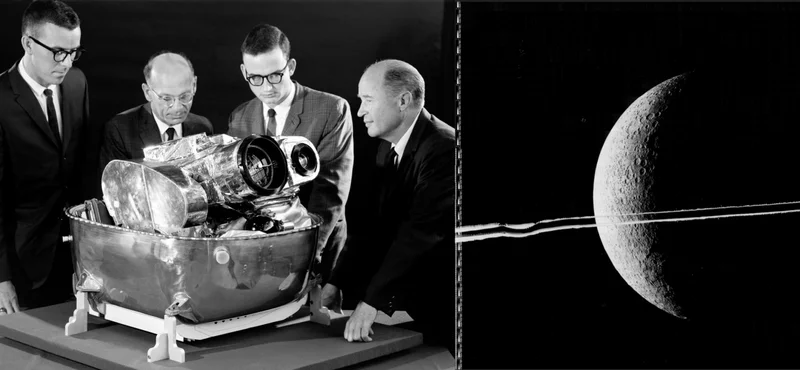
In 1966 and 1967, NASA sent five robotic spacecraft into orbit around the Moon. Constructed for the primary purpose of finding landing sites for Apollo, the Lunar Orbiters also enabled nearly comprehensive mapping of the Moon in stunning detail. The quantity and resolution of the photographs returned by Lunar Orbiter was unprecedented, thanks to a camera system built by the Eastman Kodak company of Rochester, New York. Their imaging system involved elaborate mechanisms to expose photographic film in orbit, develop the film onboard the spacecraft, and remotely transmit images back to Earth.
In February of 1967, the Rochester Times-Union published a story about how Kodak had “pre-invented” the Lunar Orbiter camera. Kodak director of R&D Arthur Simmons told the Times-Union that “no one walked in and asked us to develop a camera and film system to take closeup photos of the moon…Kodak has, for want of a better word, a ‘library,’ of hundreds of ‘conceptual ideas’ which we don’t advertise.”1 But the story of the camera’s “pre-invention” was more interesting than Simmons let on. When Kodak joined Boeing’s bid for the Lunar Orbiter in 1963, the camera system already existed. The company had originally developed it for the Air Force in the 1950s as a part of the highly classified satellite surveillance program called Weapons System 117L (WS-117L).
The nature of WS-117L and the clandestine origins of the Lunar Orbiter camera system were vaguely known by some at the time, but the full details were only revealed to the public through declassification decades later. This article won’t linger on the detailed technical specifications of the Lunar Orbiter cameras, but will instead focus on tracing the system’s development from conception to its adoption by NASA. It is the story of some of the first attempts by the United States to remotely transmit images from space, and how those same systems were adapted for lunar exploration.
WS-117L had roots in RAND studies of satellite surveillance concepts going back to 1946, and was the first major attempt to put those ideas into practice. The United States was hoping that satellites could be used to monitor the buildup of nuclear weapons and launch sites in the Soviet Union. In 1953, RAND Report 262 laid out in full the feasibility and utility of such systems, and by 1955 the Air Force began soliciting contractors for WS-117L. Eastman Kodak created camera systems for Lockheed’s bid, and the the Air Force awarded their contract in October of 1956.2
Originally, RAND had primarily considered using television systems.3 “Near real time” imaging was considered by some to be the ideal form of satellite surveillance, so television was a logical choice. But in a declassified history of the program, Robert Perry explains that the goal of real time imaging quickly became contested within the Air Force–it was unclear whether the technology was ready to satisfy requirements, and the alternative film recovery systems showed clear feasibility and reliability early on. Some of these efforts were spun off from WS-117L into the Discoverer-CORONA program, which sent Kodak camera systems into orbit, and returned capsules of exposed film for aerial retrieval and processing back on Earth.4 Early on, however, a near real time system was very much a part of the plan. In their bid for WS-117L, Kodak created a remote transmission system that would fly in what became known as the SAMOS program.
Television systems were still in consideration early on, but there were clear technological limitations at the time, especially when it came to resolution. Kodak’s newly formed Apparatus and Optical Division settled on a system to develop film onboard the spacecraft and “readout” the images to receiving stations on Earth. Planners envisaged five cameras for SAMOS, the first three dedicated to testing Kodak’s readout system (the others testing advanced recovery stems). The E-1 camera would primarily be a technology demonstrator, while the E-2 and E-3 would test the ability for their system to take images at more functional resolutions. All used the same basic architecture.
In a way, this camera system was in fact “pre-invented,” as it was mostly a clever assembly of existing technologies, many created by Kodak. The company had decades of experience in aerial photography going back to World War I. By the end of World War II, they had created advanced aerial films, compact film storage systems, and image motion compensation techniques. They had also worked on IR bomb sights and proximity sensing for the Navy, which would become useful for developing thermal control materials for the spacecraft.5
Illustrations from 1957 show a rough sketch of their plans for SAMOS readout. Kodak’s 70mm film would be exposed, processed, and stored before readout and transmission. Electronic signals received on the ground would be used to reconstruct the images.
By 1958, planning documents started detailing two of the key technologies that ultimately made the readout system possible. One was what became known as Kodak “Bimat” film, labeled in the illustration below as “WEB.”6 This web was coated with gelatin containing the necessary processing chemicals, enabling “dry” processing. The web was pressed against the exposed film, developing and fixing the images before storage and transmission.7
The origins of Bimat film are somewhat obscure in the public record. One Kodak-produced history suggests that the technology started as a laboratory investigation with amateur photography in mind, and was then applied to use in aerial photography.8 Considering the timeline, it was either a happy accident that this experiment matured just in time for WS-117L, or Kodak engineers started looking into the technique specifically in response to the challenges of film photography in space.
A Lockheed development plan from March 1956 describes the processing system in vague terms, stating that it would “not differ significantly” from existing methodologies for “airborne rapid-processing,” and describing a notional “a roller-applicator type” system. It also lists “the handling of photographic chemicals” as one of the “major difficulties to be overcome.”9 The illustration from 1957 shows the onboard processing step without the “WEB,” a detail that only shows up in diagrams like the one above labeled 1958.10 Then, a patent for a “web processing method” was filed in August 1959 by Kodak researchers, presenting “a one-step method for substantially completely developing and fixing a photographic image…without immersion in photographic processing baths.”11 David McDowell, an engineer who joined up with Kodak in late 1956 and worked on both SAMOS and Lunar Orbiter, also remembers Bimat being developed specifically for the project. “Bimat was started as soon as we started work on E-1 and E-2,” he told me, “because we knew we had to process film in orbit.”12
The second key technology was the readout system itself, which involved collaboration with the Columbia Broadcasting System Laboratories to create a flying-spot scanner.13 It worked using what McDowell calls an “inside-out CRT,” using a cathode-ray tube that fired an electron beam through the exposed film. Variations in the density of the film changed the intensity of the beam, and those variations were recorded by a photomultiplier and translated into electronic signals that could be sent back to Earth. Teams on the ground received those signals, used equipment to translate them back into an image, and recorded that image on film. Before passing through the film, the beam reflected off a revolving drum (seen in the diagram below) for thermal management.
In October 1960, the first E-1 camera launched on an Atlas-Agena, but failed to inject into orbit. Meanwhile, officials were actively debating the wisdom of continuing the readout program. Costs were rising, engineering difficulties plagued the program, some of the technology was beginning to seem obsolete, and CORONA-like systems were looking like a better option until more advanced readout techniques could be developed. Despite these issues, there were advocates for readout, and tests continued so that any decision could be made based on tangible results.
In January 1961, the second SAMOS test launched with another E-1 camera and sailed into orbit. In Sunnyvale, California, technicians at a readout station received transmissions from the spacecraft, and the result was a photograph with a 100 foot resolution. The system had worked.14
The E-2 camera would be the next step, with more advanced aiming systems and a higher resolution. All of the rotating systems within the spacecraft created complexities when it came to achieving these objectives. One key difference between E-1 and E-2, McDowell recalls, was that E-2 used a rotating nosecone to help stabilize and aim the camera.15
The first attempt to launch an E-2 ended two seconds after liftoff, when the Atlas fell immediately back to the ground and exploded. After the E-2 launch failure, readout was largely abandoned in favor of recovery programs. According to Perry, Air Force Colonel W.G. King believed that almost without exception, “everything a readout system could do a recovery system could do better.”16 Among other problems, readout systems required long lives, necessitating higher orbits that sacrificed resolution and created greater power requirements.17 Kodak engineers, including McDowell, remember one of the primary constraints being the bandwidth required to transmit the images, and the fact that they were only using a single ground station.18
No other E-2 cameras were flown, but it wasn’t the end of the story for the camera system. After the Air Force canceled further launches, E-1 and E-2 hardware was left scattered around the country, with one test model remaining in Eastman Kodak facilities in Rochester.
Perry reports that officials at NASA knew about the E-1 system and inquired about the cameras as early as April of 1961, and that the Air Force gave them permission to get details from contractors. The film readout system was similar to the method employed by the Soviet Luna 3 spacecraft to return the first images of the far side of the Moon in 1959, and NASA was interested in using the E-1 for similar purposes. Perry quotes Colonel King saying that NASA officials “did [not] seem to understand much about the problems of taking pictures from a space vehicle.” He did not believe the system would be usable for lunar exploration, but the idea didn’t go away.19
At that time, the best candidate for using such a camera system would likely have been for the Surveyor program’s planned orbiter, which was encountering its own problems. NASA historian Bruce Byers writes that several factors converged that led to dropping the Surveyor orbiter in favor of a standalone project. JPL was dealing with failures of the first Ranger probes, which delayed its work on Surveyor, and the development of the Centaur upper stage planned for Surveyor was also running into trouble.
Meanwhile, Apollo planning was underway. NASA officials decided to deprioritize orbiter data, because landing data was more helpful for hardware development, which had top priority. The orbital imagery would be primarily helpful for landing site selection, which could come later. JPL was to focus on getting Surveyor landers ready, while the Office of Space Sciences (OSS) began developing alternative plans for an orbiter.20
Oran Nicks put Lee Scherer on the job of developing a spacecraft that could fly on Agena. He originally looked into adapting Ranger or Able 5 to the task. After they handed the program off to the Langley research center, however Byers writes that Langley director Floyd Thompson opted for a competitive bid.21 But this competition may have been, if not a complete smokescreen, weighted heavily in the favor of one particular bid. Correlating the Lunar Orbiter program with the timeline presented in Vance G. Mitchell’s declassified history of NASA/DOD relations paints a fascinating picture.
In 1962, as the Surveyor orbiter was under study, NASA Associate Administrator Robert Seamans met with DOD research official John Rubel to discuss lunar reconnaissance. Then, in May 1963, little more than a month after Langely submitted Lunar Orbiter’s Project Approval Document to Seamans, a much larger meeting took place between NASA and DOD officials. They directly discussed the use of NRO equipment for both unmanned vehicles and the Apollo program. Immediately following this meeting, NASA administrator James Webb and Seamans started working with DOD officials on how to put this into practice, and specifically on how NASA could create unclassified contracts for such arrangements. Despite reservations, Rubel’s successor, Eugene Fubini, had the NRO look into NASA’s request.22
In mid July, an agreement was drafted between NASA and the DOD giving NASA permission to use NRO equipment for “both unmanned and manned lunar reconnaissance operations,” under certain stipulations. It included the following plan of action:
“…it will be the responsibility of the NRO to select a contractor, generally from among those engaged in the present covert reconnaissance programs, to develop equipment meeting these specifications in a secure and protected, or ‘black’, fashion. Concurrently, NASA will grant the same contractor an overt or ‘white’ reconnaissance contract which will serve as a technically plausible cover for the development of the flight hardware actually to be employed, during that length of time in which the flight hardware must be regarded as highly sensitive because of its relevance to the on-going covert reconnaissance operations.”
23
Mitchell recounts one instance of very direct contact between the interested parties during this period. “On 24 July 1963,” he writes, “NASA, NRO, and CIA representatives met with Fredrick C.E. Oder, a retired Air Force colonel involved with Samos in the 1950s, and now an Eastman Kodak executive.” The group directly discussed adapting the E-1 and E-2 cameras for lunar exploration, consulting Kodak engineers who thought it would be feasible.24
On August 28, the DOD/CIA/NASA agreement was signed by James Webb and Secretary of Defense Robert McNamara.25 On August 30, Seamans reviewed Langley’s Request For Proposals document, and NASA released it to contractors.26 The Boeing/Kodak bid was approved by Seamans and Webb in December. “Although the available documentation does not say so,” Mitchell argues, “the NRO, by virtue of the provisions of the 28 August agreement and its knowledge of reconnaissance camera systems must have played a role in the selection process.”27
This all may help explain the fact that at least in its early stages, Lunar Orbiter was kept under tight security measures at Kodak. McDowell remembers that at the time, work on Lunar Orbiter was kept “in the same level of secrecy that the [SAMOS] projects were.” Work was extremely siloed–engineers building individual components did not always know exactly what they would be used for. McDowell says that this was a pretty standard practice for Kodak at the time, but that the fact that they were using the E-2 probably had something to do with it.28
Regardless of whether the outcome of the competition was predetermined, the Kodak system did have real advantages over the other bids for Lunar Orbiter. It promised increased flexibility, the capability of taking images simultaneously in multiple resolutions, and the ability to achieve impressively high resolutions.
Kodak’s final Lunar Orbiter camera system used a process largely identical to their E-2 cameras.29 They even seem to have borrowed some of the illustrations from SAMOS presentations for Lunar Orbiter documentation.
The primary modifications that Kodak engineers made were to the lenses and shutter systems. They sought to meet very strict NASA requirements regarding resolution of the images. Compared to the E-1 and E-2, which had 100-foot and 20-foot resolution respectively, NASA’s goals for Apollo planning stated a roughly 3-foot resolution (closer to the never-realized plans for the SAMOS E-3). They also moved from a single ground station to three. Kodak’s final system was capable of achieving that resolution given the right orbit.
Through Lunar Orbiter documentation, we get a closer look at the reconstruction process. Transmitted images were displayed with a kinescope and captured on 35mm film, which was sent to Rochester for reassembly. Strips of 35mm film were assembled to form a full frame, which was in turn captured on film and sent off to NASA. This meant that the images themselves traveled across several different rolls of film before finally being put to use.
The photographs brought back by Lunar Orbiter played an integral role in Apollo site selection, and brought a wealth of new information to cartographers and scientists. The camera system performed admirably, although engineers did encounter a handful of difficulties over the course of the five flights. Some of these difficulties had to do with the Bimat film itself, which operated somewhat inconsistently. The film could “stick,” experience dryout, or see droplet formation, leaving artifacts on the film.30 The continuing issues with the film into 1966 and 1967 may hint at some of the specific engineering and reliability issues that contributed to the end of SAMOS readout.
Frame 76, H3 from Lunar Orbiter V. This frame contains the landing site for Apollo 11, and displays several of the artifacts seen on Lunar Orbiter imagery. The landing site itself is nearly obscured by the line in the center, which may be a Bimat supply separation line. FromNASA/LOIRP.
Because of its spin-off from Surveyor during the push for Apollo, Lunar Orbiter was arguably the very first spacecraft designed to conduct reconnaissance specifically for human spaceflight. The modification of military hardware for the purposes of exploration has a long tradition in the history of exploration, and this is a particularly fascinating example in that tradition. It is the story of a unique camera system straddling technological eras that ended up playing two very different roles in the geopolitical competition of the Cold War.
Footnotes
- “How Kodak ‘Pre-Invented’ the Lunar Orbiter Camera (Based on an article in the Rochester Times-Union, February 3, 1967)”, 105:9, Kodak Historical Collection, D.319, Rare Books, Special Collections, and Preservation, River Campus Libraries, University of Rochester ↩︎
- “Chronology: WS 117L Background,” NRO, Declassified WS117L, SAMOS & Sentry Records, ID 953, https://www.nro.gov/Portals/135/documents/foia/declass/WS117L_Records/953.PD; and “Space System Development Plan: SAMOS R&D Program” 12 July, 1960, NRO, ID 608, https://www.nro.gov/Portals/135/documents/foia/declass/WS117L_Records/608.PDF; during the history of WS-117L, ARPA took a direct role in management for a period, and the project went through various names. This article’s primary focus is on the camera systems, and so avoids detailing these changes for simplification. The documents linked here contain detailed explanations of these changes. ↩︎
- “Project Feed Back Summary Report,” ed. J.E. Lipp and R.M. Salter, R-262, Volume 1, March 1, 1954 (RAND), https://www.rand.org/pubs/reports/R262z1.html ↩︎
- Robert Perry, A History of Satellite Reconnaissance Volume IIA – SAMOS, Revised October 1973, NRO, ID 304, https://www.nro.gov/Portals/135/documents/foia/declass/WS117L_Records/304.PDF; and Kenneth E. Greer, “CORONA,” inCORONA: America’s First Sattelite Program,ed. Kevin C Ruffner, pp 4-6, https://www.cia.gov/static/Corona-Between-the-Sun-and-the-Earth.pdf ↩︎
- David McDowell (former Kodak engineer) in discussion with the author, March 22, 2024 ↩︎
- This is one of the earliest references to this technology that I have been able to find. The term “Bimat” came later, and in Lunar Orbiter documents at the time, engineers have often retained the “web” terminology, referring to it as “Bimat web.” For more on how Bimat worked: https://www.cia.gov/readingroom/docs/CIA-RDP33-02415A000500120032-7.pdf ↩︎
- See “Advanced Reconnaissance System Weapon System 117L,” 1 March 1958, NRO, ID 101, https://www.nro.gov/Portals/135/documents/foia/declass/WS117L_Records/101.PDF; This was one of the primary differences between Kodak’s readout system and Luna 3’s, which used wet processing methods. ↩︎
- “Kodak Contributions to Aerial Photography,” p 6, 106:6, Kodak Historical Collection, D.319, Rare Books, Special Collections, and Preservation, River Campus Libraries, University of Rochester ↩︎
- “Pied Piper Development Plan: Vol II Sub-System Plan, E. Visual Reconnaissance,” Lockheed Aircraft Corporation, 1 March, 1956, NRO, ID 502, https://www.nro.gov/Portals/135/documents/foia/declass/WS117L_Records/502.PDF ↩︎
- The date is somewhat difficult to decipher in the provided image, but is clearly 1958 on the one in this document: https://www.nro.gov/Portals/135/documents/foia/declass/ForAll/041723/F-2022-00223_C05142220.pdf ↩︎
- Leonard W. Tregillus, Arthur A Rasch, and Edwin B Wyand, Jr, “Web Processing Method and Composition,” USPO Patent 3,179,517; https://patentimages.storage.googleapis.com/bd/76/21/1d361f54f0613e/US3179517.pdf ↩︎
- McDowell, 2024; The University of Rochester Special Collections Library is also currently processing some Kodak Research Laboratories documentation, to be opened in 2027. I am hoping that more information might be forthcoming. ↩︎
- This was similar in principle to Luna 3, which would have been in development around the same time or slightly after the Kodak/CBS system, despite flying sooner. The 1956 Lockheed document contains a pretty detailed description of the flying spot scanner, pretty much as it appeared in the final system. Luna 3’s scanner had definitely begun development by the middle of 1958, but preliminary work may go back to 1957 or earlier. Some of the basic principles behind the flying spot scanner go back even further to some of the earliest experiments in television. See Don P. Mitchell’s description of the Luna 3 systems: http://mentallandscape.com/L_Luna3.htm; and this account of Luna 3’s transmission system, including the use of film recovered from US spy balloons: http://www.svengrahn.pp.se/trackind/luna3/SpyBalloon.htm ↩︎
- Perry, pp 152-167 ↩︎
- David McDowell in discussion with the author, December 17, 2025. McDowell discussed the stabilization difficulties and the nosecone design in the 2024 discussion, as well. ↩︎
- Perry, pp 175 ↩︎
- Information on E-1/E-2 launches and the fate of the cameras from Perry, pp 165-177; continued investigation of readout, pp 178-196 ↩︎
- McDowell, 2024; also see comments in “RMSC Gambit Exhibit Press Conference”, t25:20, https://www.youtube.com/watch?v=HBMtsBZJT94 ↩︎
- Perry, pp 168, 173 ↩︎
- Bruce Byers, Destination Moon: A History of the Lunar Orbiter Program, April 1977, NASA, pp 9-29, https://ntrs.nasa.gov/citations/19770016195 ↩︎
- Byers, pp 16-29, 40 ↩︎
- Vance G. Mitchell, Sharing Space: The Secret Interaction Between The National Aeronautics & Space Administration & the National Reconnaissance Office, 1961-1995, NRO/CSNR, pp 12-13, https://www.nro.gov/Portals/65/documents/foia/declass/ForAll/012422/F-2019-00002_C05116216.pdf ↩︎
- “DOD/CIA-NASA Agreement on NASA Reconnaissance Programs,” 17 July, 1963, https://www.cia.gov/readingroom/docs/CIA-RDP33-02415A000400060019-0.pdf ↩︎
- Mitchell, p 14 ↩︎
- For the final draft, see: https://www.nro.gov/Portals/135/documents/foia/declass/UPWARD/1.%20DoD-CIA-NASA%20Agreement%20on%20NASA%27s%20Reconnaissance%20Program.PDF ↩︎
- Byers, pp 46-47 ↩︎
- Mitchell, p 15 ↩︎
- McDowell, 2025 ↩︎
- For an earlier simplified account of this transfer, and a summary of some of the technical differences, see R. Cargill Hall, “SAMOS to the Moon: The Clandestine Transfer of Reconnaissance Technology Between Federal Agencies,” NRO, https://www.nro.gov/Portals/65/documents/history/csnr/programs/docs/prog-hist-01.pdf ↩︎
- Lunar Orbiter documentation often details these types of imperfections, including in the contractor report for Lunar Orbiter I: https://ntrs.nasa.gov/api/citations/19670023005/downloads/19670023005.pdf ↩︎