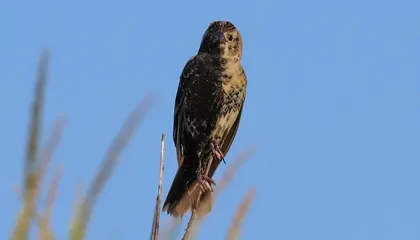
A half-male, half-female bird has Chicago-area birdwatchers atwitter.
Scientists say an eye-catching bobolink with both male and female characteristics temporarily took up residence at a nature preserve just west of Chicago, giving some lucky birders a rare chance to observe one of nature’s most intriguing biological phenomena up close.
The bobolink is what’s known as a “bilateral gynandromorph.” Because of a genetic anomaly, the right side of its body is male while the left side is female, with a straight vertical line dividing the two halves. It’s believed to be the first documented gynandromorphic bobolink.
Luke Dahlberg, conservation seed program manager for the nonprofit Citizens for Conservation, first spotted the bird this spring at the group’s 246-acre Hill ‘N Dale Preserve in Barrington Hills, about 40 miles northwest of downtown Chicago.
He spent a day in May photographing male bobolinks in their striking breeding plumage—black-and-white with a golden patch on the back of the head—as they returned from their wintering grounds in South America. But when he got home and looked through his photos, he was surprised to spot a bird with a very different appearance: a full-body profile of tan-gold feathers.
Dahlberg shrugged it off, thinking that perhaps the creature just had an unusual molt pattern. Outside of breeding season, males sport the same yellow-brown coloration as females, after all.
But a few weeks later, back at the preserve, he spotted the very same bird. That’s when he noticed it had male plumage on one side of its body and female plumage on the other. Ornithologists later confirmed the creature’s status as a bilateral gynandromorph.
“I had a better chance of photographing a unicorn,” Dahlberg tells WTTW’s Patty Wetli. “It’s extremely rare in nature.”
One of the experts called in to help identify the bird, dubbed “Black and Tan,” was Cameron Rutt, a conservation ecologist with the Field Museum in Chicago who estimates he took roughly 1,000 photos of the unusual animal.
Rutt had never seen a gynandromorph in person, so he was “thrilled,” he tells WTTW.
“It was first flying right and then it was next flying left, and it looked like two completely different individuals,” he says. “But it’s the same bird.”
Black and Tan behaved just like any other male bobolink, singing, performing courtship flights and establishing a breeding territory in hopes of wooing a female mate. And in the end, the creature succeeded: According to WTTW, it nested, reproduced and raised fledglings.
The bird has since left the preserve, reports the Chicago Sun-Times’ Elijah James, but Dahlberg hopes it will return next spring.
Did you know? Split-color lobster
Earlier this year, fishers caught a rare 1-in-50-million “split-color” lobster off Cape Cod. The creature was fully female—so not a gynandromorph—but it still had two sets of genetic information in its body, which caused one side to be orange and the other to be brown. In lobsters, split colorization is thought to result from one fertilized, unlaid egg absorbing another fertilized, unlaid egg.
According to Rutt, gynandromorphism has been recorded in fewer than 100 individual birds, representing around 45 of the world’s more than 11,000 known bird species.
The exact causes of bilateral gynandromorphism are a bit murky. However, in birds, scientists think the condition might result from a “mistake” during female meiosis, the cell division process that produces egg cells, Brian Peer, an ecologist at Stephen F. Austin State University, tells WBEZ Chicago’s Sasha-Ann Simons.
Female birds have two sex chromosomes, one Z and one W. Normally, meiosis divides these chromosomes between an egg cell and a small cell called a polar body, the latter of which cannot be fertilized and eventually breaks down. But researchers suspect that if the separation process goes awry, an egg cell can end up with an extra chromosome. If that egg cell is then fertilized by two sperm carrying the male-associated Z chromosome, the resulting embryo could end up with a mix of cells—some genetically male (ZZ) and some genetically female (ZW). As the embryo develops, those two types of cells can give rise to the resulting bird’s distinct male and female halves.
“That’s probably what happened in all of these cases, or at least that’s our understanding based on relatively few examples of this in the lab,” Peer tells WBEZ Chicago.
Between late 2008 and early 2010, Peer and his colleague Robert Motz observed a gynandromorphic northern cardinal in northwestern Illinois for more than 40 days. This bird, however, never paired with a mate. A split-sex cardinal was also spotted in Pennsylvania in 2019, followed by a similar sighting in 2021—possibly the same bird.
In 2023, researchers identified a gynandromorphic green honeycreeper in Colombia, with male-associated blue feathers on its right side and the emerald-green feathers of females on its left. Beyond birds, gynandromorphism has also been recorded in animals including the common archduke butterfly and a type of sweat bee.