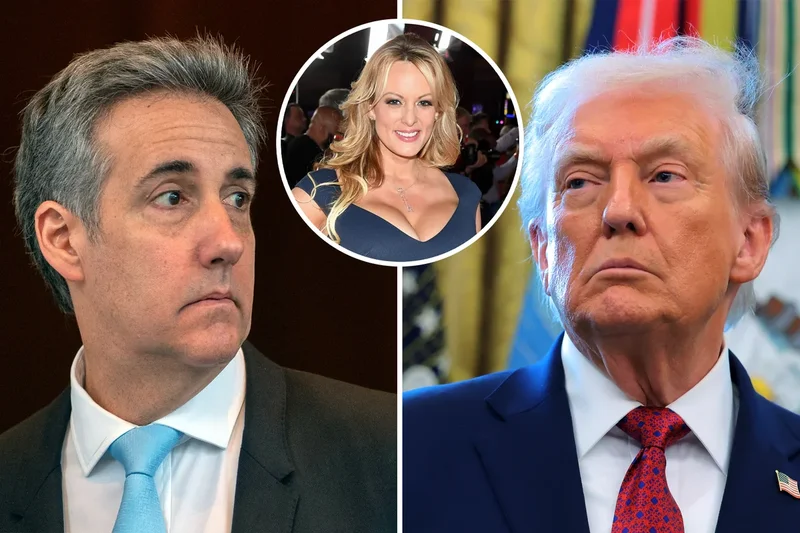
There is a move that daytime television producers make when a show has run out of plot. A character who died — buried, mourned, whose death powered two seasons of grief — walks back through the door. There was a secret hospital. There was an identical twin. The coma was faked.
Ratings spike for a week while the audience waits to find out what it meant, and then the writers discover they have nothing for the character to do, because the return was never a story. It was a substitute for one.
That is what aired on WABC radio on Thursday night, and it is worth being clear about who it was for.
Michael Cohen spent a decade as Donald Trump's fixer, went to federal prison, testified against him in a Manhattan courtroom and helped produce 34 felony convictions. Trump called him a rat. Cohen built a second career calling Trump a criminal.
Eight years of that, and the reckoning Thursday lasted under a minute.
"A good advocate, and then they weaponized you like nobody's ever been weaponized," Trump offers — no villain in the story after all, just an unnamed third party that did this to both of them.
Cohen takes it: "Well, maybe just you and I, sir."
Then Trump says the line that matters most: "I respect the fact that you recanted everything you said."
Cohen's response? "Yeah."
He starts a sentence, is talked over, gives up, and pivots to a fond anecdote about 2016. Nobody apologizes. Nobody utters the words “prison,” or “conviction” or “hush money.” The dead man walks back through the door and the show moves on.
Remember, the public largely came to know Cohen thanks to the Stormy Daniels hush money case. On May 30, 2024, a unanimous jury convicted Trump on all 34 counts of falsifying business records in connection with a scheme to silence adult film star Daniels, real name Stephanie Clifford, whose story about having sex with Trump threatened to derail his 2016 presidential campaign.
Cohen — who testified that he frequently sought approval for his “loyalty” to “the boss” — agreed to pay Daniels out of his own pocket, took out a home line of credit to front the cash, and created a shell company from which he could transfer the funds to Daniels’ attorney. Trump, the first-ever criminally convicted president, avoided jail time in that case but was handed a sentence of “unconditional discharge” that preserved the jury’s unanimous verdict.
Cohen would go from saying he would “take a bullet” for Trump to calling him a “conman” and liken him to a Mafia boss. Which begs the question of why this interview Thursday was booked at all, in the third week of August, in a year when the president has more urgent problems than an eight-year-old grudge.
The answer is in his numbers. Trump's approval is averaging around 38 percent against 59 percent disapproval — a net deficit of roughly 21 points, and below the 37 percent floor of his own first term. Gallup had him slightly better in August, at 40. Nobody has him near the water’s surface.
The number that will decide November is worse. Independent voter approval sits at 34 percent, down 14 points from where he started. In 2018, when Republicans lost 41 House seats, Trump's independent approval going into the midterms was 36. He is now beneath that. The generic ballot has Democrats up better than six points.
And the reasons are not mysterious. Roughly 37 percent of Americans approve of his handling of the economy. Consumer confidence is at levels last seen in 2022. Tariff-driven price increases that began biting in the first quarter accelerated through the second, while the Federal Reserve held rates — a squeeze voters experience at the till rather than in a chart.
Meanwhile the war Trump started against Iran is in its sixth month, the USS Abraham Lincoln has been at sea more than 265 days, and the announcements that the fighting is over keep being followed by more fighting.
Neither problem can be solved by November, because both are his. He chose the tariffs. He chose the war. What is left is to talk about something else.
So watch what Trump actually does with the 15 minutes Cohen gave him.
He spends them arguing that the economy is a "renaissance" — factories returning, Toyota and Honda announcing, chip plants in Arizona, Eli Lilly building six of them, "more money being invested in the United States right now than at any time in the history of our country by a factor of five."
He is making the case to an audience that, by every available measure, does not believe it.
Prices surface exactly once. Trump concedes, almost in passing, that energy costs will be "a little bit higher for gasoline." A host might have stayed there. Cohen instead hands him a better line — suggesting he tell Americans they "get to go to sleep at night" without fear of an Iranian missile — and the subject is gone.
That is what the booking bought: a quarter-hour of unchallenged airtime on a friendly frequency, the border and the economy re-litigated on his own terms, and his most famous accuser sitting still and obedient while the president described his sworn testimony as recanted.
Cohen, for his part, was not pretending to be a journalist here. The disbarred lawyer — who previously submitted a pardon appeal to the White House — described the relationship this week as "being resuscitated," called Trump "boss" on air, and by his own account resubmitted an application for a presidential pardon within hours of taping.
A man who wants clemency from Donald Trump has exactly one route to it, and it is not adversarial interviewing. Which is what makes the casting work. Resurrected characters are easiest to write when they need something.
And there is another one queued up. The Wall Street Journal reported this week that Trump is pushing for a fourth meeting with Kim Jong-un, possibly around his Asia trip in November — a fortnight before the midterms. He confirmed the warmth himself on Tuesday, declining to say whether the two are exchanging letters again and noting, approvingly, that Kim "has 57 very powerful nuclear weapons."
They have done this three times. Singapore, Hanoi, the handshake at the DMZ. Extraordinary staging, and not one warhead surrendered — Kim has more of them now than when the cameras first rolled. None of which is an argument against a fourth summit. It is an observation about what a fourth is for.
The tell, in daytime and in this, is what follows the reveal. The resurrected character drifts to the margins within a season, because there was never a plan past the door opening. Trump's own tape doesn't end so much as stop, mid-sentence, on pharmaceutical tariffs. "What's happening now is a miracle," he says. "I hope it gets properly reported."
Cue the evil twin.