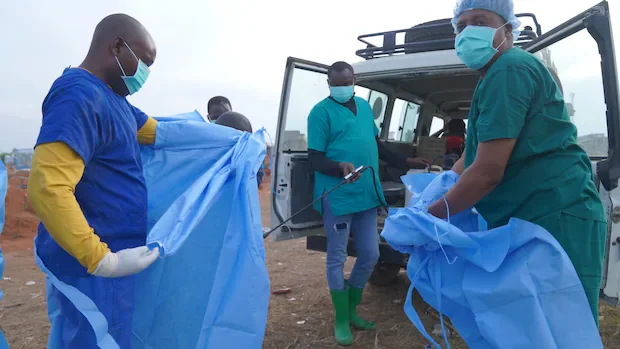
Ebola spreading exponentially in Congo as death toll tops 2,500, UN says
Late-stage trials will test efficacy of a vaccine designed for a different strain of the disease
More than 2,500 people have now died in the Democratic Republic of Congo's Ebola outbreak, which is spreading exponentially in an area larger than France, senior United Nations Ebola co-ordinator Julien Harneis said on Friday.
Speaking on a video call from the northeastern Congolese city of Bunia, Harneis called for more aid, saying an existing pool of funds is set to run out within weeks.
Health workers there were coming under attack by locals angered and terrified by the outbreak, and were themselves falling sick and dying from the disease, he added.
Vaccine for different strain sent for late-stage trial
The grim death milestone comes as an allocation of doses of a vaccine for a previous Ebola strain has been sent to the D.R.C. Congo requested the vaccines last week from the global Ebola virus disease vaccine stockpile.
That vaccine, called Ervebo, is approved to prevent disease caused by the more common Zaire Ebola virus strain. 20,000 shots out of the 70,000 allocated will be used in a late-stage trial to understand the impact of the vaccine on the current Bundibugyo virus.
"It is not known whether Ervebo may be protective against the Bundibugyo virus in humans," the World Health Organization said, stressing the importance of clinical trials to provide new evidence.
'Fear translated into angry young men'
In late July, the D.R.C.'s 17th Ebola epidemic became the biggest in the country's history in terms of the number of cases, surpassing the previous worst outbreak in 2018 to 2020.
It is caused by the Bundibugyo species of Ebola, which has no approved vaccines or treatments.
"The Ebola outbreak is growing exponentially," Harneis said. "The epidemic is spreading to an area that is bigger than France, and the outbreak is growing faster and wider than the Ebola response. And all of this is happening in an area that has had three decades of conflict and is generating huge humanitarian needs."
WATCH | Struggle to control outbreak:Some 160 health-care workers have fallen ill with Ebola, and 43 of them have died, he said.
"And then, when we do respond, apart from the threat from the virus, health-care workers and front-line workers have been attacked by youths, ambulances have been burned and stoned, and the health-care facilities have been attacked," he said.
"Fear translates into angry young men who start throwing stones at their object of fear, the ambulance," he added.
- Ebola in the Democratic Republic of Congo: What's going on and why is the outbreak so alarming?
- Health Canada authorizes mRNA vaccine trial for Ebola virus causing huge outbreak in Congo
Other aid workers have said locals have believed conspiracy theories that the outbreak is a hoax, and have reacted angrily when health restrictions prevent them from personally burying loved ones.
There have been more than 260 attacks on health workers in the past six months and eight health workers have been killed, Harneis said, "which is obviously terrifying because people are already risking their lives to deal with Ebola."
Aid cuts in recent years have reduced the capacity of humanitarian organizations, he said.
Another problem is paying the tens of thousands of people involved in tackling the outbreak, he said. Banking services were hit after the government stopped commercial flights and thereby hobbled the means by which cash is delivered to banks.