The BBC's coverage of the Women's Tennis Association's new policy requiring genetic sex testing for players uses visuals from Getty Images of a black woman's hand.
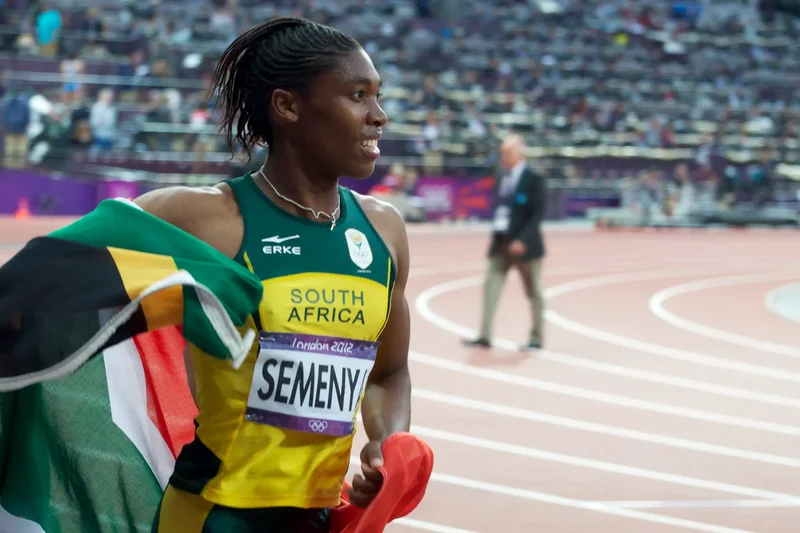
This illustrates a pattern where stories about fairness in women's categories often visually centre athletes of African descent. High-profile DSD (Differences of Sex Development) cases, such as South Africa's Caster Semenya in 2009 after she remarkably won gold in the 800 metres at the World Championships in Berlin with a time of 1:55.45 in the final, Namibia's Christine Mboma and others from sub-Saharan Africa, frequently dominate headlines.
Biological sex categories in sport exist because males who go through puberty typically develop significant advantages in strength, speed, muscle mass, bone density and cardiovascular capacity due to higher testosterone exposure. World Athletics, WTA and other bodies have moved toward stricter rules based on the SRY gene (on the Y chromosome) to define eligibility for the female category.
DSD conditions (for example, 5-alpha-reductase deficiency or partial androgen insensitivity) can result in individuals raised as female having XY chromosomes, internal testes and elevated testosterone, conferring performance edges in certain events. Data from World Athletics indicates DSD athletes (often from what they point to specific African regions due to higher prevalence of certain genetic variants) have been over-represented in elite finals far beyond population expectations.
These are not "cheats" in the intentional doping sense. Many athletes like Semenya were assigned female at birth, identify as women and competed under prior legitimate rules. However, governing bodies argue that retaining male-typical advantages undermines fair play for the vast majority of female athletes with typical XX development. Who are they to judge what a typical XX development is because natural women come in different kinds and developments?
Policies requiring suppression of testosterone or genetic confirmation are said to aim to protect the category, not target race. Prevalence of certain DSDs varies geographically and genetically, which are aimed to justify why some stories feature black athletes more prominently, not because of media racism but demographics of cases.
European media, including the BBC, reports these stories because they involve major competitions, legal battles (Semenya's cases at CAS, Swiss courts, ECHR) and policy shifts by international federations such as World Athletics. Under the leadership of World Athletics president Sebastian Coe, the organisation implemented strict eligibility rules for athletes with DSD.
These regulations barred Semenya from her preferred racing distances (400m to one mile) without testosterone-suppressing medication.
This has led to a lengthy, ongoing legal battle. The Getty image choice may reflect stock availability or visual relevance to prominent athletes but it may be as emblematic of selective framing.
Doping scandals span all demographics. Kenyan distance runners have faced high numbers of sanctions in recent years, as have athletes from Russia (state-sponsored), the US, Europe and elsewhere. Historical cases include Ben Johnson (Jamaican-Canadian sprinter), Marion Jones (Black American), Lance Armstrong (white cyclist) and many in baseball or cycling from various backgrounds.
The 1988 Seoul Olympics 100m final is infamous as "the dirtiest race in history" because six of the eight finalists were either implicated in or tested positive for performance-enhancing drugs during their careers.
They were all black men but the preferred black athlete was awarded the gold medal. Johnson (Canada) finished first in a world-record 9.79 but was stripped of the gold medal and disqualified three days later after a justifiable positive test for the steroid stanozolol. Carl Lewis (United States) was subsequently promoted to gold.
Years later, it was revealed he had failed three drug tests for stimulants during the US Olympic trials. He was cleared to compete by the USOC after claiming he inadvertently took a banned supplement. Linford Christie (Great Britain) was promoted to silver.
He tested positive for the stimulant pseudoephedrine after the final but was cleared in a split decision by the IOC medical commission, who accepted he had inadvertently consumed it in ginseng tea. Dennis Mitchell (United States) finished fifth (promoted to 4th) and later served a two-year ban for elevated testosterone in 1998.
Ray Stewart (Jamaica) finished 6th and later became a central figure in subsequent track-and-field doping investigations, ultimately receiving a lifetime coaching ban from USADA in 2010 for trafficking performance-enhancing substances. Desai Williams (Canada) finished 7th and later admitted to using performance-enhancing drugs during his career, testifying at the 1989 Dubin Inquiry.
Only Calvin Smith (United States, bronze) and Robson da Silva (Brazil, 5th) never tested positive or were implicated in a drug scandal throughout their respective careers.
Studies on media coverage frequently flag racial bias in framing (e.g., Black athletes stereotyped as "naturally gifted" physically versus white athletes as intelligent/hard-working or harsher criminalisation narratives in some US contexts).
However, anti-doping enforcement data shows no clear pattern of European media uniquely targeting Black athletes as "cheats." However, black athletes face high scrutiny and scathing criticism once suspected. Some South African rugby players are another example.
East African runners' doping issues often tie to training cultures, altitude programs or economic pressures in specific nations, reported factually alongside others. Russian and Chinese state programs received intense scrutiny too.
Claims of systemic "painting Black athletes as cheats" overlook that performance anomalies (sudden improvements, outlier physiques) trigger scrutiny regardless of race, standard in anti-doping. Media amplifies controversies involving stars and black athletes dominate sprints, jumps, rugby and some middle-distance events due to a mix of genetic, environmental, training and cultural factors (for example West African descent in sprinting, South Africans in rugby and boxing and East Africans in long-distance running). This, at times, leads to more visible cases, not conspiratorial bias. With that said, the bias, even in that smallest margin, must not be ignored.
European outlets like the BBC operate under public service mandates emphasising fairness, science and inclusion debates. Coverage of Semenya emphasised human rights angles, her personal story and South African perspectives criticising "humiliation," alongside governing bodies' fairness arguments. Similar nuance appears in WTA/BBC tennis stories.
Some critics such as myself argue that there are still other black sports people, especially black sportswomen, by focusing on biology over identity. Yet ignoring biology risks erasing advantages. Studies and federations (World Athletics, swimming, rugby) document retained male puberty benefits post-transition or in DSD.
Overrepresentation data (for example, ~50-60 DSD finalists since 2000) is empirical, not narrative invention. Doping reporting follows evidence: WADA, AIU sanctions are public. Kenyan cases are prominent because of their success in distance running. European media has also heavily covered white/European scandals (for example, cycling's EPO era, BALCO involving diverse athletes).
Why does this perception persist? Visual and narrative framing. Stock images and focus on African DSD athletes does feel targeted, especially amid broader cultural debates on race and biology. The media often defaults to sympathetic victim narratives for individuals vs. systemic policy.
There's geographic focus where Europe hosts many major federations (UEFA, World Athletics HQ in Monaco, and so on) and journalists. African successes often invite scrutiny, as with any dominant group.
Stereotypes versus Statistics: Acknowledging group-level genetic/physiological patterns (for example, ACTN3 variants, muscle fiber types, testosterone distributions) in elite sport is sometimes data-driven with what could be seen as a racist slant because many international sports federations are controlled from countries that are not majority black countries.
Humanism requires individual fairness over group essentialism. Blanket denial of biology harms female athletes of all races.
There's also activism influence where some coverage reflects pressure to frame eligibility rules as discriminatory, downplaying performance data.
Lelo Mzaca is an award-winning multitalented journalist, copywriter and presenter of The Big Breakfast Show on Radio 2000. He has an overwhelming passion for sport, lifestyle, music, arts and culture.