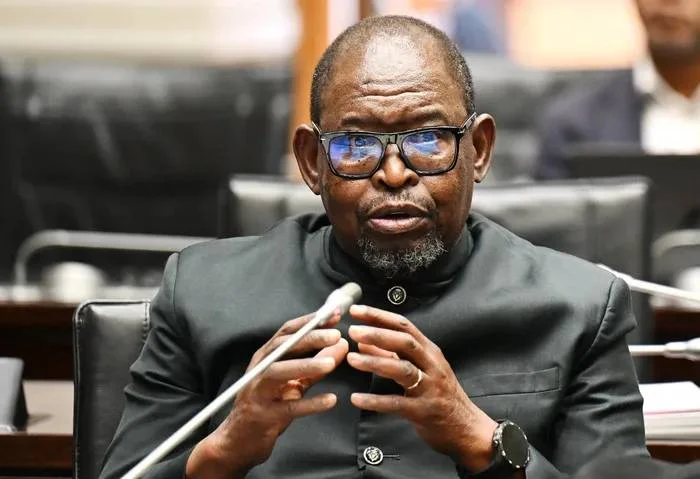
Finance Minister Enoch Godongwana is considering steps to restore stability at the Public Investment Corporation (PIC) after six nonexecutive directors were reported to have resigned less than a year after the board was appointed.
Financial news platform Currency reported on Wednesday, 22 July, that nonexecutive directors Lerato Makwetla, Lindy Bodewig, Mpumelelo Maseko and Dorothy Kobe had resigned the previous day. The report, by Vernon Wessels and Rob Rose, cited three well-placed sources.
Their departures follow the resignations of Thabi Nkosi and Nosiphiwo Balfour on 15 July, two days after PIC chief executive Patrick Dlamini was placed on precautionary suspension. Currency also reported that Godongwana had called a meeting for Monday, 27 July, to consider dissolving the board.
Godongwana declined to provide Daily Maverick with details of his plans. âI will not be commenting further on issues at the PIC in public. I have noted and received communication from the board and will, at an appropriate time, provide further details on the measures we are contemplating as the PICâs shareholder to ensure a return to stability for the entity,â he said in a written response.
If the four latest resignations are confirmed, the remaining nonexecutive directors are PIC chair and Deputy Finance Minister David Masondo, Stephen Boikanyo, deputy chair Mugwena Maluleke, Matimba Justice Shiburi and Lindiwe Motshwane.
According to Currency, the departures include the chairs of the committees overseeing listed investments, unlisted investments and risk. A person familiar with events told the publication that the board had been âhollowed outâ, with no investment experience left among the remaining directors.
The PICâs 2025 integrated annual report shows why the departures involve more than the number of people around the boardroom table. The PICâs constitution places control of its affairs in the hands of the board, and executive management handles day-to-day operations except for matters reserved for the board and its committees.
The report says a board or committee quorum is reached when most members participate, provided nonexecutive directors are in the majority. It requires the risk committee and three investment committees to be chaired by nonexecutive directors with sufficient knowledge and experience. The timing of the resignations will affect whether decisions can be validly taken and how quickly committees must be reconstituted.
The board was appointed about 10 months ago. The National Treasury had, however, already invited fresh nominations for the PIC and several other public entities at the end of May, before the latest governance crisis erupted. Nominations for new directors closed on 6 June.
The latest departures follow a nine-to-two board vote to suspend Dlamini while allegations in a whistleblower report are investigated. The board has said repeatedly that the suspension is precautionary and does not constitute a finding of wrongdoing.
Chief financial officer Batandwa Damoyi was appointed acting chief executive to provide continuity. The PIC also replaced acting chief investment officer August van Heerden with Leon Smit after the Government Employees Pension Fund (GEPF) did not approve Van Heerden as a key person under its investment mandate.
More than a boardroom dispute
The annual report recorded R3.049-trillion in assets under management at 31 March 2025, up 13.3% from R2.691-trillion a year earlier. By the time the present crisis erupted, the PIC said it managed about R3.7-trillion.
The GEPF accounted for 87.8% of assets in the annual report, and the Unemployment Insurance Fund for 5.58%. The remaining funds include assets belonging to the Compensation Fund, the Compensation Commissioner Pension Fund, the Associated Institutions Pension Fund and other public bodies.
Dlaminiâs suspension stems from a whistleblower complaint linked to his handling of a PwC investigation into the PICâs settlement of a long-running dispute related to Lanseria Airport. Dlamini has denied wrongdoing.
The corporation planned to divide the single chief investment officer position into three roles covering listed investments, unlisted investments and Âproperty and infrastructure. One of the three would eventually become executive director of the investment division.
The annual report shows that investment governance had already been reworked. In April 2024, the previous board approved an overarching group investment committee and separate committees for listed, unlisted and unlisted property investments. It said this additional oversight was a response to recommendations by the Mpati Commission and a board evaluation.
The Financial Sector Conduct Authority (FSCA) opened an investigation after becoming âincreasingly concernedâ about governance, leadership stability, transparency and confidence in the PIC.
The board initially said it had given the FSCA all the requested information and welcomed the regulatorâs oversight. Days later, Masondo told PIC employees that management had failed to inform him or the board about the FSCAâs earlier requests for documents concerning the whistleblower matter. He said he learnt about them through later correspondence and then supplied the information.
At the meeting, Masondo defended Dlaminiâs Âsuspension. He said the board obtained advice from senior counsel and had a duty to act on serious allegations rather than ignore them. He maintained that the PIC remained operationally stable and its investment mandates continued without interruption.
The PIC maintains that it implemented the Mpati Commission recommendations, including stronger whistleblower, ethics and conflict of interest controls. Its 2025 annual report was categorical: as at 31 March 2025, all 243 recommendations for which it was responsible had been implemented.
The same report said its three ethics reporting channels received 35 allegations of unethical or questionable conduct during the year. Only one had been concluded and closed by year-end; the other 34 remained under investigation. The largest category was unethical business practices, followed by fraud and corruption.
The Association for Monitoring and Advocacy for Government Pensions disputes this assessment. It says two recommendations remain unresolved: ending the deputy finance ministerâs role as board chair and placing greater weight on professional expertise in appointments.
The annual report acknowledges the tension. King IV recommends an independent nonexecutive chair, but Masondo is not independent because he is deputy finance minister. The PIC Act nevertheless requires the minister to designate the deputy finance Âminister, or another deputy minister from the economic Âcluster, as chair.
Godongwanaâs next move must establish whether the current board can still function and can settle the division of authority between the chairperson and the Âexecutive.
The PIC says its mandates remain intact. The reported board collapse shows that institutional stability is now in doubt. DM
This story first appeared in our weekly DM168 newspaper, available countrywide for R35.