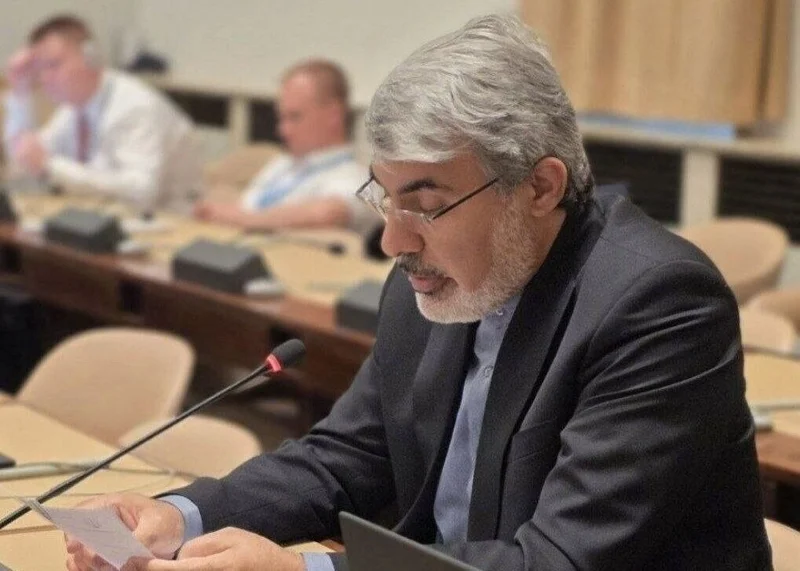
Iran calls for binding treaty to prevent an arms race in outer space
TEHRAN- Iran has called for the immediate start of negotiations on a comprehensive, legally binding international treaty to prevent an arms race in outer space, warning that the growing militarization of space poses a serious threat to international security and the peaceful use of space technologies.
Addressing the Conference on Disarmament in Geneva on Thursday, Iran’s Permanent Representative to the United Nations Office and other international organizations, Ali Bahreini, said the increasing dependence of societies on space-based technologies had made the security and sustainability of outer space a shared international concern.
Bahreini said Iran remained committed to preserving outer space exclusively for peaceful purposes and argued that the deployment of weapons and offensive military capabilities in space could undermine international peace and security and threaten the equal right of all countries to explore and use outer space for peaceful purposes.
Iran expressed particular concern over the development of military space programs and capabilities, including the establishment of dedicated military space forces, the designation of outer space as a war-fighting domain and initiatives such as the so-called “Golden Dome.” Bahreini warned that efforts by individual states to establish military superiority in space could prompt other countries to develop counter-capabilities, creating cycles of escalation and increasing the risk of an arms race.
Tehran also raised concerns over 'the increasingly hostile use of large satellite constellations, commercial satellites and other space-based systems.' Bahreini said international humanitarian law should not be applied in ways that could provide undue protection to commercial satellite networks when they are used for hostile purposes or in ways that infringe on the sovereignty of states.
Iran further argued that international protections should extend beyond objects in orbit to ground-based infrastructure that supports peaceful space activities. Bahreini said research and production facilities, launch sites, operational and monitoring centers, as well as civilian and scientific infrastructure supporting essential space services, should not be subject to military attack.
He accused the United States and Israel of targeting civilian and scientific infrastructure associated with Iran’s peaceful space activities during 'the recent full-scale war against Iran.'
According to Bahreini, the facilities supported disaster management, environmental monitoring, satellite communications, scientific research, public warning systems and emergency services.
Iran condemned the attacks and warned that a failure by the international community to respond could leave other states vulnerable to similar actions.
“Space security must not be defined solely from the perspective of technologically advanced countries,” Bahreini said, arguing that developing countries have the same right to security in their peaceful use of outer space.
Iran therefore called for the immediate commencement of negotiations at the Conference on Disarmament on a comprehensive, non-discriminatory and legally binding international instrument to prevent an arms race in outer space, commonly known as PAROS.
Tehran said such an agreement should prohibit the placement of weapons in outer space, prevent the threat or use of force from space against states or space objects, ban the use of space-based capabilities for hostile and offensive military purposes, and provide effective protection for peaceful civilian space infrastructure.
Bahreini said Iran regarded a draft treaty submitted by Russia and China in 2008 and updated in 2014 as a useful basis for future negotiations. The proposed framework seeks to prevent the placement of weapons in outer space and prohibit the threat or use of force against space objects.
Iran also rejected the idea that voluntary measures alone could adequately address the growing security risks in space. Bahreini said measures such as responsible-behavior norms, risk-reduction mechanisms and operational or technological restraint could complement a legally binding agreement but could not replace one.
“PAROS is an urgent security imperative,” Bahreini said, calling on states to move beyond fragmented and non-binding approaches and demonstrate the political will to begin negotiations without further delay.
Iran said any future agreement should also promote equitable and non-discriminatory access to outer space, space technologies and related capabilities, particularly for developing countries, while safeguarding their right to benefit from the peaceful uses of space.