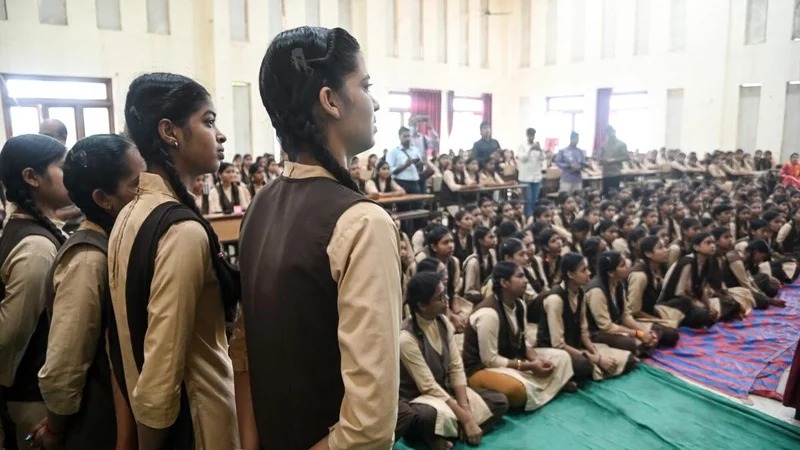
Imagine three children who are not getting the education their neighbours get.
The first is an Adivasi. The second is from a household belonging to the poorest 20% of the population. The third is a girl. The intuitive picture is that these disadvantages pile on top of one another: that a poor Adivasi girl carries three burdens, each multiplying the last.
Using household-level data from the government’s 2025 Comprehensive Modular Survey: Education (CMS-E), conducted as part of the 80th round of the National Sample Survey (NSS), we looked at whether that is true. Some of it is. A good deal of it is not. We found that the gender gap barely moves at all. It does not change with caste, or with income, or with anything a family can buy its way out of.
Caste and money
Start with private schooling. 42% of children from the General category attend a private school. For Adivasi children, the figure is 16%.
A major reason for this difference is that the cost of attending a private school is high, which many families cannot afford. Average monthly spending per person ranges from about ₹2,500 in Scheduled Tribe households to ₹3,900 in General category households.
We compared children whose families has similar education expenditure, live in the same State, and are at the same stage of school, as far as the data allowed.
For children from Other Backward Classes (OBC), the disparity in private schooling is mostly caused by income. 36 in every 100 OBC children attend a private school, about six in every 100 less than General category children. However, for OBC and general category families spending similar education expenditure per person, the gap nearly vanishes. But it returns when comparing children living in the same State, to about four in every 100.
For Dalit and Adivasi children, the difference barely narrows. About 22 in every 100 Dalit children and about 16 in every 100 Adivasi children attend a private school. Compare this with General category children, whose families spend the same amount per person, in the same State, at the same stage of school, Dalit children are still about 15 in every 100 behind and Adivasi children are 13 in every 100 behind. Two families spending the same amount, in the same State, with children the same age, and one child is markedly less likely to be inside a private school gate.
That residue is not a price. It is about which families believe a private school is meant for people like them, and which schools admit whom. It is the part of caste that money does not reach.
Money buys a school seat, not tuition
Private tuition behaves completely differently, and the contrast is the most useful thing in this data.
Household spending explains almost none of the caste gap in coaching. What explains most of it is geography. Compare a Dalit child and a General-category child in the same State, and the gap all but vanishes. India’s tuition economy is concentrated in the east, and different communities are not evenly distributed across the map.
Adivasi children are the exception again. Their coaching gap halves once you account for where they live, and then stops. Something we cannot see in this survey is still keeping them out.
Two markets, then, with two different logics. A school seat is a high, recurring cost that a household can or cannot afford. Neighbourhood tuition is cheap, bought a month at a time, and available only where somebody is selling it.
Gender gap ignores both geography and caste
Here is where the intuitive picture breaks down.
Nationally, 27.8% of enrolled boys receive private coaching, against 26% of girls. In private schooling the gap is similar: 34.7% of boys attend a private school, against 30.2% of girls. Set against most other gender statistics in Indian education, that looks almost like parity.
The obvious next question is who that small average is hiding. Surely the gap is wider among poorer families, where a rupee spent on a son cannot also be spent on a daughter. And surely it is wider among the communities already furthest behind.
Neither turns out to be true.
Take the income first. Among the poorest 20% of households, girls are about two in every 100 less likely than boys to receive coaching. Among the richest 20%, the figure is also about two in every 100. Between those two extremes, it wanders a little, but never far, and never in a consistent direction.
Now caste. Among Adivasi children, girls trail boys by about one in every 100. Among Dalit and OBC children, it’s about two in every 100, and among general category students, the effect is almost nil. The differences are small enough that they could easily be by chance rather than by real pattern and we test them to check and they are.
Nor does it change as children move up through school. The gap is much the same in the early years as it is around the board examinations, when the pressure on a family’s education budget is at its highest.
This is not what disadvantage usually looks like. Caste gaps shrink when you account for money. Coaching gaps shrink when you account for geography. The gender gap does neither. It sits at roughly the same size across the whole of Indian society — rich and poor, Dalit and Brahmin, east and south.
A daughter in one of India’s wealthiest households is passed over at about the same rate as a daughter in one of its poorest. Whatever produces that is not scarcity, because the richest 20% are not short of money. It is a decision families make about a son and a daughter that appears to be made much the same way at every income level.
What this means
We see three inequalities, and they do not behave the same way.
Part of the caste gap is money. The rest is not, and for Dalit and Adivasi children the rest is most of it. Our data cannot show what that remainder is made of, but it is the sort of thing money does not fix: whether a family expects a private school to take their child, whether they have been turned away before, whether anyone they know has been admitted. Fee waivers do not reach any of that. This matters for policy, as the Right To Education Act’s reservation of private school seats is administered largely as an income test, and an income test cannot close a gap that income does not explain.
Access to tuition is mostly about where a child lives, which is a question of where public education has become so thin that families feel obliged to buy a second version of it.
And gender runs underneath both, unchanged by either. It is the one gap in this data that India’s growing prosperity shows no sign of closing on its own. Households that can afford everything else are still, on average, buying slightly less of it for their daughters.
Source: Comprehensive Modular Survey on Education (CMS-E) 2025, unit-level data, Ministry of Statistics and Programme Implementation. Estimates are survey-weighted and cover currently enrolled children.
(Raunak Maitra is a Master’s student at the Centre for Development Studies, Thiruvananthapuram. Karan Babbar is an Assistant Professor of Economics at XLRI Jamshedpur.)
Published - August 21, 2026 08:30 am IST