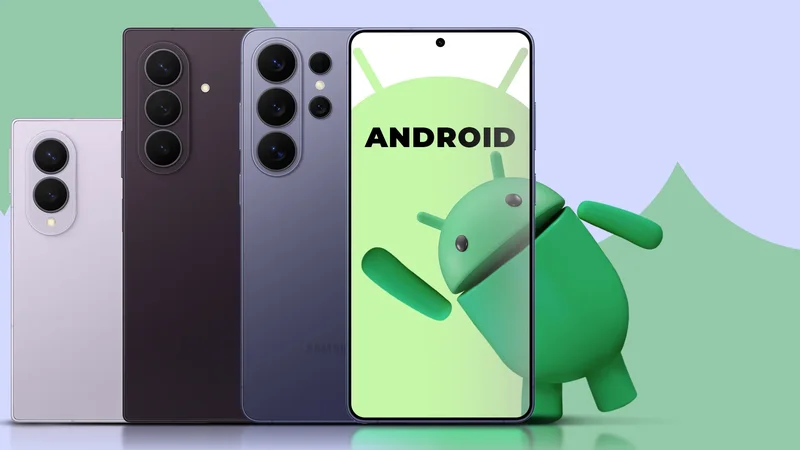
Google may own Android, but the more I look at the Google Pixel lineup, the harder it is to see the Pixel as the platform's true showstopper.
While Google has improved its phones in small, careful steps, compared with Samsung's pace with foldables, customization, ecosystem features, and hardware variety, the Pixel often feels conservative.
And after seeing how little Google has done with Pixel compared to Samsung over the year, I can't help but feel that Samsung is still the real face of Android.
Google has stopped feeling ambitious with the Pixel
Google still treats Pixel like a limited-market product
The last few Pixel launches have left me with the same feeling: Google is refining its phones, but it is rarely pushing them somewhere new.
The cameras get better, the chips improve, Gemini gains more tricks (which eventually come to Samsung phones), and the designs receive small tweaks, but the overall formula barely changes.
For a company that controls Android and has been making its own phones for years, I expect a little more ambition.
I am not asking Google to add features simply to fill a spec sheet. But Pixel hardware should feel like the place Android's creator takes risks.
Instead, most of the excitement now seems to come from software and AI features that could eventually appear elsewhere.
Availability is another area where I struggle to give Google a pass anymore.
The Pixel is no longer a new experiment. Google has been building these phones for years, yet buying one can depend heavily on where you live.
A phone can't really become the face of a global platform if huge groups of Android users barely encounter it.
Samsung shows up in more places, at more price points, and for more kinds of buyers.
Samsung understands Android customization better
Good Lock represents Android at its best
This is where Samsung feels much closer to what Android has always meant to me.
Samsung gives me more choices almost everywhere I look. I can reshape the lock screen, change the home screen layout, customize the Quick Settings panel, automate my phone with Modes and Routines, and decide how notifications should appear.
That flexibility makes Samsung the perfect example of Android's famous "Together, not the same."
Good Lock takes that philosophy to another level. It is the clearest example of why I still associate Samsung with Android's freedom.
Instead of deciding that one interface works for everyone, Samsung hands me the controls.
With Good Lock, I can go beyond changing a wallpaper or icon pack. I can use it to redesign almost every part of One UI.
I don't need every one of these options, but that's exactly the point. Samsung lets me decide which ones matter.
Pixel's simpler approach will appeal to plenty of people, but Android was never supposed to mean one rigid experience.
Samsung offers Android for almost everyone
It made foldables genuinely mainstream
One of Samsung's biggest advantages is that I don't have to fit into a single idea of what an Android phone should be.
If I want something affordable, there is the Galaxy A series. If I want everything Samsung can throw at a conventional phone, there is the Ultra.
If I want something different, Samsung now gives me multiple foldable options.
The new Galaxy Z Fold 8 is a great example. Samsung has moved to a broader form factor, with a 5.5-inch cover display and a 7.6-inch inner screen that opens into a wider 4:3 canvas.
Samsung even offers the Fold 8 Ultra with a larger 8-inch main display, alongside the compact Flip 8.
That variety matters because this is exactly what Android should enable.
Samsung isn't asking everyone to buy the same slab phone in three sizes. It is experimenting with shapes, screen ratios, price points, and use cases.
Google may have conventional flagships and its own foldable, but Samsung gives me more ways to choose an Android device that fits my life.
Samsung takes more risks, even when they fail
Galaxy feels like a platform, not one phone line
What I appreciate about Samsung is that it is still willing to try something unusual.
Not every experiment becomes a hit, but that has never stopped the company from pushing ahead. The Galaxy Z TriFold is the perfect example.
I may not necessarily want every experimental Galaxy device, but I want Android manufacturers to take these kinds of risks.
Compared to Google, Samsung also feels bigger than a collection of smartphones.
To me, it is the only Android OEM that goes toe-to-toe with Apple when I look at the whole ecosystem.
Galaxy phones sit alongside mature Galaxy Tab tablets and a full Galaxy Book laptop lineup.
Add watches, earbuds, TVs, and SmartThings, and Galaxy starts feeling like a platform of its own rather than another Android phone brand.
Galaxy is still Android's default image
None of this means Pixel phones are bad, far from it. Pixels still have an important place in the Android world.
My issue is that the Pixel no longer feels like it represents everything Android can be.
Samsung does more with the freedom. From Good Lock and DeX to foldables, broader availability, and a much wider device ecosystem, Galaxy shows Android at its most flexible and ambitious.