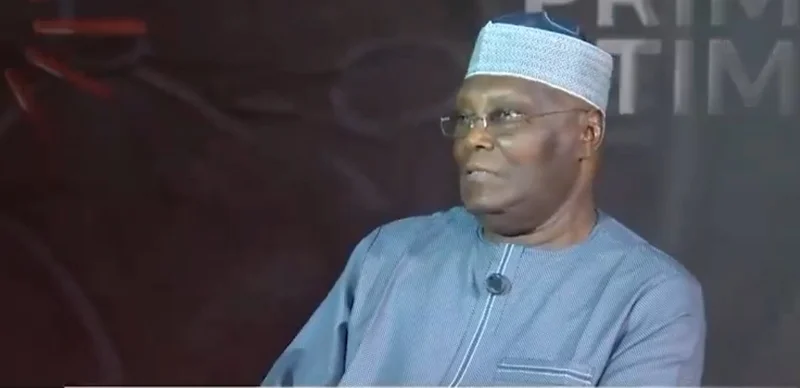
The media adviser to former Vice President Atiku Abubakar, Paul Ibe, has defended his principal’s decision to change his position on petrol subsidy, saying a leader should be willing to review a policy when its implementation causes hardship to citizens.
Mr Ibe made the position known in a statement posted on his X handle on Friday, in response to the presidency’s criticism of Atiku’s recent promise to restore petrol subsidy if elected president in 2027.
The Special Adviser to President Bola Tinubu on Information and Strategy, Bayo Onanuga, had criticised Atiku’s position as a reversal of the policy stance he held during the 2023 presidential campaign.
PREMIUM TIMES reported that Atiku, the presidential candidate of the African Democratic Congress (ADC) for the 2027 election, had said he would restore petrol subsidy if elected, arguing that the removal of the subsidy had imposed severe economic pressure on Nigerians without sufficient evidence that the savings had been properly deployed.
| | |
|---|
“If I win the presidential election, I will restore the subsidy. And anyone who stole Nigeria’s subsidy funds must return the money,” Atiku said during a Facebook Live session.
He also questioned what had happened to the money saved from ending the subsidy, asking whether the funds had been used to improve healthcare, education and security.
The former vice president acknowledged that he had initially supported the removal of the subsidy but argued that circumstances and the policy’s consequences had changed his position.
His proposal has since triggered a renewed confrontation with the presidency, which accused him of abandoning his earlier economic position for political reasons.
Mr Onanuga argued that returning to a subsidy regime would be retrogressive and fiscally unsustainable, while also challenging Atiku to explain how the proposed subsidy would be funded.
The presidency also disputed Atiku’s claim that the government had accumulated about N30 trillion in savings from subsidy removal, saying there was no such windfall. It argued that the former subsidy system had placed a significant burden on the Nigerian National Petroleum Company Limited and that the removal had helped correct longstanding distortions in the petroleum market.
Leaders must be willing to change course
Responding to the criticism, Mr Ibe said Atiku should not be attacked simply because he was prepared to reconsider a position he held in 2023.
“Leadership and heartlessness should never go together,” he said, arguing that a responsible leader must be prepared to “rethink, restructure or even reverse a policy” where its implementation was causing severe hardship.
Mr Ibe acknowledged that Atiku supported the removal of petrol subsidy during the 2023 campaign, but said changing a policy position after observing its consequences should not automatically be regarded as hypocrisy.
According to him, the more important issue should be whether the policy has improved the lives of ordinary Nigerians and whether the resources released by the reform have translated into better transportation, healthcare, education, employment and social protection.
“Public policy does not work that way,” Mr Ibe said, rejecting the argument that Mr Atiku’s 2023 position should permanently bind him to the policy.
He argued that governments routinely reassess policies, while economists revise assumptions and central banks change course when circumstances change.
“Presidents should be capable of doing the same,” he said.
World Bank data
Mr Ibe also cited World Bank assessments to support his argument that the subsidy removal and other reforms had imposed significant short-term costs on households.
The World Bank said after the subsidy was removed in 2023 that petrol prices increased sharply, with retail gasoline prices rising by an average of 163 per cent. It also said the reform contributed to inflation and placed particular pressure on poor and vulnerable Nigerians.
The bank subsequently maintained that the reforms were necessary to restore fiscal stability but stressed that social protection and compensation would be needed to shield vulnerable households from the effects of higher petrol prices.
More recent World Bank data cited by Mr Ibe showed that an estimated additional seven million Nigerians fell into poverty in 2025, taking the estimated proportion of the population living below the national poverty line to 63 per cent.
The World Bank also said poor households spend up to 70 per cent of their income on food, while noting that improvements in Nigeria’s macroeconomic indicators had not yet translated sufficiently into better living standards for many citizens.
Mr Ibe said the figures underscored the need to assess economic reforms not only by their impact on government finances or macroeconomic indicators but also by their effect on ordinary Nigerians.
He said the distinction should be made between acknowledging the problems associated with the old subsidy system and supporting the manner in which the subsidy was eventually removed.
“There is also an important distinction between recognising that the old subsidy regime was expensive, opaque and vulnerable to abuse and insisting that the only alternative was the manner in which subsidy removal was implemented,” he said.
Atiku’s plan
Mr Ibe said Atiku’s proposed approach was not simply a return to the old subsidy arrangement but part of what he described as the Atiku Economic Recovery Plan (AERP).
He said the plan would focus on reducing domestic refining costs and linking government intervention to locally refined petroleum rather than relying on imported products.
According to him, lower refining costs would translate into lower petrol and diesel prices, which would reduce transportation and logistics expenses across the economy.
He said farmers would consequently spend less on transporting agricultural produce to markets, while manufacturers would benefit from lower production and distribution costs.
“Additionally, manufacturers will face lower production and distribution cost,s and businesses will have greater capacity to invest, employ and expand,” he said.
Mr Ibe said the ultimate objective was to revive an economy he claimed had been weakened by the Tinubu administration’s economic policies.
“Ultimately, the Atiku plan will jumpstart the economy laid prostrate by Tinubu’s ‘Bole Kaja’ policies,” he said.
For Mr Ibe, the test of economic policy should ultimately be its effect on Nigerians.
“Policies are made for people. People are not made to suffer indefinitely for policies,” he said, adding that when a policy hurts the population it was designed to serve, “compassionate leadership demands the courage to rethink it.”