History gives us iconic visuals that etch themselves into collective memory and political calendars.
Sometimes, however, it is the uncaptured image that forms in our imaginations that holds unshakeable power in the mind.
Like how we imagine Gcina Dhladhla dying in a toilet cubicle of the car tracking company she worked for after allegedly being denied sick leave and forced to work when she'd complained that she was feeling ill.
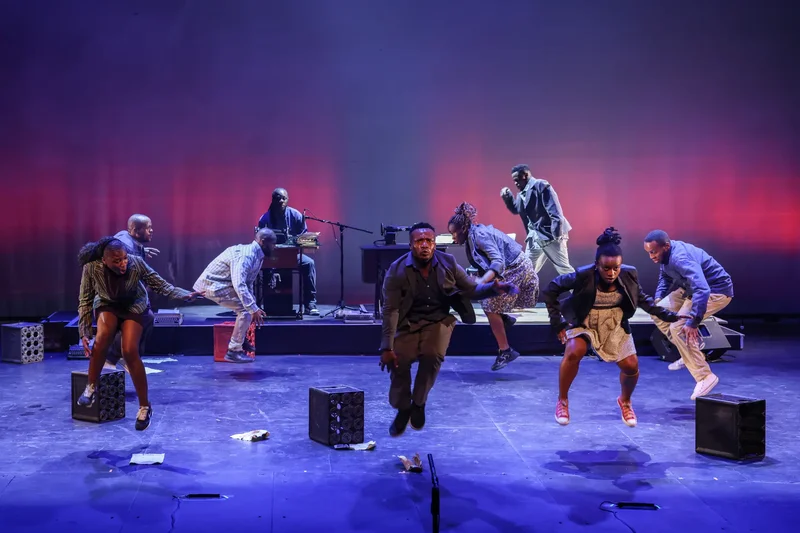
The disturbing horror of workplace exploitation and inhumanity such as Dhladhla's story and the Marikana massacre, with its 14th anniversary coming up on August 16, is what the dance theatre production Izithukuthuku: The Tattered Soul of the Worker gives attention to.
The urban and domestic collide in the opening sequence of the show.
In a powerful use of lighting, a frozen moment of the performers portraying life of migrant labouring is silhouetted onto the wall for a dramatic haunting.
The still images may represent the lives and spirits of commuting workers; or "cogs in the machine", bringing forth the thematic weight of the production in a poetic style.
Ushering the performers into movement is a pulsating percussive soundscape from which the work is grounded and erupts.
Izithukuthuku, which translates into "fruits of my sweat", critiques the violence of capitalism and how it erodes the psyche of many who toil for survival in Johannesburg and similar industrial cities across the globe.
Co-conceptualised by isi Pantsula dancer and choreographer Vusi Mdoyi and director and theatre maker, Phala Ookeditse Phala of VAP Dance Academy, Theatre and Studios, the work's exploration of the working class's erosion is not linear.
The storytelling employs a stylised, fragmented narration of a disturbed mind to display the damage.
"When we began conceptualising Izithukuthuku, woefully sitting with our thoughts was the mass murder of 34 striking Marikana miners in 2012 by the police.
This massacre is one of many examples of the brutality of the state against members of the working class who fight for improved working and living conditions," Mdoyi and Phala say.
"The capitalist system does not provide adequately for old-age pensions, sick leave and unemployment compensations, so those who leave active workforce must rely on another comprehensive socio-economic organisation to fulfil these vital needs. When their strength is spent, the system simply discards them, leaving them with little to no means of survival."
The dance that unfolds expresses the anxiety of the dilemmas as a form of release. The movement structure is a fluid hybrid of contemporary and indigenous African dance centred by isi Pantsula. The dance form, with its origins in the vibrant cultures and street smarts of Johannesburg's townships of the 1950s (specifically Sophiatown), is a fusion of different styles. Its electric footwork of rhythmic twisting, stomping and shuffling takes from tap dance, jive, African movement and gumboot dance.
Having embedded itself in the fabric of South Africa's urban cultures, fashion and music, it is intrinsic to the formations of Kwaito and Amapiano which represent the cultural identities and voices of South African youth.
IsiPantsula carries with it the history of the oppressive socio-political environments that gave birth to it.
And it is a dynamic response thereof. It is a dance of resilience, pride, ingenuity and survival. Consider the story behind the origins of gumboot dance for instance.
The Wellington thick rubber rainboots were a compromise to avoid the cost of pumping the tunnels dry from putrid waters in the harsh gold and diamond mines of South Africa's Witwatersrand area in the 19th and 20th centuries.
The miners were not allowed to speak to one another, so, when they got their gum boots, they created a coded language of boot taps, whistles and body slaps to communicate to one another signalling for rest and warning of danger.
But the gumboot dance was essentially a criticism of the poor working conditions at the mines.
In Izithukuthuku, isi Pantsula (and its hybridised components) becomes a language for the production's activism and protest. This protest is meditative and militant. The dances, together with their sonic accompaniment and by-product, lend themselves to dramatisation and symbolism.
The incessant sound of the typewriter is designed to illustrate capitalism's instructive language. Beer crates are tools to drive meaning and storytelling, sometimes aesthetically or in an abstract way. Certain movements and gestures signal significant events.
The train ride may conjure the lamentations of the migrant worker as delivered in Hugh Masekela's Stimela. There's the toyi-toyi in remembrance of the slain 34 striking Marikana miners. The ironing and nostalgic laundry washing by foot in metal bathtubs symbolise domestic work whose minimal wage often occupies national debate.
African traditional dance in conjunction with immersive percussive sound tends to get heightened to transcendent states. This quality is alive here. The show crescendos to moments where improvisation and the interiority of individual bodies takes over.
Where the subjectivities of the performer meet the ideas and emotion of the work in motion.
Izithukuthuku is not separate from its creators. It is the evolution of a meditation on life in capitalist systems borne out of colonial and oppressive histories.
"How do we engage with the debilitating pain of labour physically, intellectually or spiritually? How do we make sense of the world we live in; and how do we mediate irrational violence and injustice in current and past human history?" These are the questions the creators grapple with through this work and they invite the audience to sit with them in an affecting performance.
Incubated at William Kentridge and Bronwyn Lace's The Centre for the Less Good Idea, Izithukuthuku was developed from short-form versions which include Vuka Kleva and Footnotes which explore labour and survival in the metropolis through IsiPantsula.
It was initially commissioned by African-American dance company Step Afrika as part of its 30th anniversary at the Soweto Theatre, as a 20-minute snippet in 2024. It was later showcased at the National Arts Festival and at the Kinani Dance Festival as a fuller 55-minute piece in 2025.
After its recent and brief 2026 run at The Centre for the Less Good Idea, the show prepares for its European tour, with hopes for local showings for the 2027 season.
Izithukuthuku will be showing in Groningen, Amsterdam (Noorderzon) from 20 to 22 August; in Basel, Switzerland (Theatrefestival Basel) on 26 and 27 August and in Weimar, Germany (Kunstfest Weimar) on 30 August.