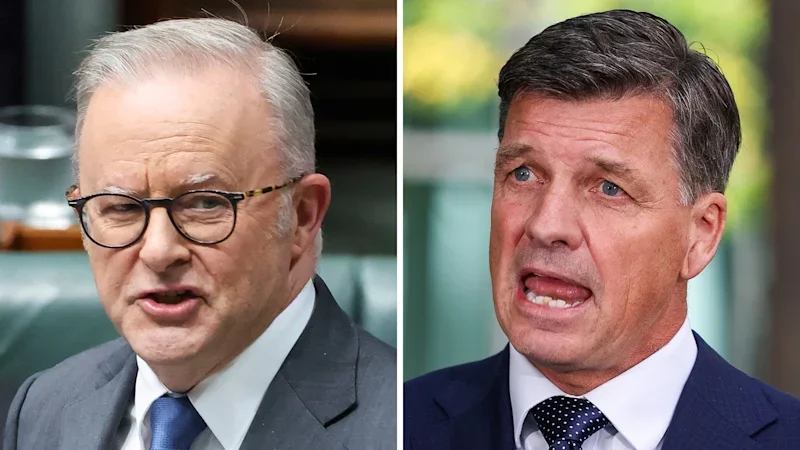
Labor and the Coalition are nearing bipartisan consensus on AI, aiming to avoid a US-style backlash against data centres ahead of next week’s national cabinet meeting.
In a new point of difference with One Nation, the Coalition has extended an olive branch to the prime minister on proposed AI regulations that will be discussed at Wednesday’s meeting of the national cabinet in Sydney.
Opposition home affairs spokesman Jonno Duniam said One Nation risked compromising Australia’s economic growth and national security if it ran a populist campaign against data centres, meaning it was “essential that the parties of government work together”.
Duniam said the far-reaching innovation presented a once-in-a-generation chance to grow the economy and that a bipartisan consensus would help secure investment from international tech firms, hopefully allowing Australia to build its own AI products.
This masthead revealed earlier this month that Albanese was talking to the White House about securing first access to the most advanced models, known as frontier models. Australia could gain leverage with the US, currently locked in a battle for tech supremacy with China, by attracting firms such as Anthropic, which plans to invest $21 billion to make Australia a second home.
“One Nation needs to tell us if they’re not going to allow data centres to be built in Australia,” Duniam said in an interview with this masthead. “If they’re just a blanket ‘no’ on things like data centres, that puts us in that category of doing nothing, which means China wins. Chinese models will be here in Australia hoovering up our data and people will be using Chinese models, which we have no control over.”
Senior figures in the government welcomed Duniam’s co-operative overtures, which could allow the major parties to forge an upbeat consensus on the AI debate that has eluded the US.
The moves towards a bipartisan stance on AI caps a fortnight in which Labor and Coalition excluded One Nation and the Greens from deals on slashing the NDIS, forcing tech firms to fund journalism, and curbing gambling advertising. Opposition Leader Angus Taylor’s forces have been well behind Hanson in the polls. The deal-making has in part been driven by an intent to prove the Coalition’s ability to shape policy and sway outcomes.
Albanese gave a speech on AI last month aimed at convincing voters that AI firms would need to follow rules on energy and water use. Duniam said his olive branch was designed to tamp down populist campaigns and to make sure the sector “gets and keeps its social licence”.
One Nation, surging in the polls, has talked up the AI opportunity, but Hanson has warned about self-regulation. In a social media post last week she put the US, Australia’s chief security ally, and China, on the same plane: “On AI, I believe we must protect Australian jobs and keep our data secure by building capacity here, not handing it to China or America.” The Greens have been campaigning for a moratorium on data centres.
The Coalition is about to release a set of AI principles which are relatively similar to those released by Labor, focusing on productivity gains and making sure data centres did not suck up resources and were built in acceptable locations.
One important sticking point is a feud over the use of fossil fuels to power data centres, which give firms such as Google, Anthropic and ChatGPT computing power to respond to searches, create new models, and produce videos. The energy market operator estimates that 6 per cent of the energy grid will be used to power data centres in 2030, up from 2 per cent now. Labor is already struggling to build enough wind and solar.
Energy Minister Chris Bowen has taken a hard line, saying data centre operators must use green energy only. But others in the government have opened the door to the use of gas.
The Albanese government has indicated it could steamroll conservative state governments of Queensland and NT at Wednesday’s national cabinet, where Albanese will seek in-principle support for his new national AI standards.
Another national cabinet meeting will be held in October to formally sign off on the standards, which the government wants to put into law next year.
Labor’s Assistant Minister for Science, Technology and the Digital Economy Andrew Charlton used a speech on Monday to say that Australia’s abundance of energy and land should be used to push Australia up the value chain.
“Australia is playing in the bottom of the stack, in energy and data centres, but most of the real economic value is higher up in the chips, models, software and intellectual property,” he said.
“The next step is using the data centre advantage and investment boom to grow our AI training ecosystem.”
Coalition spokesman for science and technology Aaron Violi applauded a bipartisan committee on AI that was established by the parliament this week.
“While AI has enormous potential to improve our lives and livelihoods, we cannot be and we are not complacent about the risks. This is why this committee will also examine the workforce and skills implications of AI job displacement but also job creation,” he said.