On a moonless night in 1908, a group of Royal Navy ships sailed into the darkness during a training exercise in the English Channel. To simulate a torpedo attack, one of the vessels set off a flare.
The bright flash was “exceedingly dazzling,” Cecil Vinning, an engineer-lieutenant on the HMS Tiger, later recalled. Because the night was so dark, “it was impossible to see anything afterwards for a moment.”
As his eyes adjusted, he realized that the Tiger, a torpedo boat destroyer, had unexpectedly cut into the path of the Berwick, a 10,000-ton cruiser. When the ships collided, the Tiger split in two. “The portion on which I was standing sank to the level of the water,” Vinning said, “and I was enveloped in the wave which came over the side.”
One segment sank immediately, while the other stayed afloat for roughly three minutes. More than half of the 57 crew members died on the night of April 2. Vinning was one of only 22 survivors. When the Royal Navy searched the area for the wreckage, the Tiger was nowhere in sight.
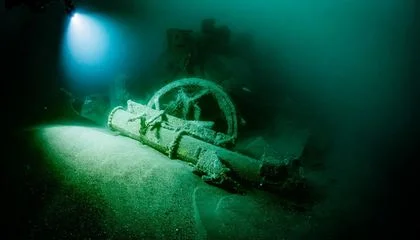
Now, 118 years later, divers and historians from ProjectXplore have finally identified the wreckage of the missing destroyer. The Tiger’s final resting place is south of the Isle of Wight and 200 feet below sea level.
“It has been the privilege of a lifetime to research, discover and document the wreck of HMS Tiger,” Leo Fielding and Dan McMullen, co-organizers of ProjectXplore, say in a statement. “We sincerely hope that our work will ensure that HMS Tiger, her story and the memory of those connected with her endure for future generations.”
The exact causes of the wreck have always been a mystery. In court-martial proceedings held weeks after the accident, some witnesses suggested that the flares may have impeded visibility. Even so, “the court made no specific finding on this point,” according to ProjectXplore’s report. As one naval officer told journalists, “I do not suppose that the mystery will ever be cleared up.”
The day after the collision, Edward VII sent a telegram to Britain’s first lord of the Admiralty expressing his sympathy “to the widows and families of those who lost their lives in the Tiger disaster.” The wreck made headlines, with the Daily Telegraph describing how the men tried to “save themselves as best they could by clinging to oars, spars and pieces of wreckage.” As a crew member from a nearby ship recalled, “The Tiger had as much chance as a sardine tin against a railway engine.”
ProjectXplore has been looking for the Tiger since 2022, when researchers began analyzing telegrams, newspaper clippings, court-martial transcripts, logbooks and contemporaneous reports connected with the accident. Based on these findings, they started surveying sections of the seabed with sonar.
The team identified the outline of the wreck in 2025. Divers finally explored the stern section in June. The following month, they dove to the bow section. During these investigations, divers found “compelling evidence regarding the final moments leading to the collision, preserving details that have remained undisturbed for 118 years,” ProjectXplore writes in a social media post.
The first clue was a dial that displayed the angle of the rudder. The pointer on the dial was set between roughly five and ten degrees to starboard, suggesting that the Tiger “had not altered course to avoid Berwick immediately prior to the impact,” per the report. The second clue came from the stern engine revolution telegraph, which featured a dial pointing toward “full.” This discovery suggested that the ship “had not reduced speed to avoid collision with Berwick,” though the evidence doesn't explain why the collision occurred.
ProjectXplore has found other historic shipwrecks before. Just last year, the Royal Navy announced that the organization had identified the HMS Nottingham, which a German submarine torpedoed on August 19, 1916.
The wreckage of the Nottingham was “incredibly intact—everything from the bridge back over is as it was the day it went down,” McMullen told Forces News’ Kitty Logan in 2025. “I’ve never seen the propeller that shiny and that well-preserved, ever.”
The discovery of the Tiger coincides with new legislation that’s currently making its way through Parliament. Some of the proposed amendments to the Armed Forces Bill could designate wreck sites like the Tiger as “protected places” from the moment they’re discovered. Divers, included groups like ProjectXplore, would still be able to visit these sites, but they wouldn’t be allowed to recover objects from them without permission.
The ProjectXplore divers photographed and measured the wreck, but they didn’t remove any objects from the site. They did, however, leave one behind: a wreath of poppies, placed beside the vessel’s tiller, to commemorate the 35 victims who died on that fateful night.