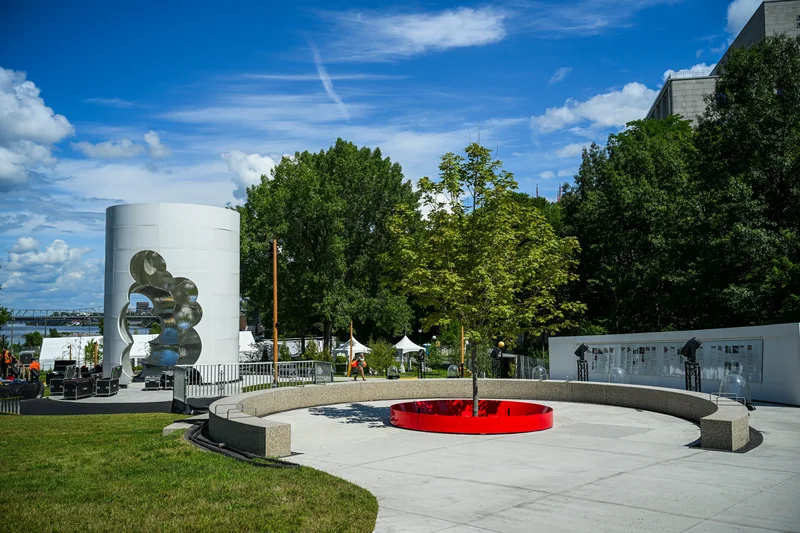
Victims of state prosecution hope Canada’s new national monument for LGBTQ+ people will be a place to learn, grieve and celebrate.
The monument officially opened Thursday morning in Ottawa, just west of Parliament Hill.
“We’re telling the stories of what happened to so many of us, and making sure that Canadians know this is a time we should never return to,” said Michelle Douglas head of the LGBT Purge Fund, in an interview.
Douglas speaks on behalf of members of the military and public service who were pushed out of their jobs on the suspicion they were part of a gender or sexual minority, a practice that was commonplace in the federal government during the Cold War.
The Heritage Department website says “the Purge was a prolonged and widespread campaign led by the Government of Canada to identify and expel thousands of lesbian, gay, bisexual and transgender members of the Canadian Armed Forces, the Royal Canadian Mounted Police and the federal public service.”
It began in the 1950s and continued into the 1990s.
The monument opening Friday was funded through a settlement in a class-action suit brought by 719 people who said Ottawa purged them because of their sexual orientation or gender identity. The $145 million settlement set aside $15 million for the monument and memorialization exhibits.
“Not enough people know that this was a historical injustice of great magnitude,” said Douglas, who is lesbian.
She said researchers have estimated 9,000 people across the federal workplace “were hunted down, they lost their jobs, they were harassed and discriminated against,” including Douglas herself.
“In the late 1980s, I was ultimately fired by the Canadian Armed Forces with the words written on my release documents ‘not advantageously employable due to homosexuality,’” said Douglas, whose lawsuit in 1992 forced the military to expand anti-discrimination policies.
The monument is called Thunderhead, which refers to a cumulonimbus cloud that appears large and tall in storms, often bringing heavy rains and lightning.
In Anishinaabe teachings, thunderheads are clouds home to the thunderers, beings “whose storms renew the land and make things right,” the LGBT Purge Fund says.
“A thunderhead cloud … holds the potential for enormous power, and the sense that it could erupt with renewed energy and hope at any moment,” Douglas said.
The design involves a sculpture with the imprint of a cloud in mirrored tile, with hundreds of thousands of small glass squares meant to evoke disco balls. Indigenous attributes symbolize identities that existed before Europeans imposed a gender binary.
The monument sits along an Ottawa River cycling path, in view of the Supreme Court and Parliament.
Douglas said there are spaces to read about history and quietly reflect, picnic benches to meet with friends and spaces to gather for solemn occasions. The Public Service Pride Network is holding a dance party this evening around the monument.
“We can express our joy and our love here,” Douglas said. “We hope any visitor will make it what they need it to be.”
Douglas was joined at an opening ceremony Friday morning by dignitaries including Gov. Gen. Louise Arbour, who said the timing of the event was particularly poignant after the deadly attack at Pride festivities in Berlin last month.
“We acknowledge the harmful biases and prejudices that led us to treat some of our fellow citizens as less deserving of a proud and dignified life,” Arbour said.
The ceremony comes amid a global rollback in LGBTQ+ rights, from transgender children saying provincial policies make them unsafe at school, to Senegal and Ghana making boosting criminal penalties for same-sex relations and LGBTQ+ advocacy.
U.S. President Donald Trump has sought to exclude transgender people from federal institutions and reversed policies meant to protect minorities.
“Discrimination must be fought, wherever it exists. And I think the LGBT purge is a cautionary tale that it is wrong to simply judge people for the way they identify,” Douglas said.
“We should not have to fight so hard for our mere existence. Here, of course, I think of people who are trying in some ways to erase the lives of trans and non-binary people.”
Similar monuments exist elsewhere, such as the Homomonument in central Amsterdam, which uses granite pink triangles that evoke the cloth badges Nazi used in concentration camps to identify LGBTQ+ people.