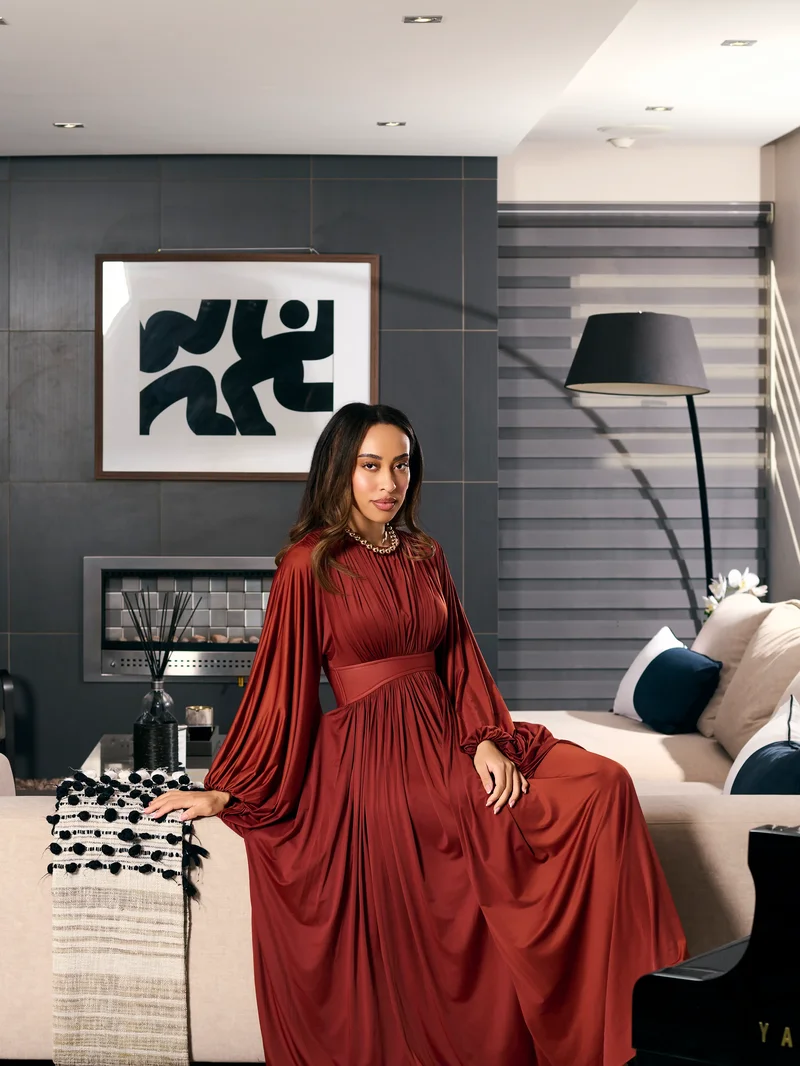
For more than a decade, Sarah Langa built her reputation in fashion.
Long before content creation became a career, she was among the small group of South Africans experimenting with what social media could become, helping transform Instagram from a platform for sharing outfit photos into a viable business for creatives.
But while audiences came to know her through fashion campaigns, beauty partnerships and lifestyle content, Langa says design was always the thread running through her life.
"My true passion and interest lies in fashion and design," she says.
After more than 10 years working in the digital space, she found herself asking a difficult question: What comes next?
For Langa, the answer was not simply about changing careers.It was about finding a creative practice that could grow alongside her life.
"I wanted to go into an industry that would allow me to evolve as a person," she explains."I always wondered what happens if I'm a mom. How would I continue creating the same kind of content as I moved through different phases of life?"
The question eventually led her away from fashion and towards interiors, although the seeds had been planted years earlier.
As a child, she constantly imagined redesigning her bedroom.Later, after buying her own home, friends increasingly turned to her for decorating advice.Before long, she was designing their spaces too, without charging a cent.
It eventually became clear that what had started as instinct deserved professional training.
Langa moved to London to study interior design, spending three years immersing herself in design history, theory and practice before returning to South Africa early last year.
"I knew this was something that needed to be executed at home," she says.
Returning to South Africa was not simply a matter of bringing international skills back home.It was also about questioning why so much of contemporary interior design continues to borrow from European and Asian aesthetics while overlooking the richness of African visual culture.
During her studies she became fascinated by the histories behind movements such as Art Deco, Minimalism, Japandi and Maximalism.Every design philosophy, she noticed, emerged from a particular historical moment, technological development or cultural identity.
What she struggled to find was an equally established philosophy rooted in African experiences.
"There are so many design philosophies but there's nothing that truly represents an African aesthetic," she says."Not in a gimmicky way but in an authentic way that represents African cultures, craftsmanship and the resources we have."
The realisation became the foundation of her design practice.
Rather than looking overseas for inspiration, Langa began paying closer attention to the materials and traditions that surround South Africans every day but often go unnoticed.
She points to animal hide sold on roadside stalls, indigenous grasses, locally produced textiles and centuries-old weaving traditions as examples of resources that many people take for granted despite their immense design value.
"There are places in the world that have never even seen real animal hides," she says."Meanwhile, we drive past vendors selling it every day without appreciating how valuable it is from a design perspective."
For Langa, the materials are not simply decorative elements.They are part of a larger effort to define what an African luxury interior might look like without relying on imported trends or borrowed identities.
Her ambition is to develop what she describes as "an African home" and, eventually, an African design philosophy.
The vision comes into focus at this year's Decorex Africa, where Langa is making her exhibition debut less than a year after launching her interior design brand, SL Interiors.
The exhibition's theme, The Soft Life, initially suggested obvious visual cues.
"When Decorex announced the theme, I immediately thought about fluffy fabrics," she laughs.
But instead of interpreting softness through textures alone, she chose to explore it emotionally.
"I thought about softness as a nostalgic experience rather than a physical one," she explains.
"It's about those memories everyone has of growing up in South Africa and the feeling of comfort that comes with them."
Her installation draws less from luxury as spectacle than from familiarity.
Rather than creating pristine showrooms filled with untouchable furniture, Langa wants visitors to feel as though they have entered a lived-in home, one that carries echoes of grandparents' houses, childhood memories and everyday South African life.
She believes true softness comes from spaces that invite people to stay rather than simply admire them.
That philosophy also extends to how the furniture is made.Instead of celebrating industrial manufacturing, Langa wants to return attention to skilled hands.
"How do we go back to making pieces with real hands?" she asks."Our hands. Our uncles' hands. Our aunties' hands."
It is a philosophy that shapes the objects and the people involved in producing them.
Behind her showroom is a factory staffed by artisans who have spent between 15 and 20 years crafting furniture.
Rather than chasing seasonal trends, Langa says they are creating timeless pieces that can remain relevant decades from now.
"I told the team we're making furniture that's not trendy but will last forever."
The Decorex installation also reflects her belief that collaboration is essential to building a distinctly African design language.
She is working with ceramic artist Bheki Ndlovu, whose sculptural works transform wildlife into hand-painted vessels that require weeks of meticulous craftsmanship.
Future collections will include beaded furniture, with intricate beadwork wrapped around solid oak table legs, while another collaboration with Mos Crib brings together weavers from South Africa and Eswatini to create woven grass furniture.
One of the installation's centrepieces is a woven chair that carries particular emotional significance.
"My mom is from Swaziland," Langa says."So having grass sourced from there felt like bringing pieces of home into Decorex."
Her fashion background also continues to influence the project.
She sees enormous potential in inviting fashion designers, embroiderers and textile specialists into furniture making, allowing traditional fashion craftsmanship to reshape contemporary interiors.
"Collaborative effort is what's going to spark innovation," she says.
Ultimately, however, Langa hopes visitors leave with something less tangible than admiration for beautifully designed furniture.
She wants them to recognise themselves.
She recalls testing the idea inside her showroom, which she deliberately designed like a small flat complete with a living room, dining room and bedroom.During the festive season she invited friends to celebrate there, curious to see whether people would genuinely want to spend time in the space.
"They stayed the whole day and night," she recalls."That was my test."
For her, successful interiors are not perfect spaces curated for photographs.They are places where people feel comfortable enough to linger, where imperfections coexist with memory and where nostalgia quietly settles into the room.
Whether someone grew up in the city or spent holidays emakhaya (in the hinterland), she hopes visitors recognise fragments of their own lives inside the installation.
"There are elements that people can relate to," she says."I want people to feel that nostalgic feeling of being at home in their grandmother's house, their mother's house or the house they grew up in."
It is an ambitious vision, particularly for someone exhibiting at Decorex for the first time less than a year after launching her business.
Yet Langa believes the timing is right.She says Decorex's willingness to support emerging conversations around African-centred design reflects an industry beginning to recognise a gap that has existed for decades.
"No one is acknowledging that there's a gap in the market," she says."For Decorex to believe in my vision and create space for these conversations is huge."
If her installation succeeds, visitors may leave with more than inspiration for their own homes.
They may begin to imagine an interior design language that has always been here, waiting to be recognised
Decorex Africa takes place at the Sandton Convention Centre from 30 July to 2 August.