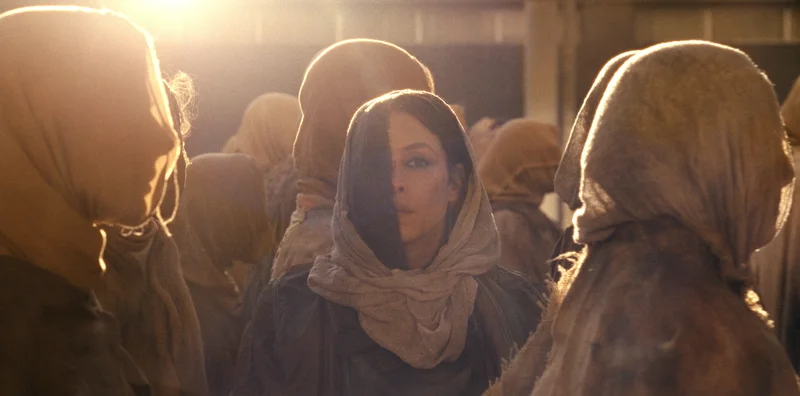
Agnieszka Smoczynska beamed her new movie Hot Spot in from a parallel universe. I have to believe this. She didn’t mention any multiversal excursions when we talked about the sci-fi film’s heady ideas and evocative psychedelic imagery, but surely it’s the only way she could have accomplished what she’s accomplished. Doctor Doom has nothing on the Polish filmmaker, is what I’m saying.
In Hot Spot, there are cyber witches, blood-transfusion worms, retrofuturist ’80s noir-fits, dried-up landscapes, ancient Greek ruins, and an omnipotent AI known as “The Head” that has effectively made humanity dependent on technology for survival. At the heart of it is a detective mystery, though Smoczynska refuses to go from point A to B in a straight line. Noomi Rapace plays Rana, a mysterious rebel leader who refuses to connect to the system, but this not just the star of Prometheus and Constellation doing the sci-fi heroine thing yet again. The movie is vivid and occasionally grotesque. Smoczynska says she isn’t really interested in whether you can follow it all or not. Just vibe.
“Hot Spot’s not about following the plot,” the director tells Polygon. “It's rather to experience this world and to ask the question about this world, and to ask the question about our world here, and also what defines us.”
Hot Spot’s not about following the plot.
That philosophy starts with Robert Bolesto, Smoczynska’s longtime collaborator and the writer of The Lure, her wildly imaginative 2015 mermaid horror movie. Bolesto originally pitched her on “a story about a witch in a refugee camp,” a premise that immediately connected with Smoczynska because of the refugee crisis unfolding across Europe at the time. But the script also folded in anxieties about fake news, deepfakes and artificial intelligence, years before ChatGPT entered the cultural conversation.
“[Robert] captured the DNA of the now, of our current world,” Smoczynska says.
Smoczynska aimed to create a visual language that turned modern anxiety into something stranger and more emotional. She describes Hot Spot as a “very metaphorical” and “very poetic” story, one concerned with AI and climate change and war, but also with much more intimate fears: “the fear for our beloved ones, for our children.” The key, she says, was to “juxtapose this fear with the love and tenderness.”
Smoczynska’s first visual anchor, her personal way into world-building, was her protagonist, Djonny, played by Andrzej Konopka. “The way he looks is very… particular,” she says. She began developing the characters through drawings, working with animator Tomek Popakul to imagine Djonny and Rana before the movie’s broader visual world came into focus.
For the real-but-unsettling landscape, Smoczynska chose Greece, including the abandoned Elinikon airport, a location that had previously housed a real refugee camp. The country’s ancient associations were important too. “In Greece, the whole European culture was born,” she says, while the burned forests, barren landscape, and ancient Greek theater surrounding her characters suggested a civilization that had already passed its expiration date.
Watching Hot Spot feels more like staring at collage painting in the Museum of Modern Art more than kicking back for Dune: Part 2 —it’s cohesive but not always coherent. For Smoczynska, that ambiguity isn't a bug. She spent five years with these characters and this story, trying to discover not simply what happens next, but “how to tell the story in terms of the visual narration.”
“I also am very interested in exploring the language of the cinema,” she says.
You don’t believe most people who say that, but Smoczynska is one of the few surrealist filmmakers who can lay down that line and own it.
Hot Spot is now playing in select theaters in the U.S..