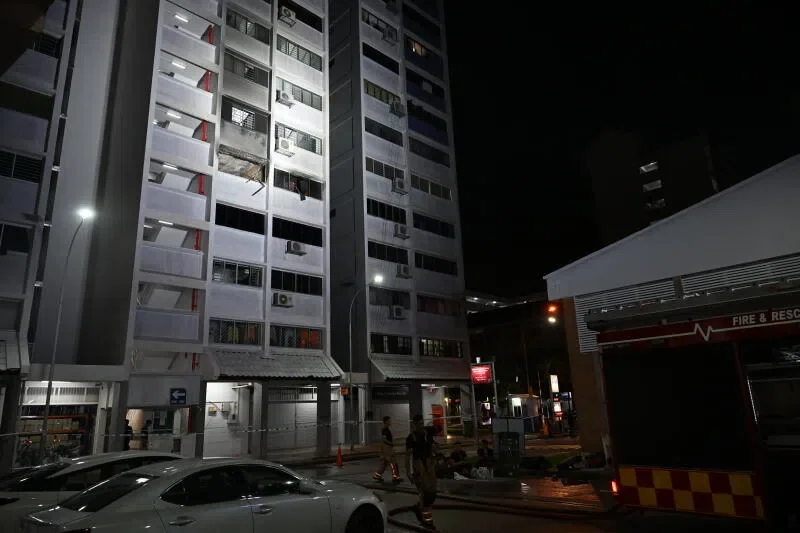
4 fatal fires in 19 days highlight challenges of evacuating elderly residents with mobility issues
AI generated
SINGAPORE - Awoken by the smell of smoke and persistent knocking on her front door, Siti Sara Hamid’s first thought was to evacuate her grandmother due to her mobility issues.
Sara, 29, and her family of five were asleep when police officers instructed residents from Block 979B Buangkok Crescent to evacuate following a blaze in a unit at about 12.30am on Aug 20.
The challenge of evacuating older residents with mobility difficulties was highlighted after four fatal fires in HDB estates in 19 days between July 28 and Aug 16.
All the victims were elderly aged between 65 and 88 years old. Around 220 people were evacuated.
MPs and social service agencies have said the evacuation process is a concern and they are looking at ways to improve emergency preparedness and evacuation support.
Shaken and unsteady on her feet, Sara’s grandmother, 83, was helped to the first floor by neighbours.
She said: “Since my grandmother needs a walker to move around, it was distressing and panic-inducing for her. Our neighbours were so supportive and patient. They told her to be careful, take her time, and not panic.”
Social service agency Lions Befrienders Service Association (Singapore), which provides care and support to elderly, said it is important for the elderly to recognise danger.
Karen Wee, an executive director at the agency, said: “We need to ask, ‘Can the elderly raise the alarm or physically evacuate? Otherwise, does somebody nearby know that assistance may be required?’”
She said those at risk are frail elderly living alone, have mobility difficulties, hearing or visual impairment, or are experiencing social isolation and cognitive decline.
Stress, smoke and confusion during an emergency can make these limitations much more significant, she noted.
“That is why building community capability alongside individual preparedness is so important,” Wee said.
Violet Yang, manager of TOUCH Community Case Management at TOUCH Community Services, said the difficulty of evacuating the elderly during a fire is a nationwide issue which requires the collective effort of all relevant government agencies and community partners.
TOUCH works with the authorities and community partners to identify risks early, encourage safer home arrangements and coordinates help to ensure that evacuation plans are clear.
MPs echoed similar sentiments.
MPs Yip Hon Weng and David Hoe have filed parliamentary questions in recent months over the safety and evacuation plans for elderly residents and those with mobility issues in the event of a fire.
In March, Non-Constituency MP Terence Ho asked the Ministry of National Development (MND) about fire safety in light of the ministry’s plans to build 60-storey flats.
MND replied that the Singapore Civil Defence Force has been helping grassroots organisations, like the People Association’s Community Emergency and Engagement Committees, to plan and conduct evacuation drills and exercises.
MP Shawn Loh, who represents Jalan Besar GRC and oversees the Whampoa-Boon Keng ward, said there was a fire in 2025 in his area, where residents carried immobile neighbours to the evacuation area.
He commended the neighbourly spirit, although he noted it was not ideal to always depend on neighbours when evacuating.
Hoarding issues
Even if an evacuation plan exists, escape routes can be blocked by clutter or discarded items.
The Thye Hua Kwan Moral Charities (THKMC), a social welfare organisation which serves elderly, families and persons with disabilities, said staff and volunteers are encouraged to observe the elderly’s living environment for potential safety risks.
Its spokesperson said: “These may include excessive clutter or hoarding, obstructed access of escape routes, unsafe use of electrical appliances or wiring, and other visible fire or home safety hazards.”
If any hazards are identified, THKMC staff will engage the elderly to explain the concerns and encourage practical steps to improve safety. In cases which require further intervention, the elderly may be referred to social workers or case managers for follow-ups.
Loh said he will be submitting a question, at the next parliamentary sitting, on forcibly entering flats that pose an imminent fire risk.
MP for Bukit Panjang SMC, Liang Eng Hwa, said that beyond raising awareness, they should also review whether SCDF and other relevant agencies, including HDB, have adequate powers to intervene where serious fire hazards are identified within residential units.
He said: “This could include the ability to conduct inspections and issue enforcement notices requiring residents or homeowners to remove, rectify or mitigate identified fire hazards.”
The recent spate of deadly HDB blazes started on July 28 when a 70-year-old man died in a unit at Block 39 Circuit Road.
On July 31, a fire at an eighth-floor flat at Block 309 Clementi Avenue 4 killed a 65-year-old man and injured two firefighters.
On Aug 3, a blaze broke out in a fifth-floor unit at Block 684 Race Course Road, which saw five people aged between 55 and 88 taken to hospital. The 88-year-old man died on Aug 5.
And on Aug 16, a 67-year-old man died after a fire broke out at Block 339 Jurong East Avenue 1.
Sim Ann, an MP for Holland-Bukit Timah GRC noted that fire prevention education and emergency response has been a regular part of neighbourhood activities.
Sim, who oversees the Clementi area where one of the fatal fires occurred, said: “We plan to build on this and draw even greater attention to common causes of residential fires, such as unattended cooking, electrical fires and the use of open flame in homes.”
Sara said the fire at her block made her realise that whether young or old, those with disabilities may struggle during emergencies.
She said: “While my family and I live on the third floor, my grandmother asked me what would happen if we had lived on a higher floor. What would the protocol be to bring her to safety?”