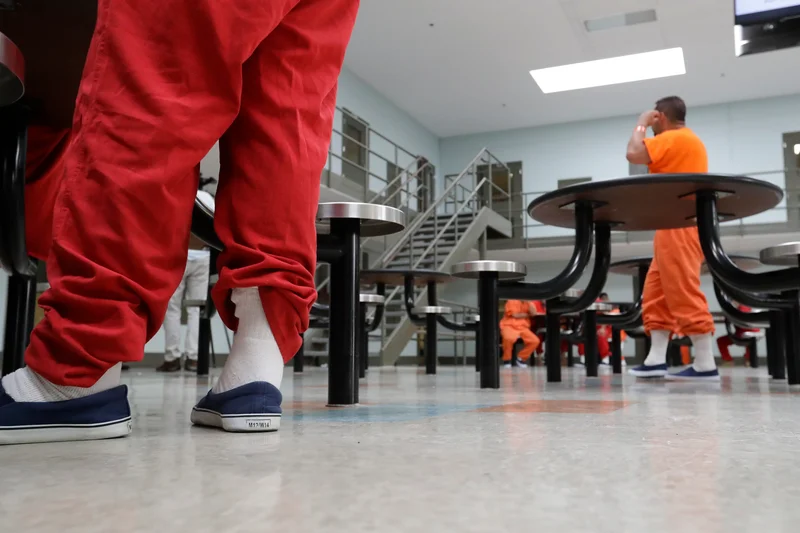
When Carlos entered an immigration detention center in the California desert, his oversized uniform fit him snugly. Eight months later, it was hanging off him: he had lost 40 pounds (18 kilograms).
“Many people lost even more weight,” says the Central American migrant, describing an ordeal he attributes to what he calls deplorable food. His complaint is echoed at similar facilities across the country. To stave off hunger in the face of the “terrible” meals they are served, migrants often have no choice but to spend thousands of dollars on instant noodles, sardines, tortillas, chips, cookies and soft drinks from the facility’s commissary, where prices are exorbitant. Even then, they struggle to meet their nutritional needs: they lose weight and, in some cases, fall ill.
“It’s a perfect business,” Carlos says. When asked how often he goes hungry, he replies: “Every day.”
Accounts of persistent hunger recur throughout reports and lawsuits challenging food conditions at several Immigration and Customs Enforcement (ICE) detention centers. The problem has worsened as facilities have filled to near capacity amid the mass-deportation campaign launched by the Trump administration. ICE is currently holding nearly 66,000 people in custody and is moving toward its goal of reaching 100,000 detainees in the coming months.
This overcrowding has given rise to what migrant-rights organizations describe as a lucrative business model: products sold to ease hunger are often priced at up to three times what they would cost in a supermarket. The service, known as the commissary, is typically run by outside contractors that set prices with limited oversight. One such company is Trinity Food Services, one of the leading suppliers of food to prisons and detention centers in the United States.
“They don’t provide the proteins they need, so migrants are forced to turn to the detention center’s store to buy their own food, which is very expensive,” says Val Suárez, a community organizer and legal advocate with the California Collaborative for Immigrant Justice (CCIJ). “We’ve seen many people lose a lot of weight while detained, fall seriously ill and not receive appropriate care.”
‘Just enough to survive’
Because detainees in ICE facilities are prohibited from carrying cash or using bank cards, they depend on money deposited into their personal accounts by relatives and friends. They use those funds to buy whatever is available from the commissary. The alternative is to take on cleaning or kitchen work for a stipend that critics liken to exploitation: one dollar a day. For that wage, an eight-hour shift earns little more than the cost of a packet of Maruchan instant noodles.
A recent report by the California Department of Justice found that, after interviewing migrants held in seven ICE detention facilities across the state, some said they were spending as much as $150 a week on commissary items because the portions they were served were barely “just enough to survive.”
Some even compared it to “dog food” or called it “horrible.” Others reported stomach pain or bouts of diarrhea after eating meals that appeared to be frozen in the middle, as well as expired milk and tuna, foul-smelling meat and undercooked rice. The report found that “to make up for the small portions or bad quality of the food,” detainees were forced to purchase food from the commissary.
But while migrants spend thousands of dollars supplementing a diet that, under federal standards, is supposed to consist of “nutritious and palatable meals,” little is known about who profits from those purchases. Neither ICE nor GEO Group and CoreCivic, the private companies that operate several of these detention facilities, responded to inquiries from this newspaper about commissary revenues. Trinity Food Services also declined to comment. Meanwhile, GEO Group and CoreCivic continue to benefit from the Trump administration’s hard-line immigration policies, reporting a combined $1.4 billion in revenue in the second quarter of the year alone, up 15% and 27%, respectively, from the same period in 2025.
Exorbitant prices
An eight-ounce jar of instant coffee sold for $18 — double its price at Walmart — was the last straw for more than 300 migrants detained at California City and Golden State Annex centers in the Central Valley. Detainees signed protest letters in July and launched a boycott of the commissary service.
The list of products they alleged were being sold at inflated prices was long: a box of 40 tampons cost nearly $21, almost twice the supermarket price; a Maruchan instant noodle cup sold for $0.75, 33% above its usual price. Meanwhile, a small box of cereal was offered almost as a luxury item at $13.
“Prices for some products rose by more than 135%, when the commissaries at those centers were already very expensive, even more than at state prisons. That happens because they are run by a corporation that has the freedom to set prices,” explains Suárez of the California Collaborative for Immigrant Justice, which supported the detainees’ campaign against ICE and helped secure modest price reductions.
That protest spurred a bill (SB 941) by state Senator Steve Padilla, a San Diego Democrat. His initiative seeks to ban price gouging on products sold in private ICE jails and to cap commissary prices at 35% above the vendor’s cost. The bill passed the California Senate in May. Padilla’s office documents other examples of excessive commissary prices: a bar of soap sells for 75% more than outside detention centers; Colgate toothpaste costs 139% more; and a can of tuna fetches three times its usual price.
“Companies are taking advantage of the wave of mass incarceration driven by President Trump to exploit working-class families,” Padilla said in a statement. “We cannot allow this kind of opportunistic profiteering to continue unchecked.”
The problem, however, is not new. A 2023 study by the University of California, Los Angeles (UCLA), conducted during the Biden administration, found that migrants at the Mesa Verde and Golden State Annex ICE facilities spent an average of $112 a month at commissaries. Detainees complained of undercooked, unappetizing, expired or foul-tasting food, as well as inadequate portions.
ICE normalizes hunger
When California Department of Justice inspectors conducted unannounced visits to the state’s seven ICE detention facilities in late 2025 — Adelanto, Desert View Annex, Golden State Annex, Mesa Verde, Imperial, Otay Mesa and California City — they encountered a recurring complaint: detainees often went hungry and had to spend their own money at the commissary to buy extra food.
At Adelanto, detainees complained that the meat appeared undercooked or spoiled, that some meals were served cold, and that they had to use the same spoon for several days. At Golden State Annex, some said they spent as much as $100 on instant noodles, soup and tuna to stave off hunger.
At Mesa Verde, detainees reported spending up to $150 a week at the commissary because, beyond a basic diet of beans and bread, they did not have enough food to satisfy their appetite.
At California City, one detainee said he would go hungry if he could not buy instant soup from the commissary, while others complained that prices could be as much as four times higher than at other ICE facilities.
Minerva, a Mexican immigrant living in Los Angeles, spent several weeks at California City before being released recently. In an interview with EL PAÍS, she said “the food smelled rancid” and that she often preferred to go without eating for long stretches. According to her, however, some women told her that conditions at other ICE facilities where they had been held were “even worse.”
Responding to complaints about food quality and the commissary business, ICE opened a written statement to this newspaper with the words: “Another day, another falsehood about ICE.”
The agency said it provides three meals a day, delivered directly to detainees, along with an “adequate” supply of drinking water and other beverages. It also maintained that “meals are evaluated by certified dietitians” and that it enforces detention standards “stricter” than those applied in most U.S. prisons.
For his part, Ryan Gustin, a spokesperson for CoreCivic, said the commissary service “is not operated for profit” and stressed that comparing its prices with those of major retail chains would be “entirely inaccurate.” In a written statement to this newspaper, he explained that when an item becomes too expensive, the company tries to negotiate a lower price with suppliers, reduce its markup or remove the product altogether.
Gustin also said that revenue generated by the commissary at the California City facility goes into what he described as “a detainee welfare fund.” According to the spokesperson, some of that money is used to purchase electronic equipment as well as recreational and educational materials.
Activists, however, say they have been unable to trace how those funds are spent. “None of the detainees we’ve spoken to knows this welfare fund exists or has received any information about it,” says Suárez. “That’s why we say they have been very secretive about the actual profits they make from these vendors.”
‘Inedible’ pasta
Carlos still remembers the almost prison-like conditions under which he was fed at Adelanto, a detention center with capacity for nearly 2,000 people located about 160 kilometers (100 miles) from Los Angeles. At 5 a.m., detainees were woken up for breakfast: cereal, “something that looks like oatmeal,” waffles, and scrambled or boiled eggs. Lunch was served at 11 a.m. and, according to him, was the meal that left the most to be desired. Dinner was served starting at 4:30 p.m.
“Lunch is always small. They give you a pasta and I don’t know how they make it. They just throw it on the plate. It’s really hard. The first days I ate it because I was very hungry, but honestly, it isn’t edible,” he recounts.
To stave off hunger, his only alternative was the commissary. Carlos says he spent around $400 a month there, money deposited by relatives and coworkers. During the eight months he remained in custody, he spent about $2,500. “Ninety percent of us bought at the commissary and shared the food with those who had no money,” he says.
Sharing food was common to “add some flavor” to bland tuna and beans that, according to Carlos, often ended up in the trash. “Three or four friends would pool together the $100 each of us spent every week. We made soup, rice, something with sardines or tuna,” he says.
The two days a month when chicken was served at Adelanto were special, almost like a celebration. Detainees would line up twice in an attempt to get a second piece of chicken, hiding it under their uniforms to take back to their dormitories and eat later. Doing so violated the facility’s rules and often led to confrontations with GEO Group guards. “Some ended up in ‘the hole’ [punishment cells] for fighting to get an extra plate,” Carlos recalls.
Living on the edge of hunger, Carlos says, was one of the main breaking points for many migrants who arrived at his cell and left shortly afterward. They preferred to accept deportation rather than continue going hungry. “ICE does it to make people desperate,” he says.