Some cities transcend their own reality, with the creation of parallel, fictitious maps. This doesn’t happen to many urban centers… but it certainly does with Paris.
In this article, we’ll explore the city through crimes — both written and filmed — which are so legendary that they sometimes seem to be happening among us, rather than in the imaginations of their creators.
Let’s begin with the most famous detective in the French capital. We’re talking about Inspector Maigret, the protagonist of 75 novels and 28 short stories by the Belgian writer Georges Simenon. Jules Maigret works at Number 36 Quai des Orfèvres, a historic 19th-century building on the banks of the Seine that, for decades, housed the judicial police.
It’s currently waiting to be converted, perhaps into a museum about law enforcement.
Simenon’s character also lives at 132 Boulevard Richard Lenoir with his wife. The property couldn’t be better located, between the Bastille and the Place de la République, both with their respective metro stations.
The Parisian subway has inspired countless artists. One of its busiest stations is Châtelet-Les Halles, a crossroads between numerous lines in the Paris Metro, which are connected by moving walkways. It’s here that one of the most iconic scenes from Le Samouraï (1967) takes place: one of the best films of the noir genre, directed by Jean-Pierre Melville. In it, the character portrayed by French actor Alain Delon — a silent hitman — escapes a police pursuit to the astonishment of onlookers and viewers, who are captivated by the protagonist. They sympathize with him, despite the fact that he’s a criminal.
Continuing with locations from the silver screen: we recommend — due to its proximity to other attractions, such as the Giacometti Foundation, or the rather intriguing Passage de l’Enfer — a visit to Rue Campagne Première. This is a straight street that connects Boulevard Raspail with Boulevard Montparnasse. It’s on this street that Breathless (1960), the debut film by Swiss director Jean-Luc Godard, ends. The film tells the story of Michel Poiccard, a petty criminal who murders a policeman while traveling from Marseille to Paris. Death awaits him on Rue Campagne Première after being betrayed by his lover, portrayed by the unforgettable Jean Seberg.
It’s incredible to stroll along this street, to see its skyline, all while visualizing the unfortunate man’s limping gait as he tries to escape his final breath, sealed by the gunshots of his pursuers.
The film is best remembered for the lovers’ encounter on the Champs-Élysées. The quintessential Parisian avenue — the result of the grand renovation undertaken in the mid-19th century by Baron Haussmann — has provided countless fictional moments that will forever remain in the collective imagination.
Another of these immensely beautiful moments can be found in Elevator to the Gallows (1958). The film — one of director Louis Malle’s many masterpieces — shows the actress Jeanne Moreau desolately walking down the Champs-Élysées in the rain, amid a silence that’s broken only by Miles Davis’ soundtrack.
This feature film, a precursor to the French New Wave and a European form of film noir, is full of interesting locations. The (im)perfect crime that sets the entire plot in motion takes place at 81 Boulevard de Courcelles, headquarters of the Carala arms company. A few hundred feet away, at 182 Boulevard Haussmann, Jeanne Moreau waits on a terrace (today, it’s an Italian restaurant) for her lover’s car to arrive. He’s tasked with killing her husband, so that they can begin a new life together… something that ultimately never works out.
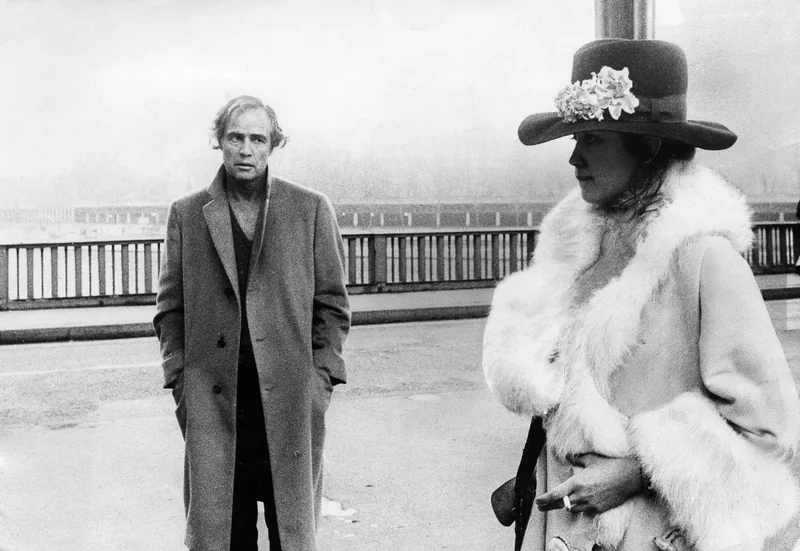
The car ends up creating confusion: its driver isn’t the assassin. Before going off to commit the crime, he leaves the keys in the ignition… something that a flower shop assistant and her boyfriend take advantage of. They steal the car and enjoy a day off, with unforeseen consequences. Things go so badly that they end up having to ditch the car near the Bir-Hakeim bridge, unmistakable for its wrought iron pillars. This is the same bridge that Marlon Brando and Maria Schneider walk over, lost in thought, during the opening scenes of Last Tango in Paris (1972), by Bernardo Bertolucci.
Literary Crimes
One of the most poignant passages in Victor Hugo’s Les Misérables (1862) — a novel that’s been adapted in numerous formats, from films to musicals — is the death of Gavroche on the barricades of the 1832 anti-monarchist uprising. The character is murdered by his opponents on the now-vanished Rue de la Chanvrerie, which was demolished by the Haussmannian urban renewal project. It was replaced by the Rue de Rambuteau, which connects Les Halles with Le Marais.
Perhaps the greatest Parisian investigator is Patrick Modiano. The 2014 winner of the Nobel Prize in Literature roams the city streets with a keen inquisitiveness: he seeks to capture every detail, before shrouding it in a fog of suspicion. In Memory Lane (1981), a real crime fills the thoughts of his alter ego, who feels uneasy as he passes by Le Palace, a theater located at 8 Rue du Faubourg Montmartre. There, on September 24, 1933, the body of theatrical impresario Oscar Dufrenne was found lifeless, his skull crushed by multiple blows. His murderer, later arrested in Barcelona’s red-light district, used a billiard cue that was found at the crime scene, wrapped in a rolled-up cloth.
This crime, which caused such a scandal, brings our journey to a close. We’ve ended up in Montmartre, an artists’ hill corrupted by overtourism, which is so overwhelming that it can erase any traces of past crimes. These include the fictional acts in Maigret Sets a Trap (1955), one of Simenon’s best works, as well as the tragically true murder of politician Jean Jaurès, on July 31, 1914, at the Café du Croissant at 2 Rue de Montmartre. He was shot dead by Raoul Villain, an ultranationalist.
Villain was eager to eliminate a nobleman who was opposed to the war that was about to erupt in Europe, before spreading across the globe. Generally, reality is far more unbearable than fiction when it comes to the motivations behind these sinister plots.