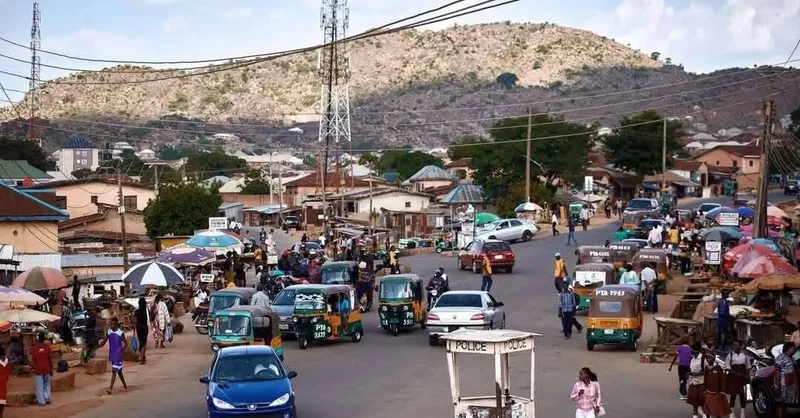
Plateau State has endured cycles of communal violence for decades. The clashes, often framed along ethnic and religious lines, have claimed thousands of lives and displaced entire communities. The first major crisis in Jos erupted on 11 September 2001, and the pattern has repeated since. The events of February to April 2026 are part of this long and painful history, but with a new and dangerous element: social media amplified the violence in ways never seen before.
The First Reprisal: Barkin Ladi
It began on a Monday.
On 23 February, suspected Fulani gunmen attacked Dorowa Babuje village in Barkin Ladi Local Government Area, killing seven people, according to the evidence log. Within hours, youths from the affected community blocked the main road. Security sources said four travellers were killed at the scene, while a fifth later died from their injuries. Two of the victims were from Jos North, a detail that soon reappeared in online discussions.
On Facebook, the violence unfolded in real time. A post by CMN (Civic Media News) on its Facebook page reported the roadblock and the killings, while a voice recording shared by one Murtala Mai Igiya captured a caller saying a traveller had been “finished.” The Hausa conversation spread faster than any official clarification. Amnesty International Nigeria later issued a condemnation of the killings.
| | |
|---|
But the most enduring consequence of that day was not only the bloodshed. During the holy month of Ramadan, a different kind of violence began to circulate online: repeated claims that reprisals would follow after Eid.
The Digital Promise: Ramadan
A screenshot shared in the Facebook group Movement for the Protection of Plateau Heritage (MOPPLAH), as shown below, warned that “after fasting, they will deal with them”. It was quickly treated as evidence of an impending reprisal. The original author, Sharfaddeen Bature, later said his words had been misrepresented and were not connected to Jos. By then, however, the inciting interpretation had already spread.
Older material was also recirculated as current. A February video of Ezekiel Dachomo, in which the Christian cleric warned that insurgents from Sokoto and Zamfara were in Plateau ‘doing their fasting here,’ was reshared after the 29 March 2026 attack on Angwan Rukuba as proof of a premeditated plan. An eviction threat was also revived from 2025, when the Facebook account Barrywhytesoftouch posted a message warning Hausa residents in Tudun Wada to vacate before 29 April. The Plateau State Police Command investigated the post at the time. The post was recirculated in 2026 out of context. By the end of Ramadan, the online tension had been sustained long enough to shape expectations. What remained was a spark to ignite an explosion.
The Explosion: Angwan Rukuba
At 8:19 p.m. on 29 March 2026, Plateau News Updates posted the first report that unknown gunmen had shot people in Angwan Rukuba, Jos North. Within hours, the violence escalated.
Before the identity of the attackers had been established, a narrative took hold online and on the ground that the assailants were Hausa, Fulani, or Muslim. That assumption was enough to trigger a reprisal that targeted Muslims almost immediately. Videos circulated showing youths killing two commercial motorcyclists and burning their bikes. One was Haruna Ibrahim, a youth corps member and newlywed. The other rider has not been publicly identified.
Alex Barbir, an American evangelist working with Mr Dachomo, arrived at the scene shortly after the attack and said he had been nearby by chance. In a video recorded with burning bodies behind him, he alleged that Christians were being killed and that a genocide was unfolding, even though at least one of the bodies in view was that of a Muslim cyclist. His video was later shared by Adamu Garba II and others.
Three days earlier, Mr Barbir had posted another video titled, “Is Allah a Bloodsucker?”, in which he misquoted the Qur’an and hadith while making claims about Muslims and violence. The video remained online.
The Inciters: When words become weapons
Mr Barbir was not alone. A youth leader, Masara Usman, posted that “the issue of peace has passed” and alleged a Christian genocide.
He also shared Mr Barbir’s interpretation of the Angwan Rukuba killings. In another video, Mr Dachomo was seen walking with a group of youths in Angwan Rukuba while voices in the background called for revenge.
Other posts reflected similar sentiments. Kefas Pam questioned whether a community would be blamed for blocking roads to intercept “fleeing terrorists”. In a separate post, a user threatened unspecified action at the central mosque on Friday. Another account, using the name Ælîyū Førçê Güèrîllå, called on Muslims in Jos to defend themselves.
A video by social media personality Verydarkblackman (VDM), recorded in Angwan Rukuba, added to the tension in the region. In it, he suggested that citizens should defend themselves. While the statement was not explicit, in the context of heightened tension and circulating claims, such messages were widely interpreted by users as justification for taking the law into their own hands.
What followed was a further escalation of violence.
The Unravelling
On Wednesday, 1 April, a curfew imposed after the 29 March attack was relaxed. Within hours, violence resurfaced. In Jos North LGA, particularly along Nassarawa and Bauchi Road, unrest was reported. At Unguwar Rukuba Junction, a man identified as Alkasim Umar was shot dead. Residents later told Fix TV that he had been caught in the crossfire during a confrontation between individuals from different religious backgrounds.
For several days, parts of the city remained tense. Roadblocks reappeared in some areas, while movement in others slowed amid uncertainty. Alongside the physical violence, a surge of online content accompanied the unrest. This included unverified claims, graphic videos, some showing severely burned bodies, and posts containing inflammatory language directed at religious groups.
A review of posts collected for this investigation shows that many of these materials remained accessible on Facebook during and after the violence. Several of these posts were reported by users. None were removed in a timely manner, or, in many cases, at all. While some users attempted to challenge or correct misleading narratives, the original posts continued to circulate widely.
What Misbahu El-Hamza saw, and what Facebook did not do
One journalist who attempted to counter the spread of misinformation was Misbahu El-Hamza. In the days following the attack, he published fact-checks clarifying that both Muslims and Christians were among the victims, and debunked claims linking an unrelated post to the Angwan Rukuba violence. His corrections, however, received significantly less engagement than the posts they sought to counter.
When asked which piece of misinformation concerned him most, Mr El-Hamza pointed to a video by Mr Barbir, which framed the incident as a targeted attack against Christians. He said he reported the video to Facebook, but it remained online. “Up until the time we spoke, it was still there,” he said.
Mr El-Hamza suggested that platforms could do more to limit the spread of harmful content. He referenced Facebook’s COVID-19-era labels, which flagged posts containing unverified information, and proposed similar interventions for conflict-related content. “If a misleading claim is flagged early,” he said, “it can reduce how far it spreads.”
At the same time, he emphasised that responsibility is shared. Governments, he said, must respond more decisively during crises, while journalists and content creators have a duty to verify information, avoid inflammatory framing, and adhere to ethical standards.
MAY 2026: POSTSCRIPT
As this report was being finalised in May, new violence was reported along Mangu Road. Travellers were stopped and, in some cases, identified along religious or ethnic lines before being attacked. Videos from these incidents began circulating online shortly after. As with earlier events, several of these posts remained accessible at the time of writing.
Conclusion
This is not only a story about Plateau State. It is also a story about how online platforms shape the spread of information during crises.
Between 23 February and 4 April 2026, Facebook became a central channel through which claims, images, and interpretations of events circulated. Posts containing threats, graphic content, and religious framing remained widely accessible, while corrective posts and fact-checks struggled to achieve similar reach.
The consequences were not abstract. Haruna Ibrahim, a newlywed youth corps member, was among those killed after being caught in a reprisal attack. His death, like others documented in this report, occurred in a context where unverified claims were already influencing public perception. Alkasim Umar, who was shot during unrest on 1 April, and the unidentified motorcyclist killed and burned during the initial reprisals, represent similar patterns of violence unfolding alongside rapidly spreading narratives.
Jos has experienced cycles of communal tension in the past. However, the speed and scale at which unverified information circulated during this period added another dimension to the crisis. Content that included graphic visuals, unverified claims, and emotionally charged framing remained visible for extended periods, shaping how events were understood in real time.
The issue extends beyond platform moderation alone. It also reflects the broader information ecosystem, where individuals and pages with large audiences can influence public perception without clear adherence to journalistic standards. In such an environment, the responsibility to verify information before sharing becomes increasingly critical.
Proposals such as improved content labelling, faster response systems during crises, and real-time fact-checking tools could help limit the spread of harmful narratives. At the same time, governments, media practitioners, and civil society actors all play a role in strengthening information integrity during periods of conflict.
The events examined in this report show how quickly online narratives can translate into offline consequences. Mr El‑Hamza, the journalist who fact‑checked the crisis in real time, put it plainly: platforms like Facebook can do more. He pointed to the COVID-19-era labels that flagged unverified information and called for similar tools during conflicts.
But he also emphasised that accountability is shared. Governments must intervene decisively during crises. Journalists and content creators must verify before posting, avoid inflammatory framing, and respect context.
The events of February to April 2026 show what happens when those responsibilities are ignored. Until platforms, governments, and media practitioners act with greater urgency, the next crisis will follow the same pattern: a post, a share, a flame, and then a body burning behind a man who calls it genocide.
This article was published under the Tech Justice and Platform Accountability Project of the Centre for Journalism Innovation and Development (CJID), with support from Luminate.
Methodology
This investigation is based on:
- A structured evidence log of over 40 social media posts collected between February and April 2026
- Archived links using web archiving tools to preserve original content
- Visual and textual analysis of posts, videos, and user engagement patterns
- One expert interview with journalist and fact-checker Misbahu El-Hamza
- Secondary reporting from media outlets, including Fix TV
- All posts referenced were verified using available metadata, timestamps, and cross-referencing with known events.
Limitations
Due to security restrictions, movement limitations during periods of curfew, and limited access to some affected communities, certain planned interviews could not be conducted within the reporting timeframe, and direct interviews with some victims’ families could not be conducted.
Additionally:
Some key individuals did not respond to interview requests
Certain claims could not be independently verified beyond available digital evidence
This investigation, therefore, relied primarily on archived digital evidence, verified social media content, secondary reporting, visual documentation, and available interviews
Care was taken to distinguish verified information from unverified claims throughout the reporting process.
Ethical considerations
Every effort was made to avoid amplifying harmful content. Graphic descriptions have been minimised, and identities are only included where already publicly available or relevant to the public interest.
Author Bio
Khalid Musa Ahmad is a Jos-based photojournalist, multimedia storyteller, and creative whose work explores conflict, misinformation, identity, and the psychological impact of violence in Northern Nigeria. Blending visual documentation with investigative and human-centred storytelling, his reporting focuses on preserving the voices and memories of people often reduced to statistics during periods of unrest. His work is particularly interested in how trauma, fear, online narratives, and collective emotion shape real-world violence and community relations. Beyond journalism, he is also a poet, bookworm, photographer, and martial artist interested in the intersection of media, culture, memory, and social accountability.